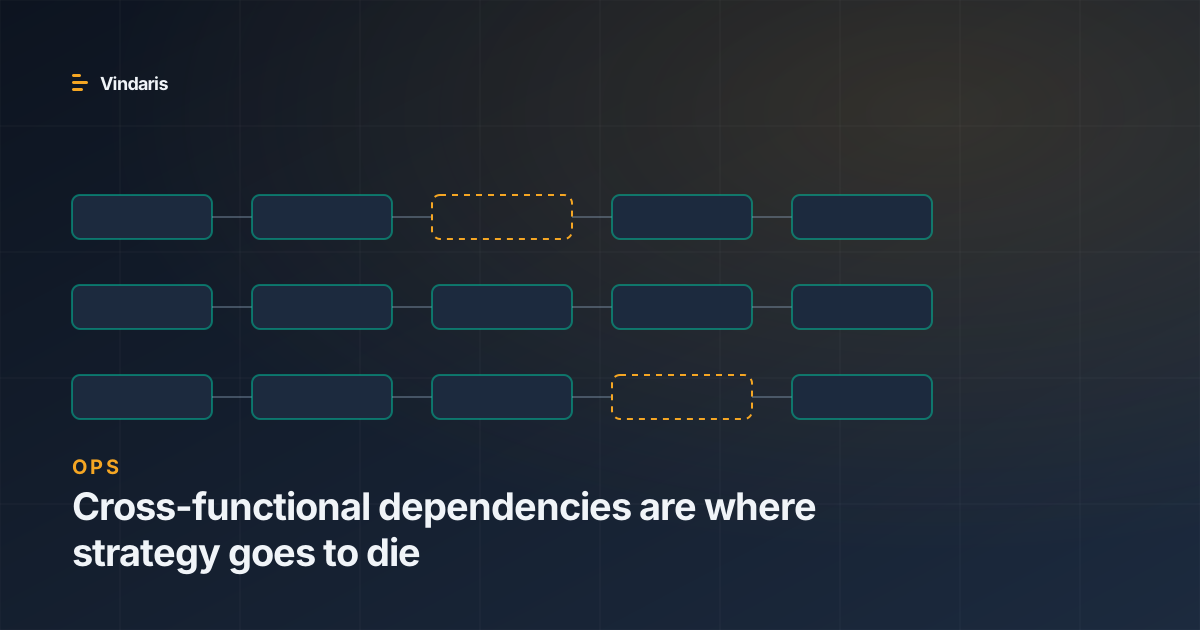
Look at any strategic bet that quietly died last year. Pick one in your own company if you have to. Trace it backwards. You will almost never find a single team that failed. Engineering shipped what was in the sprint. Marketing launched what was on the plan. Sales worked the pipeline they were given. Every team passed its own quarterly review with a green dashboard. And yet the bet missed. Nobody can quite explain why, and the post-mortem ends up using the word "alignment" three times in two pages, which is the polite way of saying nobody knows.
Strategy fails at the seams. The teams did their work. The handoff between them was where the bet bled out.
Why the seams are invisible
Every team's view of itself is structurally local. The engineering manager sees the engineering backlog, the engineering capacity, the engineering deadlines. The marketing manager sees the campaign calendar. The sales leader sees the pipeline. Each of them is doing their job competently. Each of them can produce a clean status report on Friday.
What none of them sees is the connection — the moment when engineering's API needed to land in time for marketing's launch, which needed to land in time for sales' outbound motion, which needed to land in time for the revenue commit. No single team owned that timeline. The cross-functional dependency lived in someone's head, or in a Notion doc nobody updated past week three, or in a Slack channel that fragmented when the original participants got pulled onto other things.
The status reports keep looking healthy because each team is being measured on their slice, and each slice is fine. Single-team OKRs reward teams for delivering their piece on time. They are silent on whether the pieces add up to anything when assembled. That's the gap, and it's where most strategic bets actually die.
What gets reported versus what's happening
The cleanest tell that a cross-functional bet is in trouble is the gap between the status meeting and the hallway conversation. In the official meeting, three team leads each say their part is on track. In the hallway afterwards, the engineering lead admits to the marketing lead that the API is going to be three weeks late, the marketing lead admits the launch was always going to be tight, and both of them agree to "figure it out." Neither of those conversations changes the status meeting next week. The official narrative continues. The actual narrative — the one where the bet is now structurally impossible on the original timeline — never reaches the room where it would change a decision.
This isn't a malice problem. It's a venue problem. The official meeting is too public for the honest update. The honest update happens in pairs and never lands anywhere the system can see it.
What a working dependency view looks like
For each strategic bet, the leadership team should be able to answer four questions in under thirty seconds, without scheduling anything.
Which teams have work feeding this bet? Not "which teams are involved" — which teams have specific, named work items that, if they don't land, the bet doesn't move.
What's the critical handoff path between them? Which deliverable from team A is the dependency for team B's start, and where are the dates? A bet that requires three handoffs has three places it can fail. You need to know where they are.
Which handoff is the current bottleneck? Not which team is busiest — which specific upcoming handoff has the highest probability of slipping, and what's the impact on the bet if it does.
Has any team silently re-prioritised its piece without telling the others? This is the question that catches most failures early. Teams re-plan internally all the time. Most of those re-plans have downstream effects nobody flags. The dependency view should surface the re-plan automatically.
If answering any of those four questions requires opening three tools, scheduling a sync, and waiting for someone to write a status update, the dependency isn't being managed. It's being hoped over.
The pattern that works
Cross-functional dependencies survive when they are treated as first-class objects in the same place the strategy lives — not as appendices to one team's plan. The bet has an owner who is accountable for the outcome of the bet, not the outputs of any single team. The handoffs have explicit dates, named upstream and downstream owners, and visible status. Every contributing team can see when their delivery affects someone else's, and every team has standing permission to flag a slip without it being a political event.
Teams that operate this way catch a slipped handoff in days. The downstream team sees the upstream slip in the same view the upstream team uses to plan its sprint, raises the consequence, and the trade-off conversation happens while there's still time to do something about it. Teams that don't operate this way catch the slip in the QBR, by which point the launch window has passed, the bet has missed, and the post-mortem reaches for "alignment" again.
The difference between the two is not culture. It's whether the dependency exists as an object the system can show you or only as a story someone has to tell from memory.
Why this is harder than it sounds
Making cross-functional dependencies first-class objects is structurally hard because every PM tool in the market is built around single-team work. The team's board shows the team's tasks. Dependencies on other teams are usually a hack — a link to another tool, a tag, a manually maintained spreadsheet. The view that would actually let leadership see the whole chain requires data from every contributing team, in a model that understands the dependency as a thing in its own right, not as a comment on a ticket.
This is one of the reasons strategy execution doesn't get solved by adopting a better PM tool. The unit of the problem isn't the task. It's the dependency, and the dependency lives between the tools that the work lives in. Our best strategy execution software guide compares the tools that actually model the dependency rather than just the task.
The Vindaris view
Alignment is not a vibe. It is the state of being able to see, at any moment, which dependency is at risk and who owns the gap between the boxes. The seams are where the system has to be strongest, because that's where strategy actually lives or dies. Build the dependency as a real object, in the same place as the bet it serves, and the seams stop being invisible. Skip that, and your strategy will keep being quietly killed by handoffs that everybody assumed somebody else was watching.