Open the planning deck your leadership team approved at the last offsite. Count the items labelled "strategic priority." If the number is north of five, I can tell you something about your company without ever having met it: you don't have a strategy. You have a list.
That's not a semantic complaint. The two things behave differently, produce different outcomes, and require different conversations to create. A list lets everyone in the room keep their favourite project alive. A strategy doesn't. That is precisely why so few companies have one.
Why the list keeps growing
Adding a goal feels like progress. Removing one feels like surrender. So between January and Q3, the "top five priorities" quietly become fourteen, and the deck gets renamed from "Strategy" to "Strategic Priorities" to "Strategic Themes" — each rename a small concession that the original list has lost its shape.
Nobody decides to do this. It happens through a thousand small additions, each defensible on its own. A new market opportunity surfaces, so it gets added. A board member raises a concern, so it gets added. A senior hire wants a flagship initiative, so it gets added. The list grows because saying no to any individual item feels small-minded. Saying no to all of them — which is what strategy actually requires — feels like leadership.
Which is the harder conversation: deciding which two of your five priorities to keep, or letting all five quietly stay on the slide? The second one is harder to fix, easier to live with, and structurally invisible. That's why it wins.
What separates a strategy from a list
Three things, and they're all uncomfortable.
The first is explicit trade-offs. "We will focus on the enterprise segment" is only a strategy if it's paired with "and we will not pursue SMB this year." Without the constraint, it's a preference. Anyone can have a preference. A strategy is a bet, and a bet by definition forecloses other bets. If your priority list has no twin "do-not" list, you have preferences arranged in order of enthusiasm.
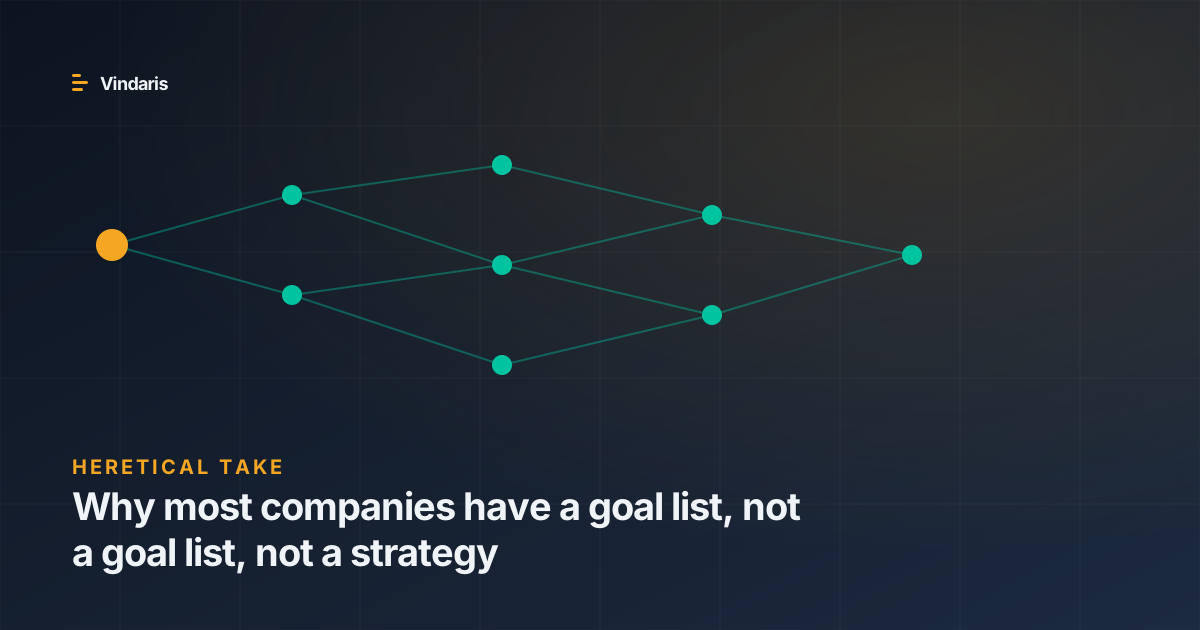
The second is connections between goals. Five objectives on a slide are just a list. A strategy shows how they reinforce each other — which one is foundational, which depends on which, which creates the conditions for the next to succeed. When goals are connected, teams can apply the logic to new situations the slide never anticipated. When they're a list, teams optimise each goal independently and wonder why the whole isn't greater than the parts.
The third is a model of causality. Why will achieving these goals actually produce the outcome you're after? A strategy has a sentence. A goal list assumes the answer is self-evident, which it almost never is. The absence of that sentence is why two years later, nobody can reconstruct why the company was working on the things it was working on.
How to tell which one you have
There's a diagnostic that takes ninety seconds and never lies. Pull a mid-level manager who was nowhere near the offsite. Show them the list. Ask two questions.
Question one: if we achieve every one of these goals, what do we actually get? If they answer in concrete language — "we'll have repositioned the company toward enterprise and reduced our CAC to a level that lets us self-fund growth" — you probably have a strategy. If they answer in adjectives — "we'll be doing well," "we'll have grown" — you have a list with strategic adjectives sprinkled on top.
Question two: if we had to drop one of these goals to protect another, which would we drop? If the answer is "we can't drop any of them" or "they're all equally important," you don't have a strategy. Strategy requires that some things genuinely matter more than others. A list where everything is equally important is mathematically identical to a list where nothing is.
The second question is the brutal one. Most leadership teams cannot answer it, because answering it in public would force the trade-off they've been avoiding for two quarters. That avoidance is what produced the list in the first place.
The practical fix
Don't run another goal-setting workshop. You don't need more goals. You need fewer.
Run a goal review with one explicit purpose: making trade-offs visible. The agenda has three items. First, the current list, read aloud, with the question "is this still genuinely a priority, or is it on the list because nobody wanted to remove it?" attached to each one. Second, for each surviving item, the named connections to other items — which depends on which, which enables which. Third, an explicit Do-Not list attached to the surviving priorities, naming what the company is not going to do in order to free the capacity these priorities require.
The output of the review is almost always a shorter list. Often by half. Sometimes by more. That's not a failure of the workshop. That's the workshop succeeding.
The Vindaris view
A list of goals can live happily in a slide deck. A strategy can't — it has to live in the same surface as the work, because its whole point is to govern what does and doesn't get capacity. When priorities, dependencies, capacity and an explicit do-not list sit in one system, the list-vs-strategy distinction stops being a debate and becomes a property of the data. You can see, at a glance, whether your "priorities" are connected, funded and exclusive — or whether they're a wish list with a strategic font.
Most companies will discover, the first time they look honestly, that they have the wish list. That's fine. Discovering it is the precondition for fixing it.