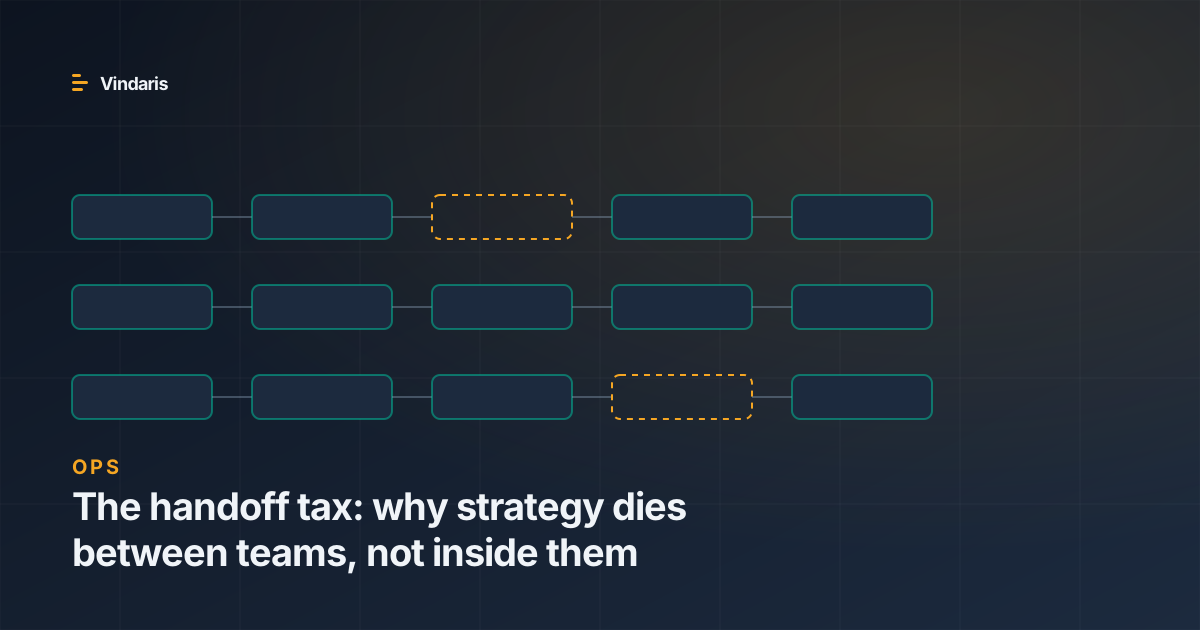
Look at any one team inside a mid-sized company and the work usually looks fine. Engineering is shipping its sprints. Sales is closing deals. Marketing is publishing campaigns. Customer Success is keeping renewal rates respectable. Each function, measured on its own, appears to be operating. And yet the strategic outcomes the company actually cares about — the ones that require all of those teams to move together — keep slipping, and nobody can quite say which team is at fault.
The reason is that the strategy isn't dying inside any of those teams. It's dying in the seams between them. We call it the handoff tax. It is invisible, untracked, and frequently the single largest source of execution slippage in any company past about fifty people.
What the handoff tax actually costs you
The tax shows up in three currencies, all of which are paid quietly and none of which appear on a P&L.
Days lost. A handoff that the originating team genuinely believes is "done on Friday" is actually queued in the receiving team's intake system, where it will sit until the next planning cycle picks it up. Four working days vanish into a queue that nobody is looking at. Multiply that across six handoffs in a cross-functional initiative and the initiative is already three weeks behind before anyone has done anything wrong.
Owners lost. The originating team marks the item complete in their system. The receiving team has not yet formally accepted it. For some period — sometimes hours, sometimes weeks — nobody actually owns the work. If something goes wrong in that gap, the recovery starts with an argument about whose ticket it is. The argument is the symptom; the ownership void is the disease.
Meaning lost. This one is the worst. The originating team understands why the work matters — the customer it's for, the strategic bet it serves, the trade-off it represents. The receiving team understands only what arrived in their queue: a ticket with a title, some acceptance criteria, maybe a Loom video if they're lucky. The strategic context does not survive the handoff. So the receiving team executes the letter of the ask, often correctly, while quietly missing the spirit of it.
Why no one fixes the tax
Because the tax doesn't appear on any single team's metrics. Each team's velocity looks fine in isolation. Engineering hit its sprint. Marketing shipped the campaign. Sales worked the leads. The slippage is interstitial — it lives in the white space between dashboards. The COO sees it in aggregate, in the form of strategic outcomes that are slow despite every team being "on track," but cannot trace the slippage to any specific team to confront about it.
The handoff tax is collected by all teams and paid by the strategy.
So the natural human response is to add coordination on top: a steering committee, a chief of staff, a weekly cross-functional sync. None of these reduce the tax. They just add a meeting whose job is to manually re-stitch what the system failed to stitch automatically. The tax is still being paid; it's just being paid in calendar time now instead of cycle time.
The structural fix
You cannot tax-optimise your way out of a structural problem. The substrate has to follow the work across teams, not just within them. When an initiative spans four functions, the unit of measurement has to be the initiative itself — not the four separate tickets in four separate systems, each of which shows green while the initiative is six weeks behind.
That requires three things. First, goals and work live in the same graph, with explicit dependencies between the pieces that span teams. Second, every handoff has a named owner on both sides, with the transition being a tracked event rather than a status change in two unconnected systems. Third, the status of the initiative is derived from the actual state of the actual work across all the contributing teams — not asserted by each team's local view of their slice.
When those three things are in place, the handoff tax becomes visible. You can point to the gap, name it, and assign it. That doesn't eliminate the friction of cross-team coordination, which is real and won't disappear. But it converts the tax from an invisible drag on everything into a specific, addressable problem with a specific owner.
What changes when the tax is visible
Two things, immediately. First, the conversation about cross-functional initiatives shifts from "whose fault is the slippage" to "where in the chain is the slippage." The latter is a productive question; the former is a political one. Second, the receiving teams start getting context with the work — because the substrate carries the strategic parent of every handoff with it, the meaning stops dying at the interface.
The Vindaris view
Cross-functional strategy needs cross-functional substrate. The handoff tax is structural; you fix it with structure, not with another coordination meeting layered on top of the existing ones. A war room, a steering committee, a chief of staff with a spreadsheet — these are all just ways of paying the tax in a different currency. The point is to stop paying it.