The default mental model for company strategy is geological. You assemble the leadership team at an offsite, argue for two days, distil the outcome into a deck, project it on a wall at the all-hands, print it on a poster, and assume the result will hold its shape until the next planning cycle. Strategy as granite.
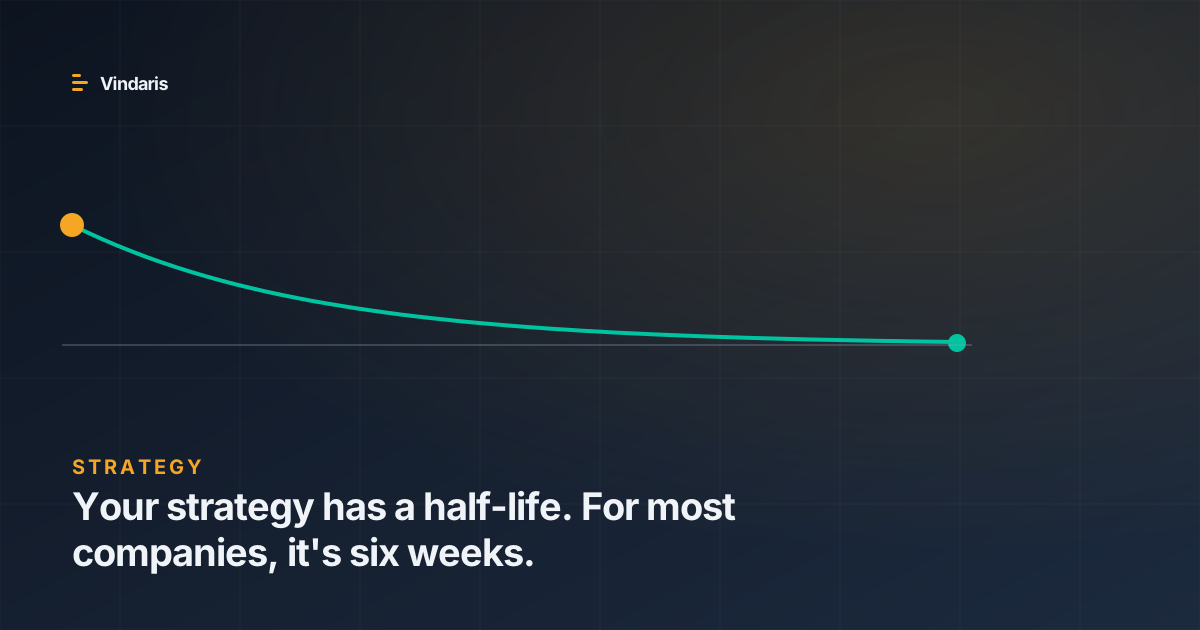
The reality is closer to a radioactive isotope. It decays. Predictably. From the moment it leaves the room. And the decay rate is much faster than the planning cadence is built for.
You can measure this yourself, if you have the stomach for it. Take a single sentence from this year's strategy deck — a real one, not a slogan — and ask ten people across the company what it means and what they're currently doing about it. Run the experiment in week one of the new plan. Then run it again in week six. Then again in week twelve. The shape of the response curve is always the same: a sharp drop between week one and week six, followed by a long flat line of partial, idiosyncratic memory that diverges further from the original sentence with every week that passes.
By week twelve, the strategy has been reinterpreted, re-prioritised, half-forgotten, and silently overwritten by whatever the team was already doing. The deck on the wall is unchanged. The behaviour underneath it is unrecognisable from what the deck describes.
Why strategies decay
Three forces erode every strategy from the day it's written, and all three are structural rather than cultural. You cannot fix them by writing the strategy better or communicating it harder.
The first is personnel turnover at the seams. The person who heard the rationale at the offsite leaves the company, takes a different role, or quietly stops being involved in that workstream. The person who replaces them inherits the conclusion without the argument that produced it. They get the bullet on the slide; they don't get the two hours of debate that explained why the bullet says what it says. Conviction halves with each handoff, because conviction lives in the reasoning, not in the conclusion.
The second is the pull of the urgent. Strategy is, almost by definition, never urgent. The thing in front of you always is. Over six weeks, the cumulative weight of small urgent items — the customer escalation, the compliance request, the integration that broke, the executive who needs a deck for Tuesday — consumes the slack the strategy required. Nobody made a decision to deprioritise the strategy; the strategy just lost the time-allocation contest, repeatedly, in tiny invisible increments, until there was no time left for it.
The third is silent reinterpretation. Nobody actively changes the strategy. They just start interpreting it in ways that align with what they were already going to do. The words on the slide stay constant; the meaning attached to those words drifts. "Customer-led growth" means whatever the speaker needs it to mean in the meeting they're currently in. By week eight, three different functions are operating under three subtly incompatible interpretations of the same sentence, and the disagreement only surfaces when their work products fail to fit together.
What this means for cadence
If your strategy half-lives in six weeks, an annual planning cycle is functionally insane. The math is straightforward: by Q3, you are operating on something that has roughly 1/64th of its original meaning intact. The deck still says what it said in January. The execution underneath has been replaced, piece by piece, by whatever showed up urgently in March, April, and May. The annual cycle was designed for a substance that doesn't exist.
There are two reasonable structural responses, and most companies should adopt both.
Shorter planning cycles. Set strategy quarterly rather than annually. The half-life problem doesn't disappear — six weeks is still six weeks — but quarterly cycles catch the decay before the isotope goes inert. You don't have to rebuild the strategy from scratch every quarter; you have to re-anchor it, decide what's still true, kill what isn't, and explicitly redirect capacity that's been quietly absorbed by urgent work.
Continuous reinforcement. Use the operating cadence — weekly portfolio reviews, monthly bet reviews, whatever rhythm the company actually runs — to actively re-anchor the strategy against the live work. Not "are we on track" but "is this still the bet we're making, and is the work in front of us actually consistent with that bet?" Weekly reinforcement is what slows the decay. Quarterly resetting is what catches the residue.
The leadership behaviour that compensates
Beyond cadence, there is a leadership behaviour that matters disproportionately: visibly re-deciding. Most leaders treat strategic decisions as one-time pronouncements, made once and defended thereafter. The decay-aware leader treats them as decisions that have to be re-made, publicly, on a regular cadence — partly to update them against new information, mostly to refresh the conviction of the people executing them.
A leader who says "we made this bet in January, and as of this week we are still making it for the following reasons" is doing work that compounds. The bet stops being a slide somebody half-remembers and becomes a live commitment that the leader is visibly renewing. That renewal restores conviction at the seams where it would otherwise have leaked out.
This is not the same as re-deciding constantly. Re-deciding too often is its own pathology — it produces strategy whiplash and erodes trust. The skill is in the cadence: rare enough to be credible, frequent enough to fight the decay.
The Vindaris view
You cannot stop strategic decay. It is a property of human attention and organisational complexity, not a failure of discipline. You can, however, compensate for it. The system has to make the strategy visible next to the work it's supposed to inform, week in and week out — not as a slide stored in a folder, but as a live layer that surfaces whenever the work is being planned, reviewed, or adjusted.
When the strategy is structurally visible at the moment work decisions are made, the decay slows because the reinterpretation gap closes. People don't drift away from the strategy because they can no longer remember what it said — they can see what it says, in context, as they make the small decisions that aggregate into execution. Without that visibility, the half-life wins, every time, and by Q3 you are executing against a memory of a strategy rather than the strategy itself.