Hoshin Kanri vs Balanced Scorecard: both map strategy. Neither owns the work.
One focuses breakthrough objectives through iterative alignment. The other maps strategy across four perspectives. Both give leadership a structured view of where to go. Neither provides a structural connection to the work that gets you there.
Free forever | No credit card | Your team keeps their tools
Hoshin Kanri vs Balanced Scorecard splits along execution and measurement. Hoshin deploys a few breakthrough objectives top to bottom through catchball, linking each goal to the initiatives and metrics that carry it in an X-matrix. The Scorecard checks whether outcomes stay balanced across four perspectives. Hoshin plans the work. The Scorecard grades the result.
Breakthrough objectives, aligned through catchball.
Hoshin Kanri emerged from Japanese manufacturing in the 1960s. The name translates roughly to "compass management" or "policy deployment." Its core premise: an organization should focus on a small number of breakthrough objectives each year and align every level of the company around them.
The alignment mechanism is catchball - an iterative back-and-forth between leadership and teams. Objectives flow down, reality flows up. Each level negotiates what it can commit to, and the plan gets revised until alignment is genuine rather than mandated. The X-matrix captures objectives, strategies, projects, and metrics on a single sheet.
Planning cadence: annual breakthrough objectives with monthly review cycles. Strength: deep focus on what matters most. Blind spot: the X-matrix is a planning artifact. Once the quarter begins, the connection between the matrix and daily work depends entirely on discipline and manual tracking.
Four perspectives. One strategy map. A broader lens.
Developed by Kaplan and Norton in the early 1990s, the Balanced Scorecard was designed to move organizations beyond purely financial metrics. It maps strategy across four perspectives: Financial, Customer, Internal Process, and Learning and Growth.
The strategy map is the BSC's signature tool - a visual cause-and-effect diagram showing how objectives in each perspective support the ones above. If internal processes improve, customer outcomes should follow, which drives financial results. The framework forces organizations to articulate these links explicitly.
Strength: comprehensive multi-perspective view that prevents over-indexing on financial metrics alone. Blind spot: the strategy map describes what should happen. It does not tell you whether the actual work happening in your organization is connected to those objectives. Scorecard reviews often become presentations about indicators, not investigations into effort.
Different organizations, different starting points.
Hoshin Kanri fits when your organization has a lean or continuous improvement culture, when you need to focus the entire company on a few breakthrough goals, or when you are a manufacturing or operations-heavy organization. It works well in environments where annual planning is rigorous and monthly reviews are already part of the rhythm.
Balanced Scorecard fits when your organization is complex, multi-divisional, or needs to balance competing priorities across functions. It suits companies that have historically over-relied on financial metrics and need a structured way to track leading indicators across customer, process, and growth dimensions.
Some organizations combine both: BSC for the strategic landscape, Hoshin for the breakthrough priorities within it. The choice depends on your culture, your size, and your existing planning cadence. What rarely depends on the framework is the execution problem that follows.
Why the framework choice matters less than the execution layer.
Hoshin Kanri and Balanced Scorecard both fail at the same point. They structure how you think about strategy. They do not structure how strategy connects to the work your teams do every day.
An X-matrix on the wall or a strategy map in a slide deck is valuable as a thinking tool. But once the planning session ends, the connection between those artifacts and the tasks in Planner, the deals in HubSpot, the sprints in your project tool - that connection is manual. It relies on discipline, status meetings, and people remembering to update a spreadsheet.
The framework structures the thinking. The execution layer structures the work. Without the second part, strategy reviews become opinion-based. Leaders ask "how's it going?" and get narratives instead of traceable evidence. Hoshin or BSC - the framework you choose matters far less than whether your goals are structurally connected to the work that should move them.
Vindaris is framework-agnostic. You can model Hoshin breakthrough objectives, BSC perspectives, OKRs, or any hybrid. The platform does not care about your goal syntax. What it does is connect whichever structure you choose to the real work happening in the tools your teams already use - bidirectional, live, traceable. The X-matrix comes alive. The strategy map gets grounded.
Hoshin Kanri vs Balanced Scorecard at a glance.
| Dimension | Hoshin Kanri | Balanced Scorecard |
|---|---|---|
| Origin | Japanese manufacturing, 1960s | Kaplan & Norton, 1992 |
| Core idea | Focus on few breakthrough objectives | Map strategy across four perspectives |
| Key tool | X-matrix, catchball process | Strategy map, scorecard |
| Planning cycle | Annual with monthly reviews | Annual with quarterly reviews |
| Scope | Narrow and deep | Broad and multi-dimensional |
| Best fit | Lean orgs, manufacturing, breakthrough goals | Complex orgs, multi-divisional, balanced metrics |
| Execution link | Manual - relies on review discipline | Manual - relies on indicator reporting |
| Vindaris support | Yes - model breakthrough objectives natively | Yes - model BSC perspectives natively |
Goals, KPIs, tasks, and strategy in one place
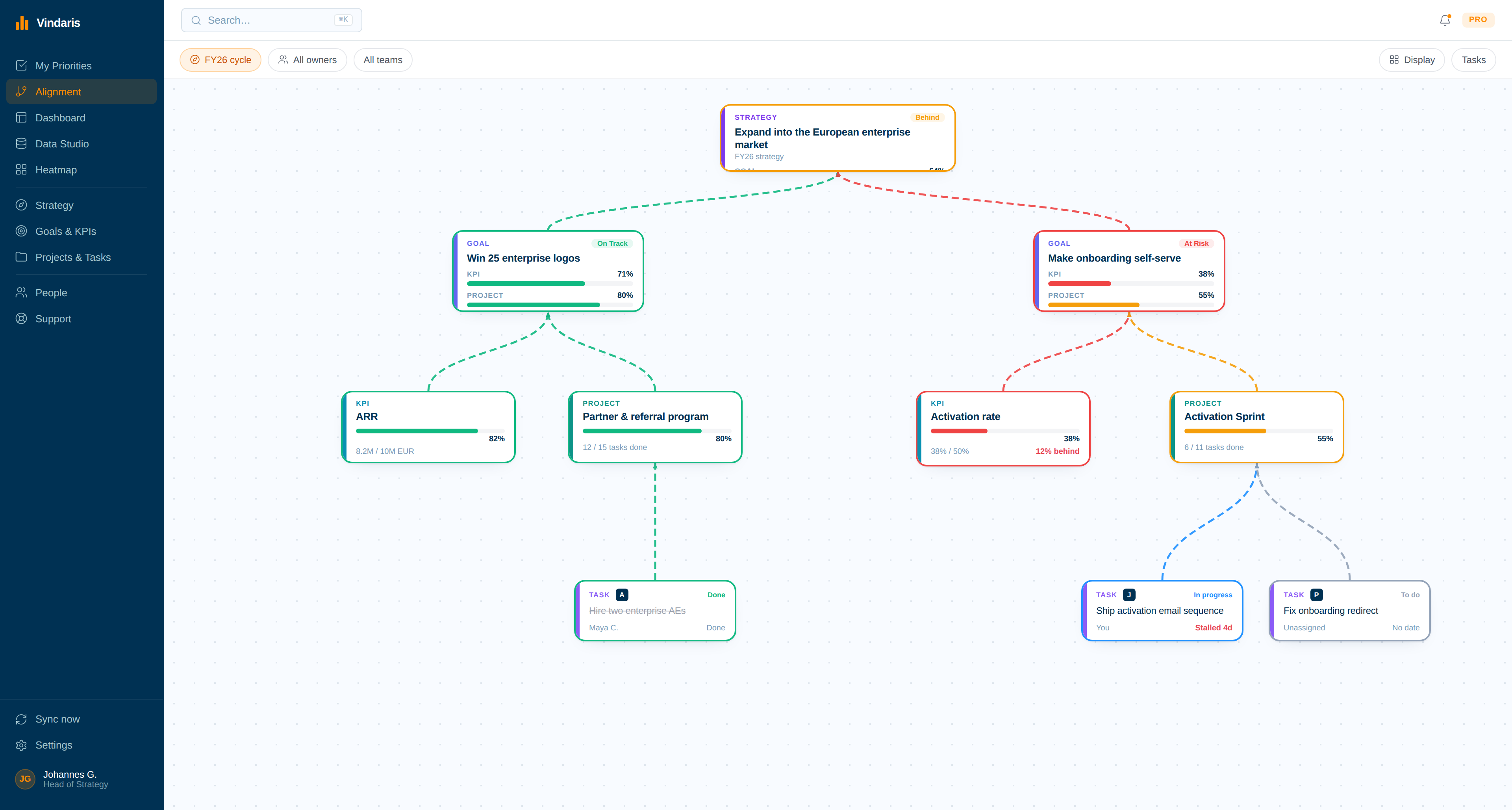
See every goal connected to the work moving it.
Drag-and-drop your alignment structure. Roll up work progress, KPIs, and goals without enforcing any framework syntax.
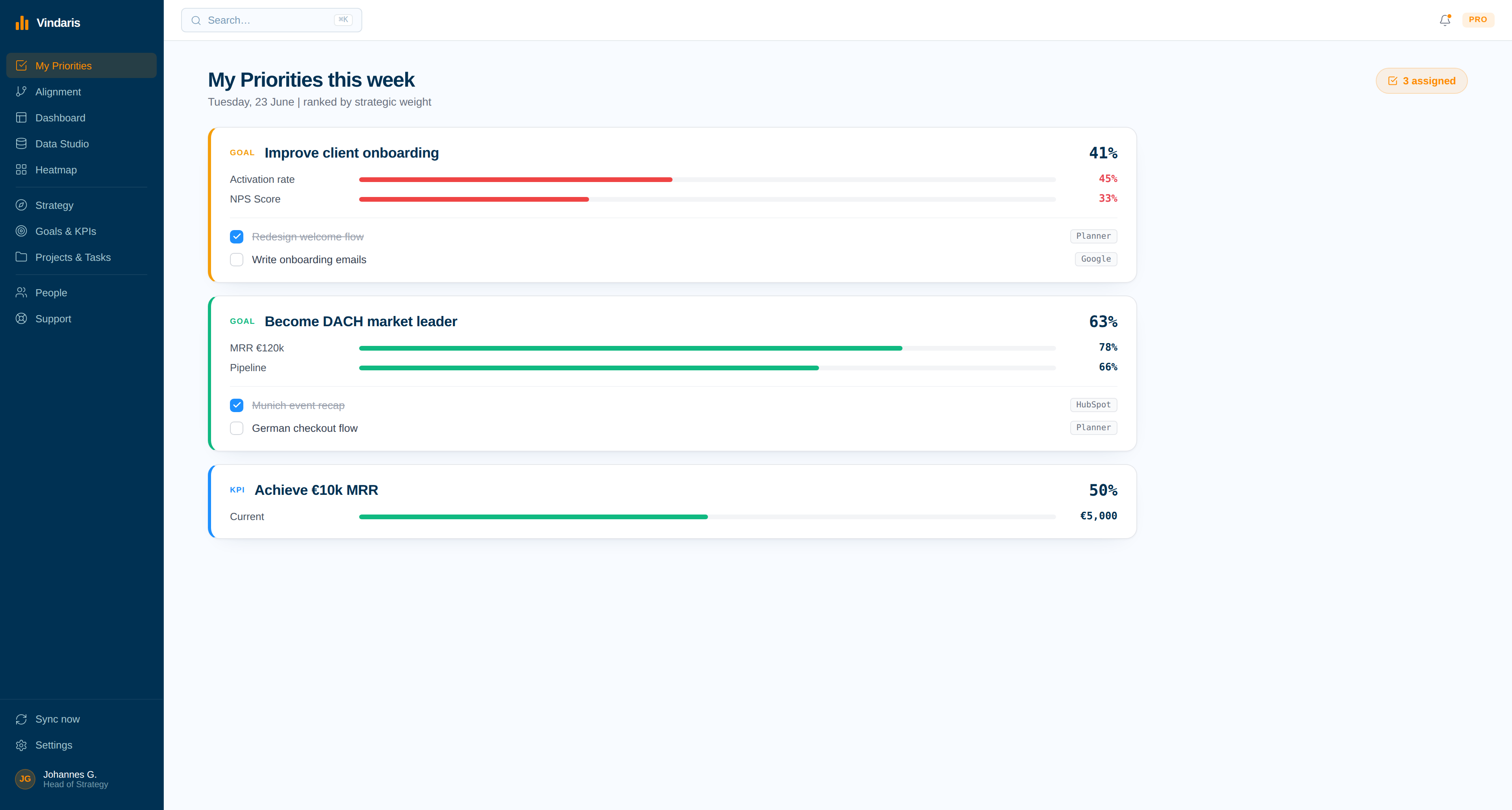
Everyone knows exactly what matters most.
A clear view of each person's goals, KPIs, projects, and tasks. Start every week focused on what's important and due.
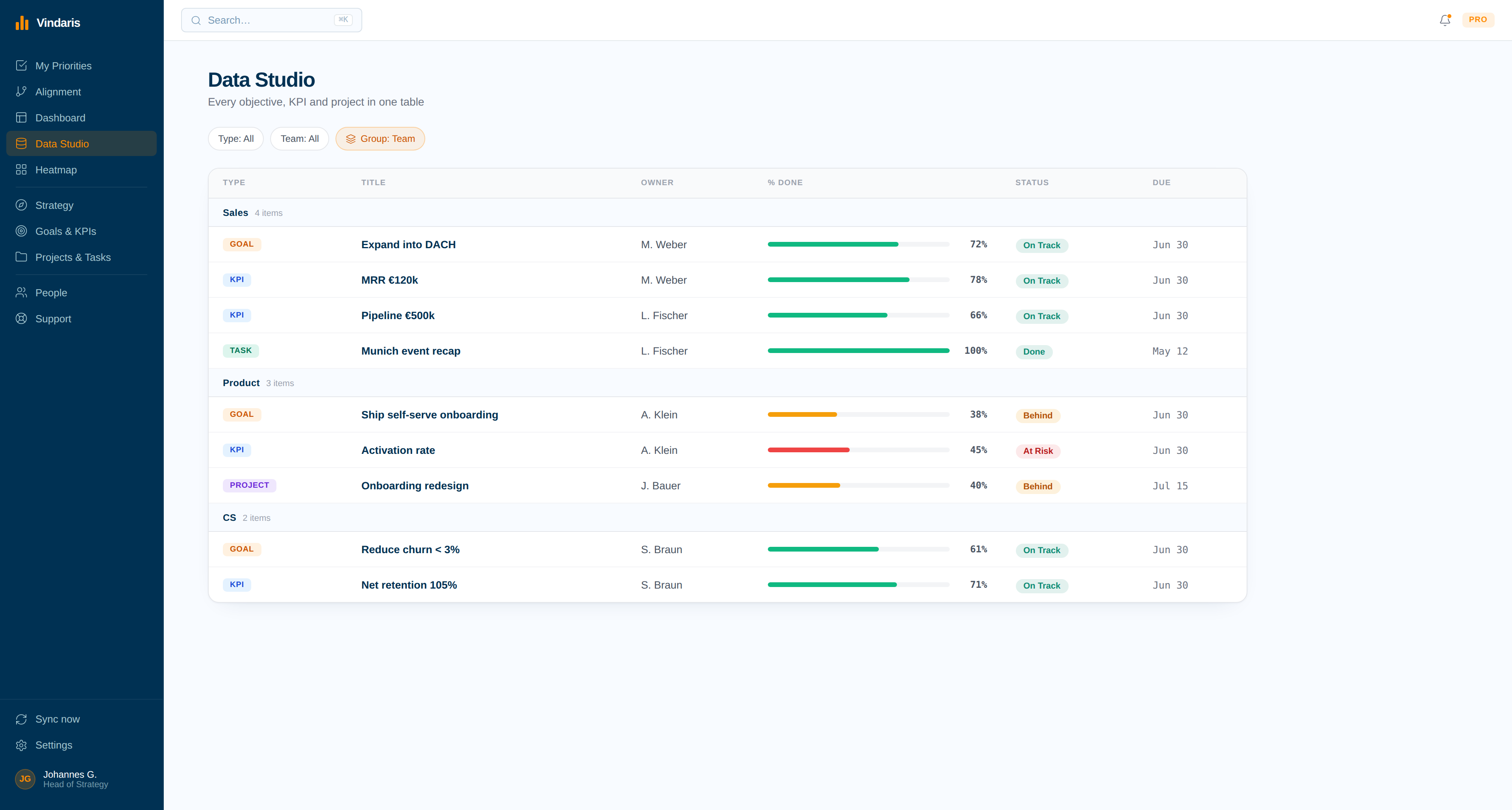
Run reports the way your management needs them.
Build custom views to rank teams, spot risks, compare KPIs to work. AI summaries push updates to Slack, Teams, and email.
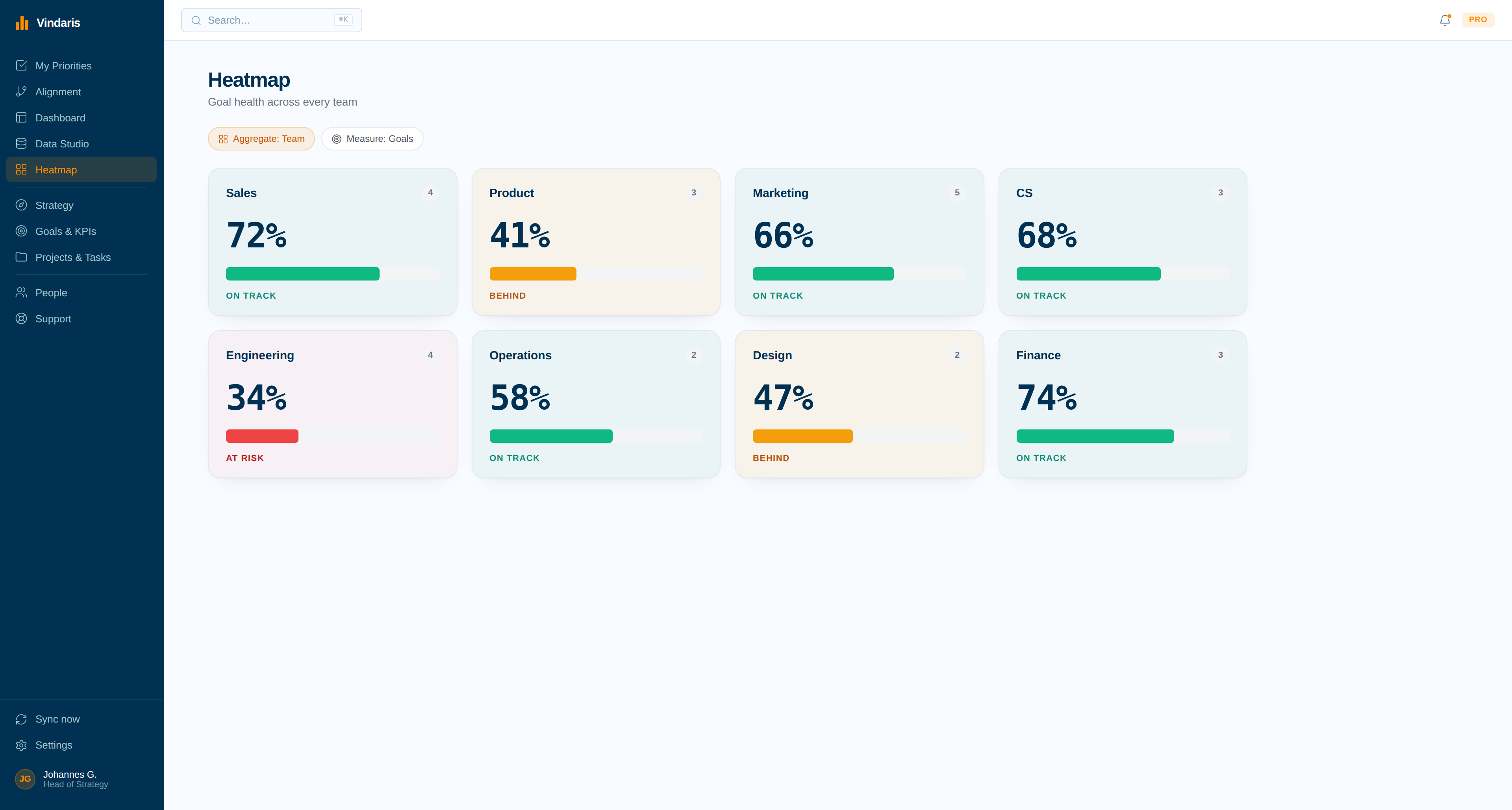
Spot risks while there's still time to fix them.
Run heatmaps across teams, goals, KPIs, and projects. Save views and get notified when risk levels change.
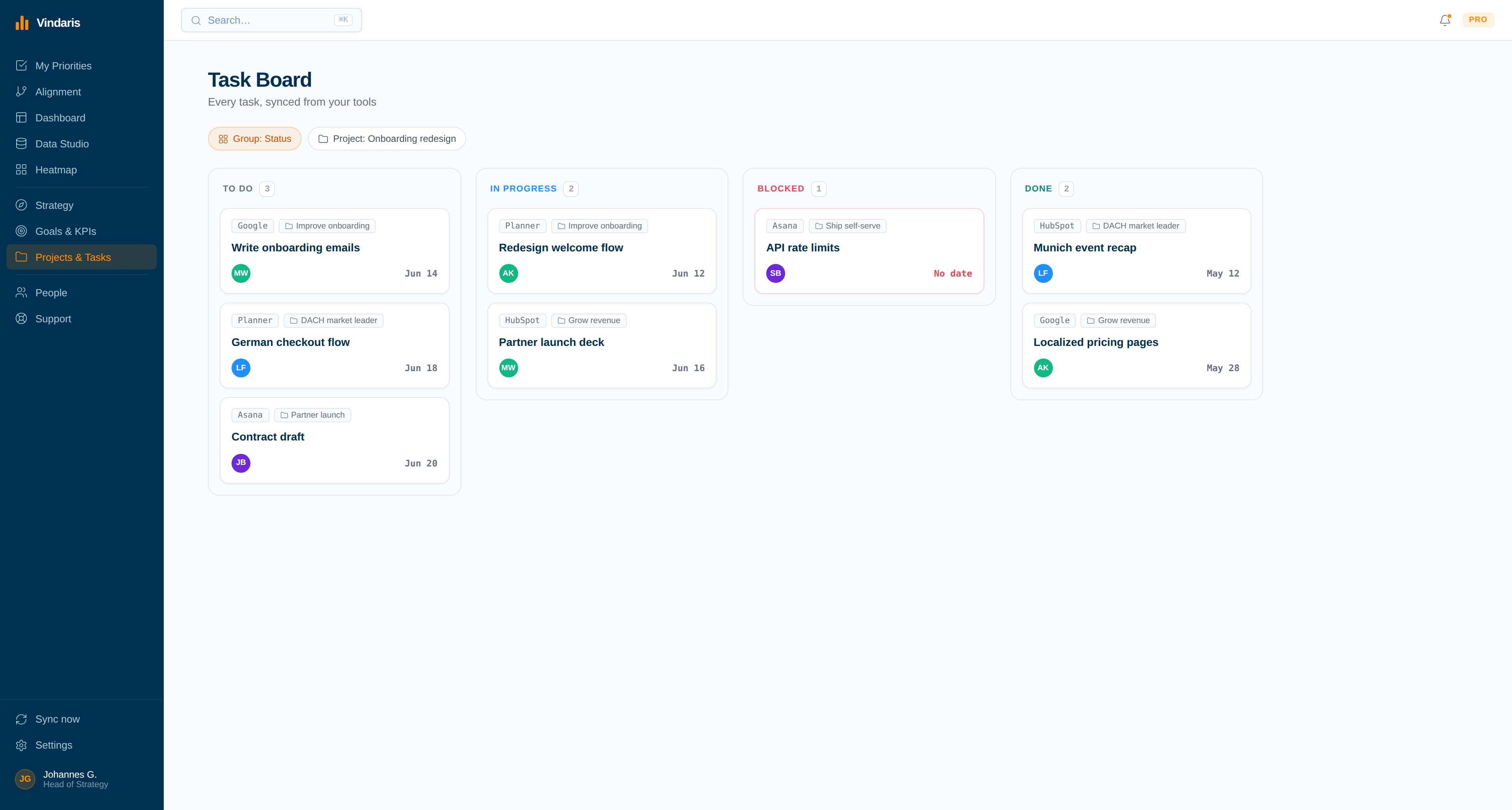
Combine tasks and projects across your systems.
Sync HubSpot, MS Planner, Google Tasks, Asana and more into one view. Bi-directional sync keeps everything current while teams stay in their own tools.
Common questions, answered
What is the main difference between Hoshin Kanri and Balanced Scorecard?
Can you use Hoshin Kanri and Balanced Scorecard together?
Which framework is better for manufacturing organizations?
Does Vindaris support both Hoshin Kanri and Balanced Scorecard?
Why do both frameworks struggle with execution?
Free forever, including two integrations
Start free with full strategy, goal, KPI, task, and project management. Pay only when you add more than 4 people, need more integrations, or more AI summaries.
Best for individual contributors, small teams or startups. No credit card required.
- All features (incl. Alignment Canvas, My Priorities, Heatmap, Data Studio & Task Board)
- Set up 2 integrations of your choice
- Invite up to 4 additional members
- 5 ad-hoc AI risk summaries per month
Best for teams, small agencies, or departmental and team management.
- All in Free
- All integrations, unlimited sync
- Unlimited AI risk summaries & alignment suggestions - ad-hoc and scheduled
- Up to 10 users within one organization
Best for multiple teams, exec teams, Chiefs of Staff, departmental leadership or full-org deployments.
- All in Connect
- Unlimited users within one organization
- Direct human support email, 24h response time
- Human-led onboarding support
Other framework comparisons
Choose the framework that fits your culture.
Then connect it to the work.
Vindaris supports Hoshin Kanri, Balanced Scorecard, and any hybrid. Free forever for goal management.
Connect your first tool - freeNo credit card | No minimum contract | Your team keeps their tools