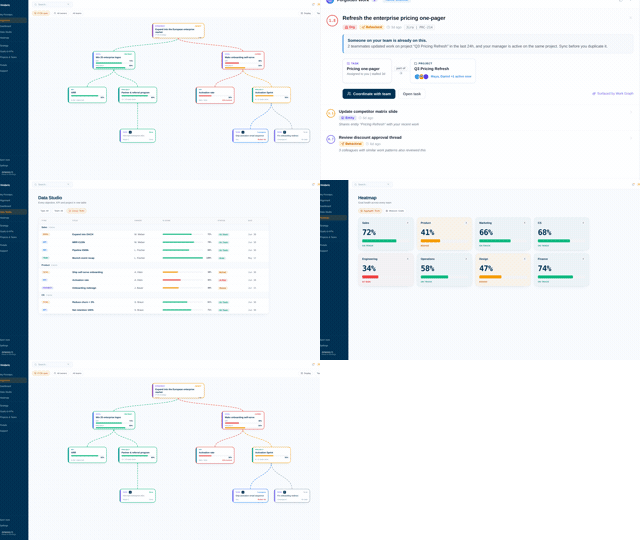
EOS vs OKR: both promise focus. Neither delivers execution on its own.
EOS uses Rocks and Scorecards. OKRs use Objectives and Key Results. Both claim to create focus and accountability. Here is what each actually delivers and where both fall short.
Free forever for goal management | Supports EOS, OKRs, and hybrids
EOS vs OKR compares an operating system with a goal format. EOS prescribes the whole rhythm: Rocks, the Scorecard, the Issues list and the Level 10 meeting. OKRs only define the quarterly outcome and the key results that prove it. Teams already running EOS usually keep Rocks and add OKRs where a stretch outcome needs its own numbers.
EOS: a complete operating system for founder-led companies
The Entrepreneurial Operating System is more than a goal framework. It prescribes how you run the business: Rocks for 90-day priorities, Scorecards for weekly activity metrics, an Issues list for blockers, and a Level 10 meeting rhythm that holds the whole thing together.
EOS works well for operationally focused businesses. Companies between 10 and 250 people, often founder-led, where the leadership team is close to the work. The structured cadence removes ambiguity. Everyone knows their Rocks. The weekly Scorecard makes activity visible. The L10 meeting has a fixed agenda that keeps conversations productive.
Where EOS struggles: scale and flexibility. As organizations grow past 250 people, the prescriptive structure can feel rigid. Cross-functional work that doesn't fit neatly into the accountability chart gets lost. And Rocks, while clear, are binary (done or not done) with no built-in mechanism to track the work that moves them forward week over week.
OKRs: lightweight goal-setting for outcome-focused teams
Objectives and Key Results strip goal-setting down to two layers. A qualitative Objective describes the direction. Two to five measurable Key Results define what success looks like. Quarterly cycles create rhythm. Stretch targets discourage sandbagging.
OKRs work well for product-led and outcome-focused organizations. Tech companies, product teams, and organizations where the goal is to change a metric rather than complete a checklist. OKRs scale well across large org structures because they're flexible enough to cascade, align, or stay independent at each level.
Where OKRs fall short: they define the destination but not the path. A Key Result of "reduce churn to 3%" tells you what to measure but not what work will move it. And OKRs don't prescribe a meeting cadence or operating rhythm, so teams that lack discipline often set them and forget them within weeks.
When to use each
Your leadership team runs the company day-to-day. You need a structured operating rhythm with clear accountability. Your priorities are execution-focused: ship this, fix that, hit this number. EOS gives you the whole system, not just the goals.
Your teams need to define and pursue measurable outcomes without being told exactly what to build. You want alignment across a larger organization without prescribing how each team works. The quarterly OKR cycle gives direction while leaving room for autonomy.
Some companies use EOS at the leadership level for operational discipline and OKRs at the team level for outcome-oriented work. This works if both connect to the same execution layer. It fails when they become two parallel goal-tracking systems with no shared foundation.
Why the framework choice matters less than you think
The EOS vs OKR debate consumes real organizational energy. Consultants are hired. Workshops are run. Leadership teams argue for weeks. Then the chosen framework is implemented, and within two quarters the same problems return: goals are set, but nobody can tell whether the work underneath is actually moving them.
Both frameworks share the same structural weakness. Rocks don't connect to the tasks in your project management tool. OKRs don't connect to the initiatives in your sprint board. The goal layer sits above the work layer, and the space between them is filled with status meetings, manual updates, and optimistic guesses.
Vindaris supports EOS Rocks, OKRs, and hybrid models natively. You pick the goal syntax that fits your organization. Vindaris provides the layer that both frameworks are missing: a traceable connection between goals and the work in your existing tools. Rocks in Vindaris link to Planner tasks. OKRs link to HubSpot deals. Both update in real time.
EOS vs OKR at a glance
| Component | EOS | OKR |
|---|---|---|
| Goal unit | Rocks (90-day priorities) | Objectives + Key Results (quarterly) |
| Metrics tracking | Scorecards (weekly activity numbers) | Key Results (outcome measures) |
| Blocker handling | Issues list with IDS process | No built-in mechanism |
| Meeting cadence | L10 (weekly, fixed 90-min agenda) | Not prescribed (varies by team) |
| Best fit | Founder-led, 10-250 employees | Product-led, any org size |
| Scope | Full operating system | Goal-setting framework only |
| Common failure | Rocks set but work not tracked between L10s | OKRs graded quarterly with no execution link |
Goals, KPIs, tasks, and strategy in one place
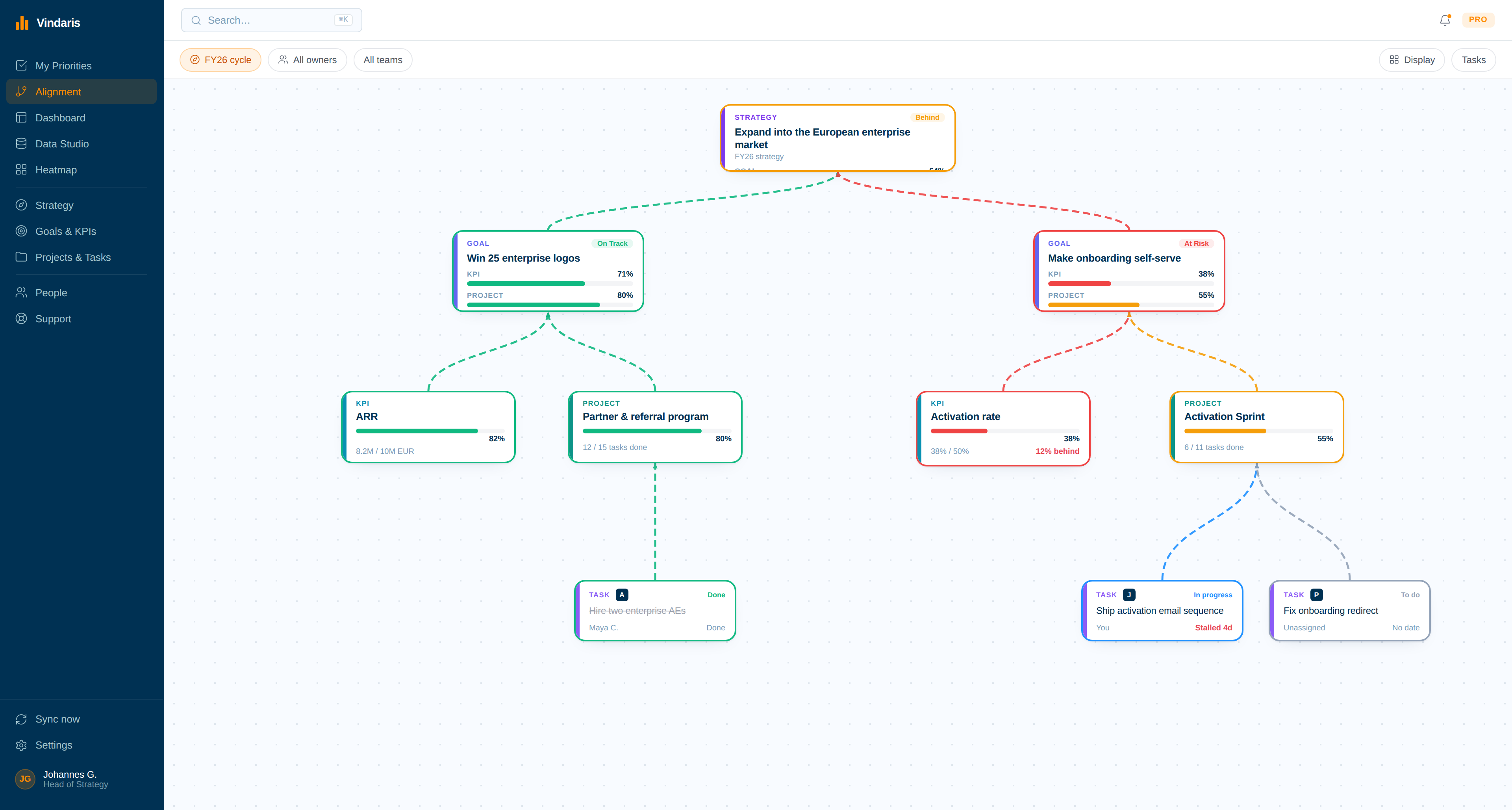
See every goal connected to the work moving it.
Drag-and-drop your alignment structure. Roll up work progress, KPIs, and goals without enforcing any framework syntax.
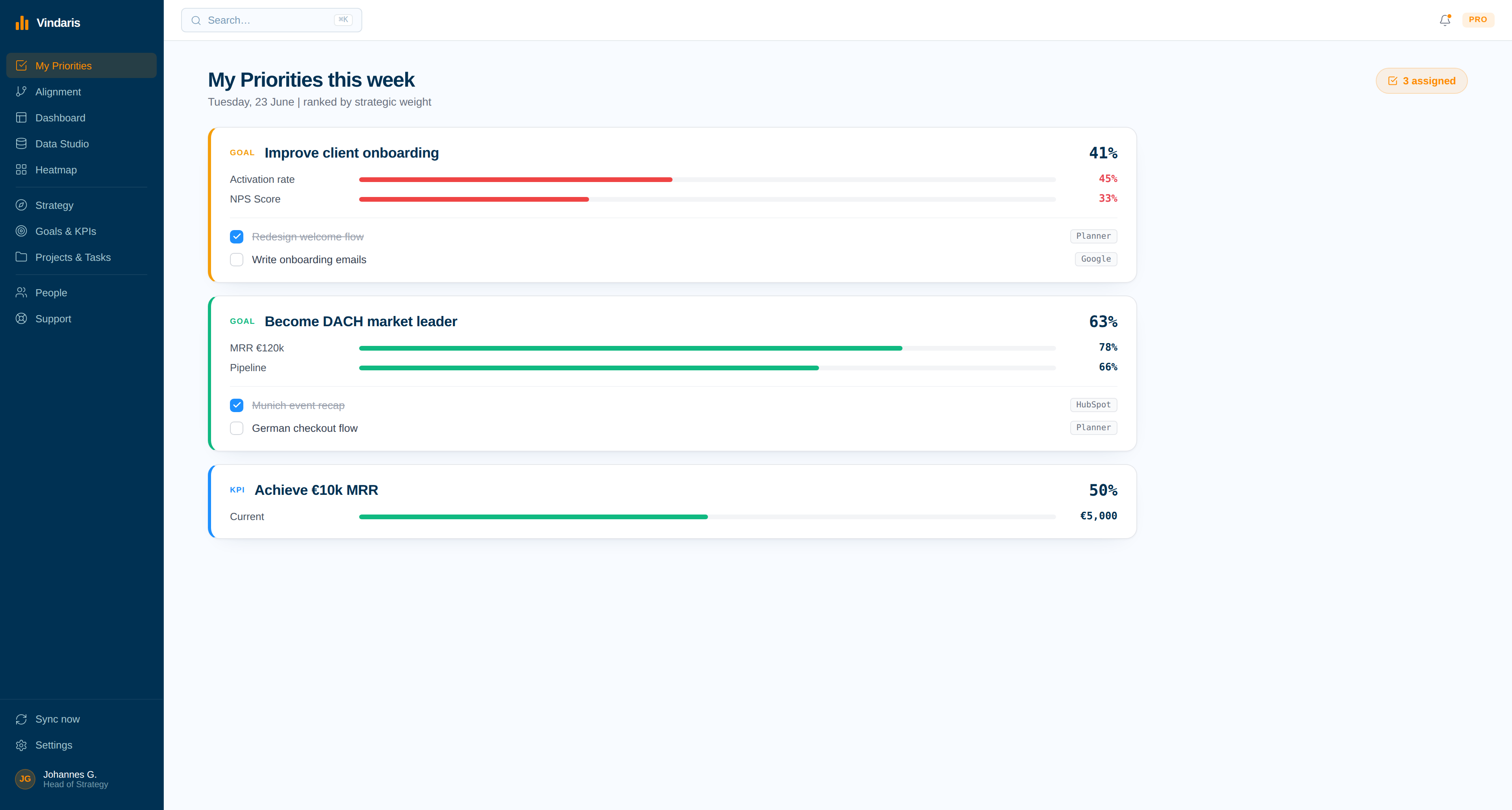
Everyone knows exactly what matters most.
A clear view of each person's goals, KPIs, projects, and tasks. Start every week focused on what's important and due.
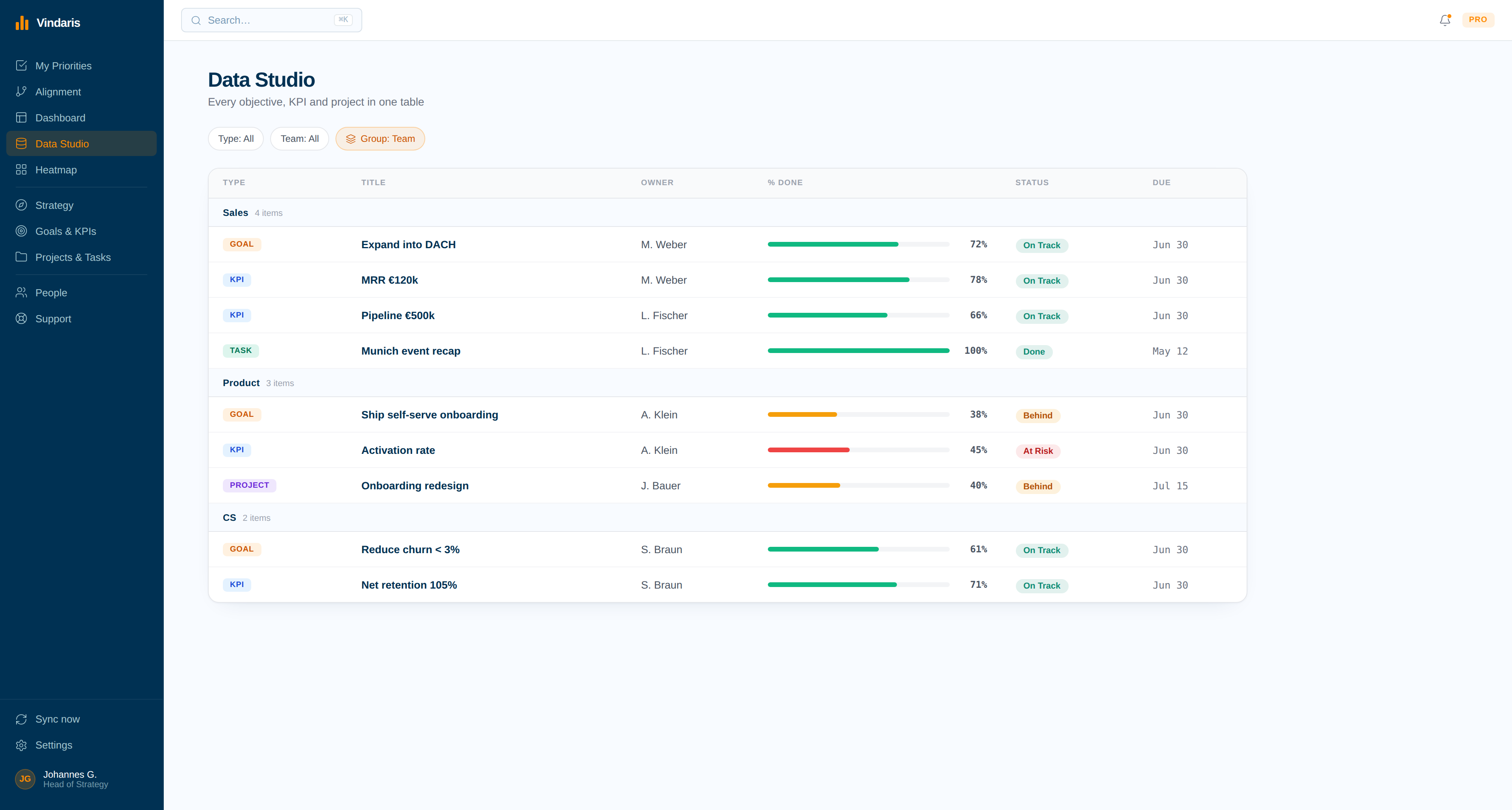
Run reports the way your management needs them.
Build custom views to rank teams, spot risks, compare KPIs to work. AI summaries push updates to Slack, Teams, and email.
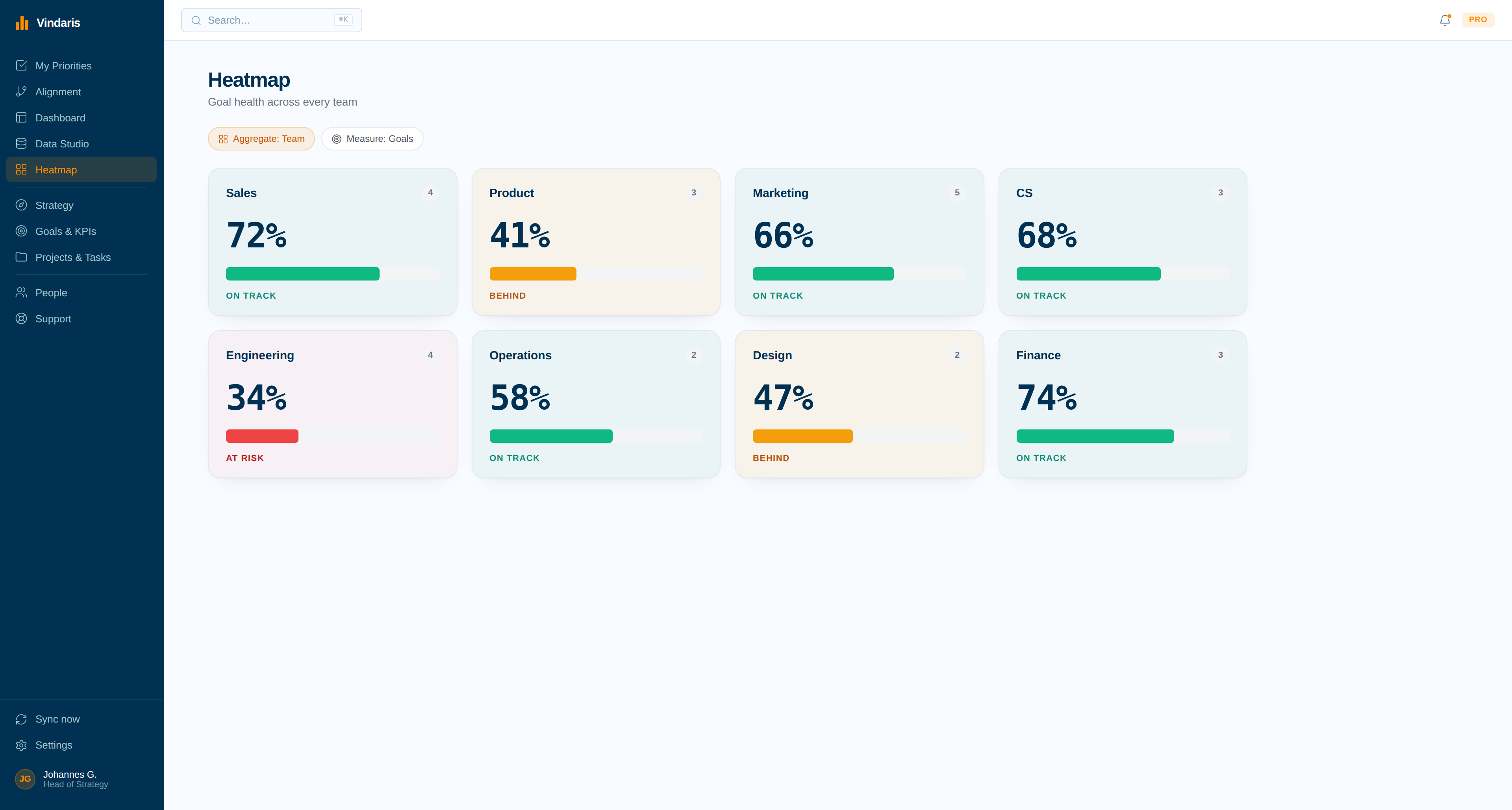
Spot risks while there's still time to fix them.
Run heatmaps across teams, goals, KPIs, and projects. Save views and get notified when risk levels change.
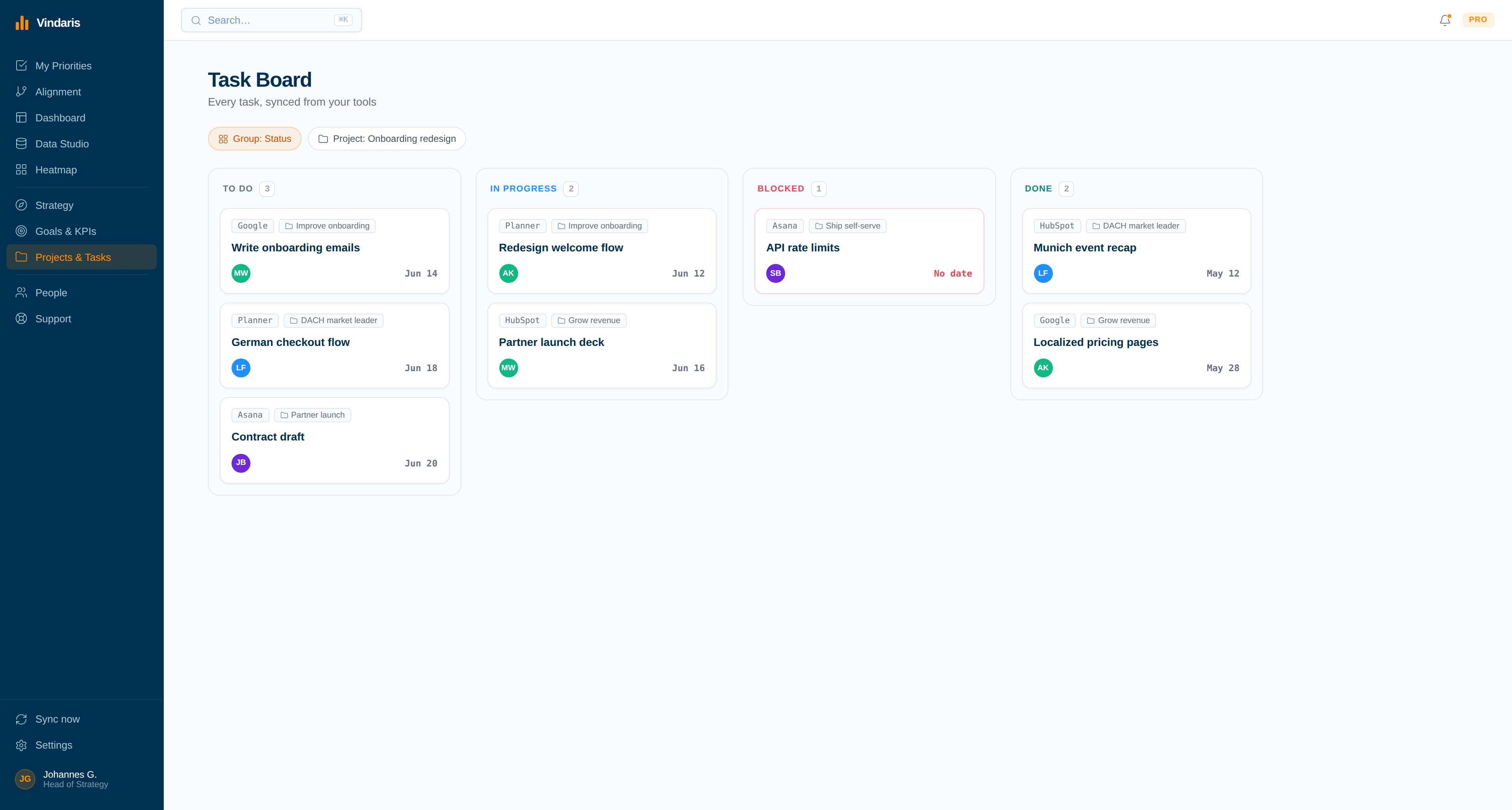
Combine tasks and projects across your systems.
Sync HubSpot, MS Planner, Google Tasks, Asana and more into one view. Bi-directional sync keeps everything current while teams stay in their own tools.
Common questions, answered
What is the main difference between EOS and OKRs?
Can you use EOS and OKRs together?
Is EOS better for small businesses?
Why do both EOS and OKRs fail in practice?
How do EOS Scorecards differ from OKR Key Results?
Free forever, including two integrations
Start free with full strategy, goal, KPI, task, and project management. Pay only when you add more than 4 people, need more integrations, or more AI summaries.
Best for individual contributors, small teams or startups. No credit card required.
- All features (incl. Alignment Canvas, My Priorities, Heatmap, Data Studio & Task Board)
- Set up 2 integrations of your choice
- Invite up to 4 additional members
- 5 ad-hoc AI risk summaries per month
Best for teams, small agencies, or departmental and team management.
- All in Free
- All integrations, unlimited sync
- Unlimited AI risk summaries & alignment suggestions - ad-hoc and scheduled
- Up to 10 users within one organization
Best for multiple teams, exec teams, Chiefs of Staff, departmental leadership or full-org deployments.
- All in Connect
- Unlimited users within one organization
- Direct human support email, 24h response time
- Human-led onboarding support
Other framework comparisons
EOS, OKRs, or both.
Vindaris connects them to the work.
Pick the framework that fits. Let Vindaris solve the execution gap underneath.
Try Vindaris freeNo credit card | Free forever for goal management