OKR vs KPI: different syntax, same execution problem.
OKRs track ambitious outcomes. KPIs track operational health. Most teams run both. The real question is how you connect either to the work that moves them.
Free forever for goal management | Supports OKRs, KPIs, and hybrids
OKR vs KPI is a difference of intent: an OKR sets an ambitious outcome you want to change this quarter, while a KPI measures ongoing health that has to stay above a line. Most teams run both, and the hard part is neither definition. It is connecting either one to the work that actually moves it.
OKRs: a quarterly bet on outcomes that matter
Objectives and Key Results were designed to create focus and ambition. You set a qualitative direction, attach two to five measurable results, and run a quarterly cycle of setting, tracking, and grading.
OKRs work well when teams need to change direction. They are outcome-oriented by design. A good OKR forces a team to define what success looks like in measurable terms, then work backward from there. The quarterly cadence creates natural checkpoints. The stretch-target convention (70% completion = success) discourages sandbagging.
Where OKRs struggle: they don't tell you what to do. An OKR says "reduce churn to 3%" but doesn't structure the work that will get you there. That gap between the goal and the tasks is where most OKR programs quietly fail. Teams set great objectives, then the work drifts because nothing connects it back.
KPIs: the vital signs of a running operation
Key Performance Indicators measure what needs to stay healthy. They are not time-bound goals. They are continuous signals that tell you whether critical functions are performing within acceptable ranges.
KPIs work well for steady-state operations. Revenue per employee. Customer satisfaction score. Average response time. First-call resolution rate. These are metrics you want to monitor continuously, not chase for a quarter and then reset. KPIs give operations teams a shared definition of "healthy" and make deviations visible early.
Where KPIs fall short: they don't drive change. A dashboard of green KPIs tells you things are stable, not that you're making progress. KPI tracking software that reads pace against target narrows that blind spot. Teams that run on KPIs alone tend to optimize for the current state rather than push toward a better one. And like OKRs, KPIs break down when there's no traceable link to the work that influences them.
When to use each
Launching a new market. Improving a product metric that has been flat. Shifting from services to product revenue. OKRs create the focus and the measurable benchmark.
System uptime. Hiring pipeline velocity. Customer support SLA. Gross margin. KPIs keep the lights on and make it clear when something slips before it becomes a crisis.
Most mature organizations run OKRs for change initiatives and KPIs for operational health in parallel. The challenge is not picking one or the other. The challenge is running both without creating two separate tracking systems that nobody updates.
Why the framework choice matters less than you think
Teams spend weeks debating OKRs vs KPIs. They run workshops. They hire consultants. Then they pick a framework, set it up in a tool, and six months later nobody is updating it. The framework was never the bottleneck.
The gap is between the goal and the work. Whether you call it an OKR or a KPI, the same structural problem exists: the goal sits in one system, the tasks sit in another, and the connection between them is a manual update, a weekly check-in, or a best guess. That is where execution visibility dies.
Vindaris supports OKRs, KPIs, and any combination natively. But the framework is just the label layer. What matters is that goals - whatever you call them - are traceably connected to the tasks, projects, and tools where the work actually happens. That connection is what Vindaris is built to provide.
OKR vs KPI at a glance
| Dimension | OKR | KPI |
|---|---|---|
| Purpose | Drive ambitious change | Monitor operational health |
| Cadence | Quarterly (set, track, grade, reset) | Continuous (always-on monitoring) |
| Ownership | Team or individual level | Function or department level |
| Measurement style | Outcome-based (did the result move?) | Threshold-based (is the metric in range?) |
| Success definition | 70% = healthy stretch | 100% = target met, deviation = risk |
| Common failure | Set and forgotten, no link to daily work | Monitored but not acted on, dashboard theater |
North Star metric vs OKR: how they fit together
A North Star metric is the single number that best captures the value your product delivers. An OKR is a time-bound goal you set to move a metric like that. They work at different altitudes, so most teams use both rather than picking one.
The North Star sits above your quarterly cycle as a durable direction that rarely changes. OKRs are the quarterly bets you make to push it. The work underneath is what actually shifts the number, whether you label the target an OKR or watch it as a KPI.
The failure mode is the one that breaks OKRs and KPIs on their own: the North Star lives on a dashboard, the quarterly OKRs live in another tool, and neither connects to the tasks that move them. Vindaris keeps the metric, the goal, and the work in one traceable structure, so you can see whether this quarter's OKRs are moving the North Star before the quarter ends.
Goals, KPIs, tasks, and strategy in one place
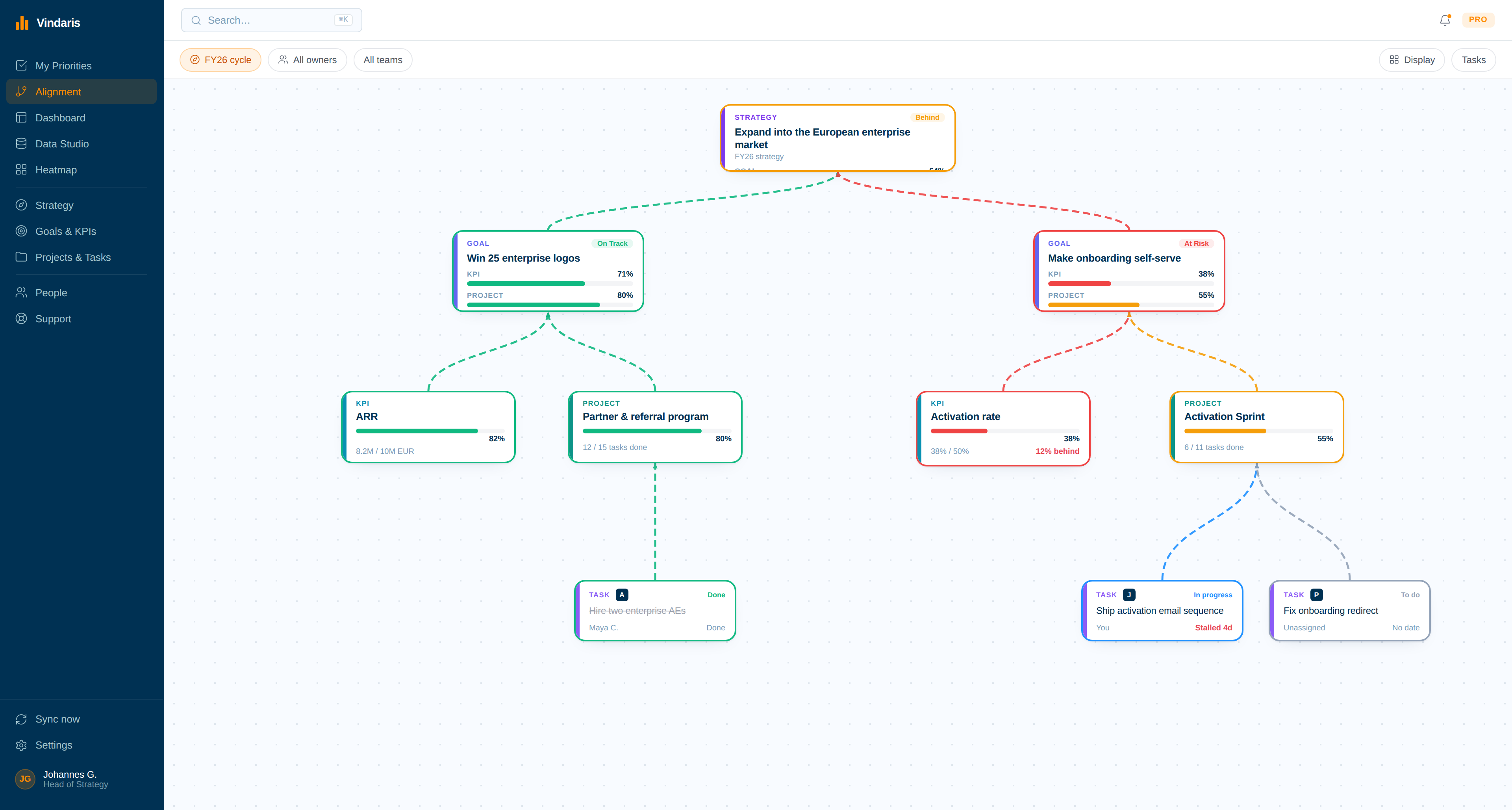
See every goal connected to the work moving it.
Drag-and-drop your alignment structure. Roll up work progress, KPIs, and goals without enforcing any framework syntax.
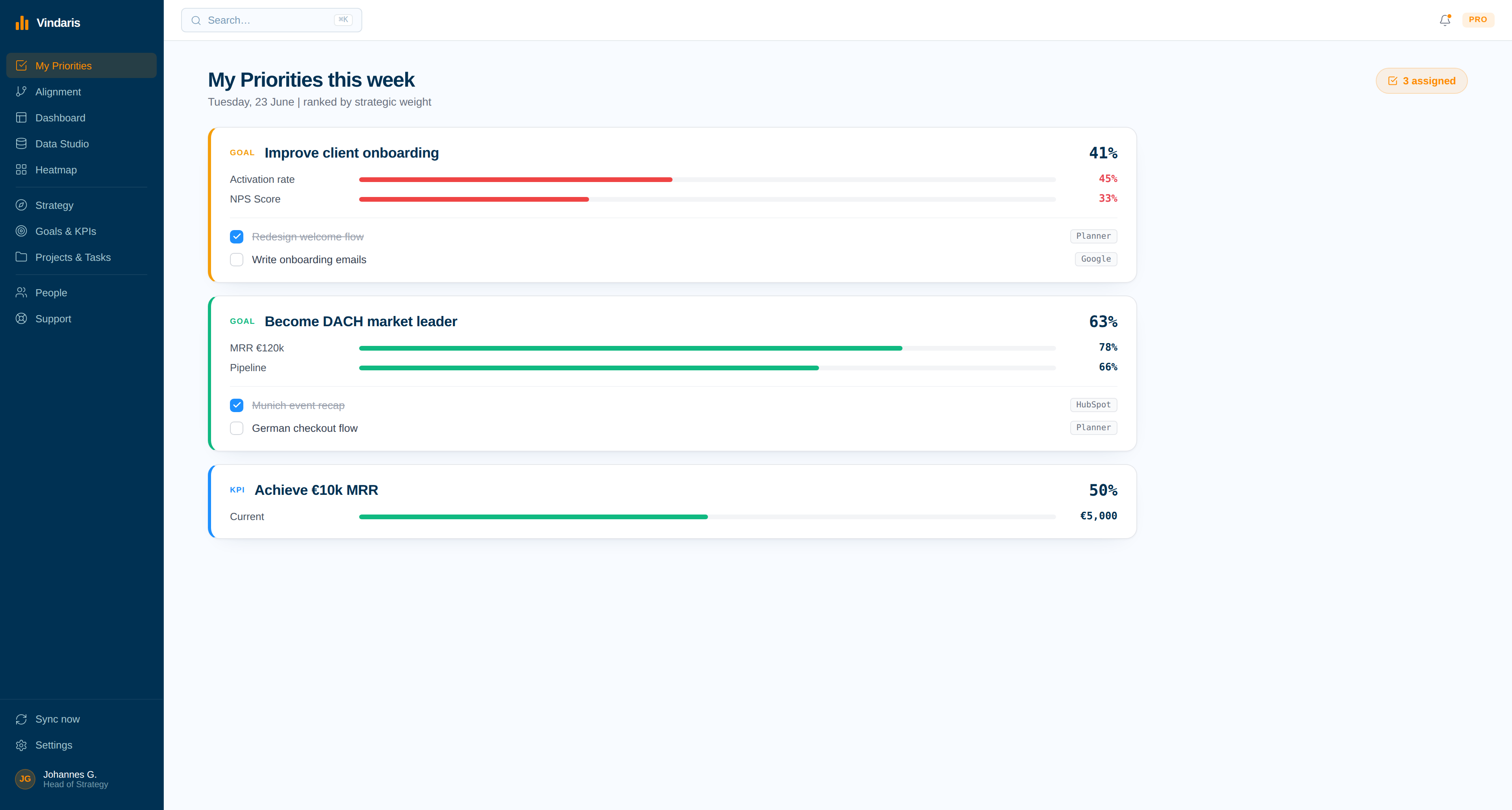
Everyone knows exactly what matters most.
A clear view of each person's goals, KPIs, projects, and tasks. Start every week focused on what's important and due.
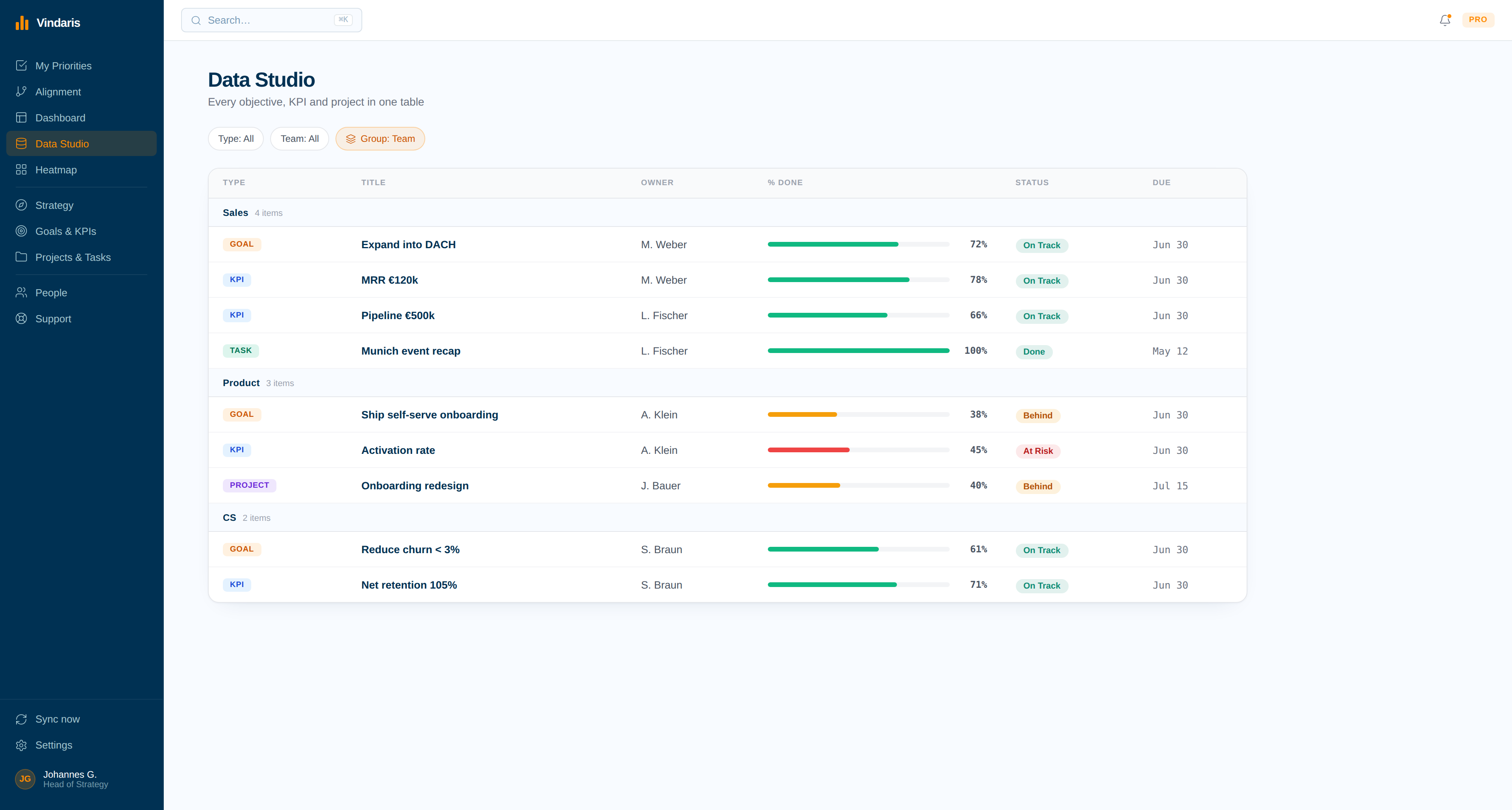
Run reports the way your management needs them.
Build custom views to rank teams, spot risks, compare KPIs to work. AI summaries push updates to Slack, Teams, and email.
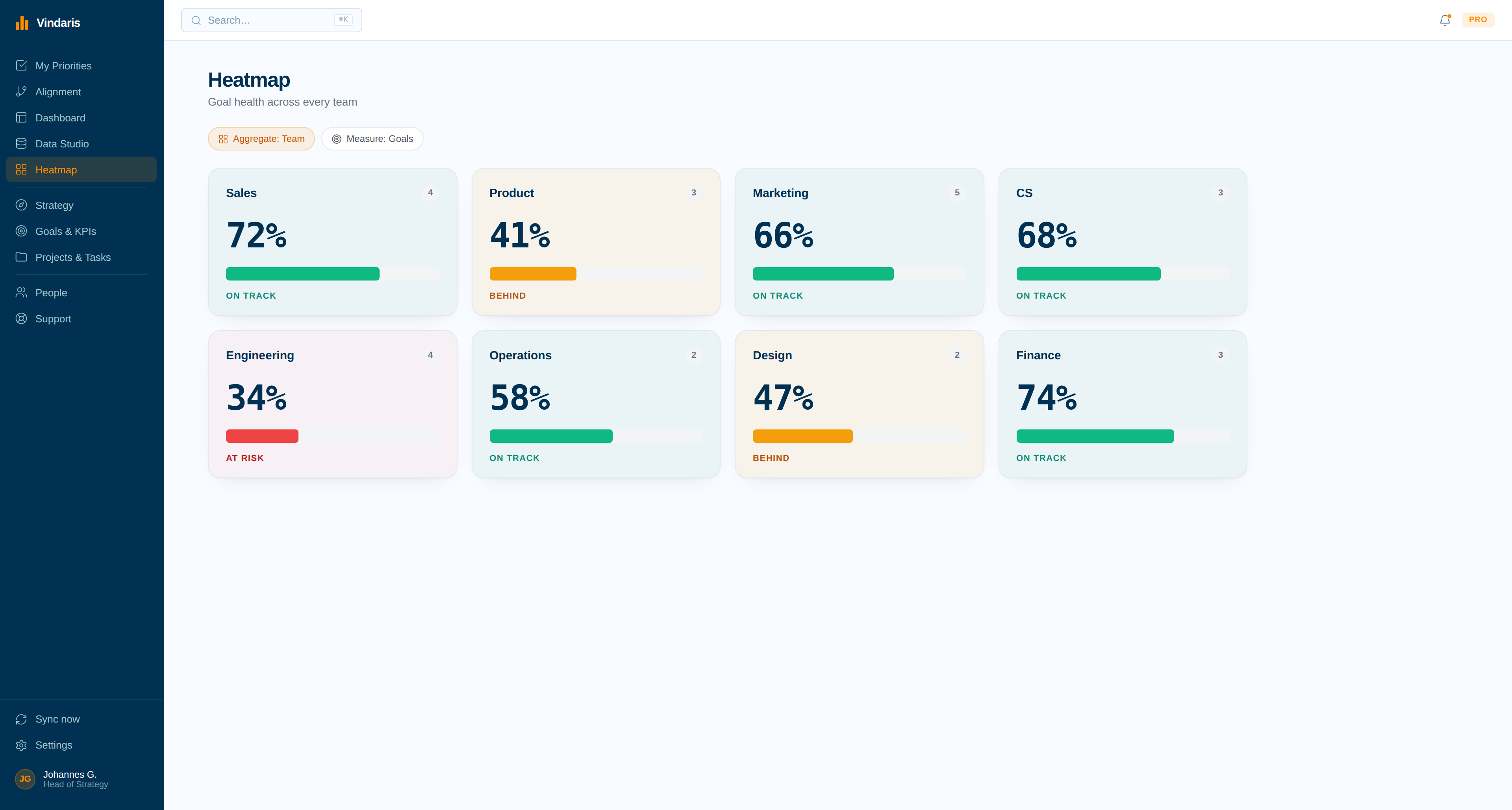
Spot risks while there's still time to fix them.
Run heatmaps across teams, goals, KPIs, and projects. Save views and get notified when risk levels change.
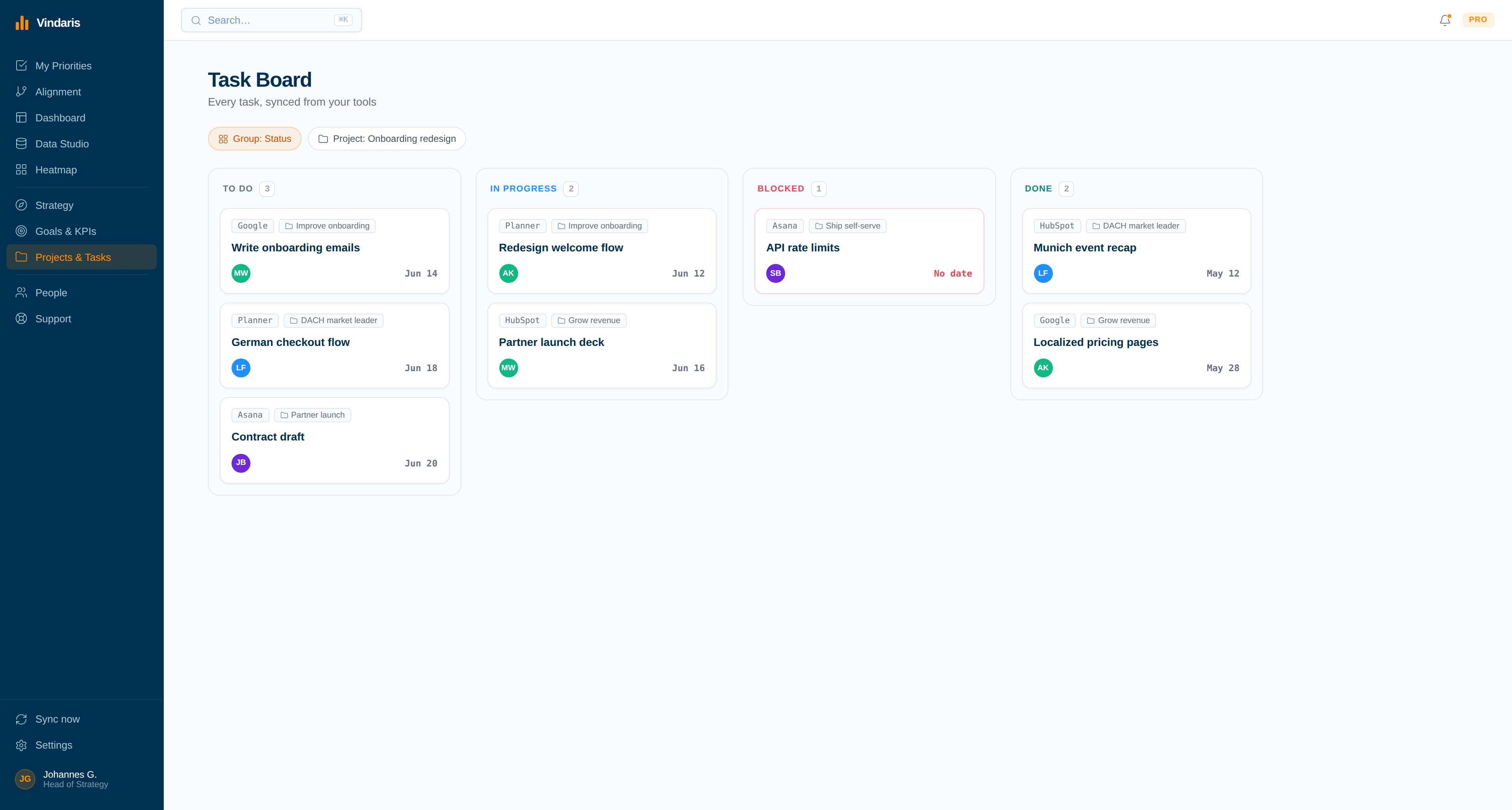
Combine tasks and projects across your systems.
Sync HubSpot, MS Planner, Google Tasks, Asana and more into one view. Bi-directional sync keeps everything current while teams stay in their own tools.
More on OKRs, KPIs, and how they fit your framework
Common questions, answered
Can you use OKRs and KPIs together?
When should I use KPIs instead of OKRs?
What is the main difference between OKRs and KPIs?
Do OKRs replace KPIs?
Why do both OKRs and KPIs fail in practice?
Free forever, including two integrations
Start free with full strategy, goal, KPI, task, and project management. Pay only when you add more than 4 people, need more integrations, or more AI summaries.
Best for individual contributors, small teams or startups. No credit card required.
- All features (incl. Alignment Canvas, My Priorities, Heatmap, Data Studio & Task Board)
- Set up 2 integrations of your choice
- Invite up to 4 additional members
- 5 ad-hoc AI risk summaries per month
Best for teams, small agencies, or departmental and team management.
- All in Free
- All integrations, unlimited sync
- Unlimited AI risk summaries & alignment suggestions - ad-hoc and scheduled
- Up to 10 users within one organization
Best for multiple teams, exec teams, Chiefs of Staff, departmental leadership or full-org deployments.
- All in Connect
- Unlimited users within one organization
- Direct human support email, 24h response time
- Human-led onboarding support
Other framework comparisons
OKRs, KPIs, or both.
Vindaris connects them to the work.
Stop debating the framework. Start connecting goals to execution.
Try Vindaris freeNo credit card | Free forever for goal management