Your OKR rollout stalled. The second attempt can stick.
Most failed OKR programs die the same way: objectives written with care, tracked in a tool nobody opens, updated by hand until people stop. The framework was fine. The architecture around it was not. Vindaris relaunches OKRs wired to the work, so they stay alive without willpower.
Free forever | No credit card required | Your team keeps their tools
Why the first rollout failed, honestly.
If several of these sound familiar, the problem was never your team's commitment.
Objectives sat in a dedicated tool or spreadsheet while the actual work ran in Jira, Asana, or Planner. Two systems, reconciled by hand, until the reconciling stopped.
Weekly updates turned into copy-pasted status and confidence scores nobody believed. Attendance faded, then the ritual did.
Time went into arguing whether a key result was 0.6 or 0.7 instead of into moving it. Grading felt arbitrary because the underlying data was.
Heavyweight OKR software demanded its own workflow. Asking teams to maintain a second system on top of their real one is a bet against human nature, and it lost.
What to do differently the second time.
Relaunch smaller, wired to the work from day one. The mechanics carry the program instead of enthusiasm. Full details on how Vindaris handles the framework are on the OKR software page.
Pick the two or three objectives that matter this quarter. Write key results you can measure from work or numbers you already track. Our OKR playbook covers the drafting, and you can use the OKR grader to check each set before you commit.
Plug in the systems where work already happens. This is the step that was missing last time: the OKRs are born connected instead of maintained by hand.
Vindaris suggests which current tasks and projects feed each key result. Teams see their real workload inside the new structure on day one.
The weekly conversation starts from what the work actually did, so it is short and honest. Scoring stops being a debate because progress is derived, not estimated.
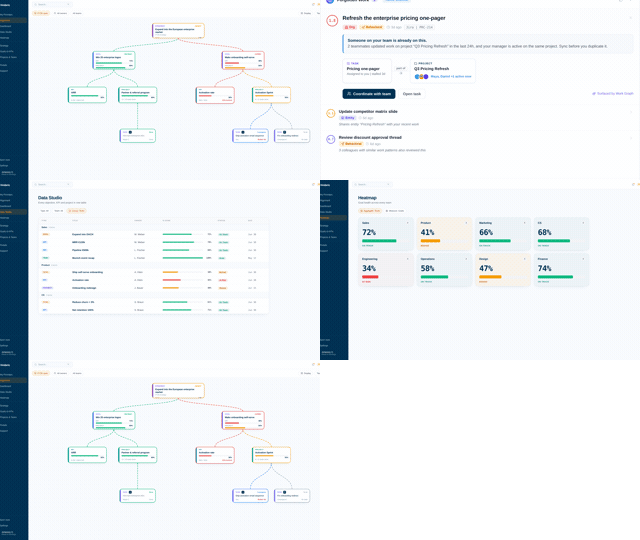
Every objective visibly connected to real work.
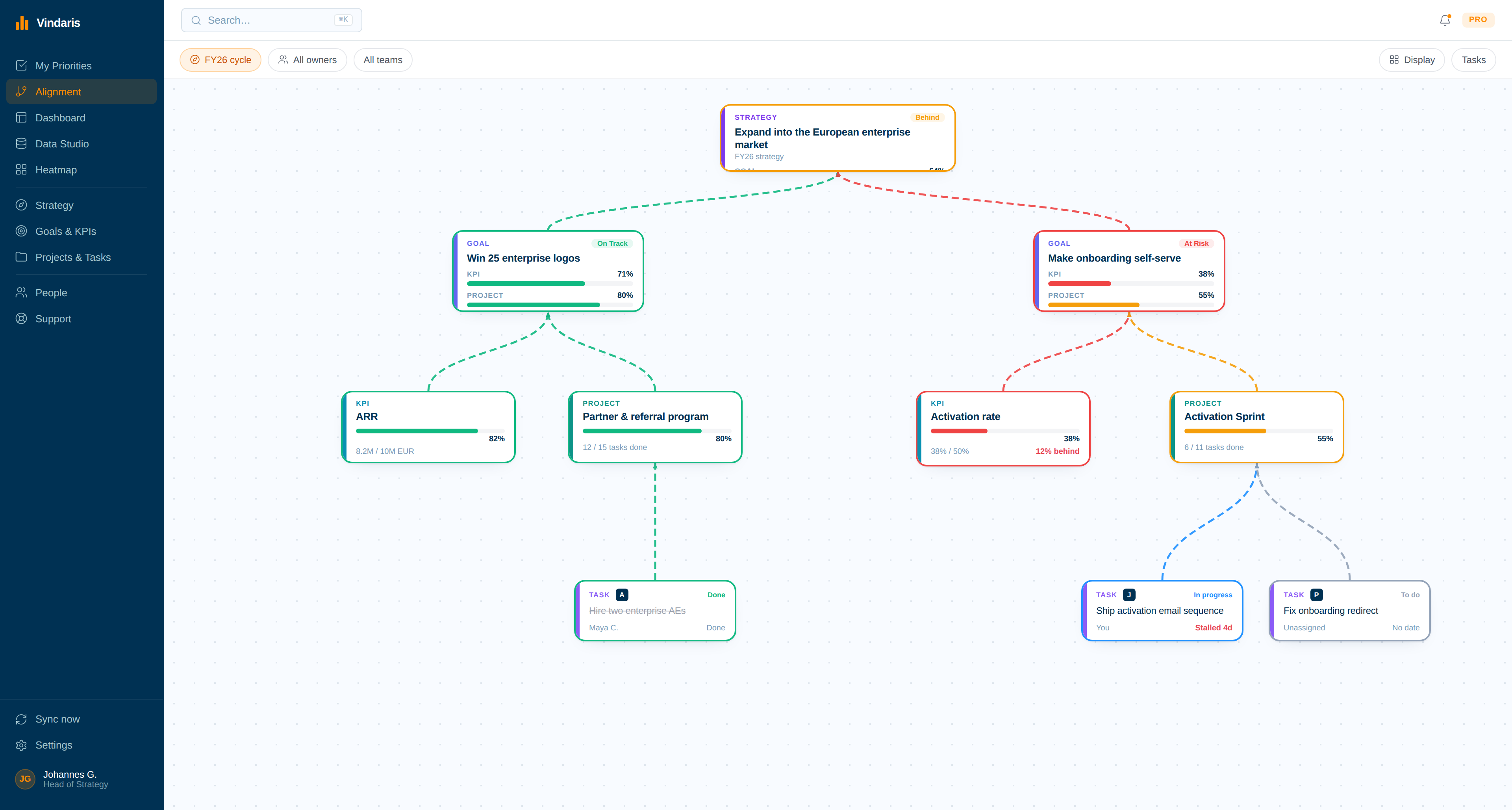
The canvas shows each objective, its key results, and the live tasks underneath. An OKR with nothing behind it is visible immediately, not at the retro.
Your team keeps their tools this time.
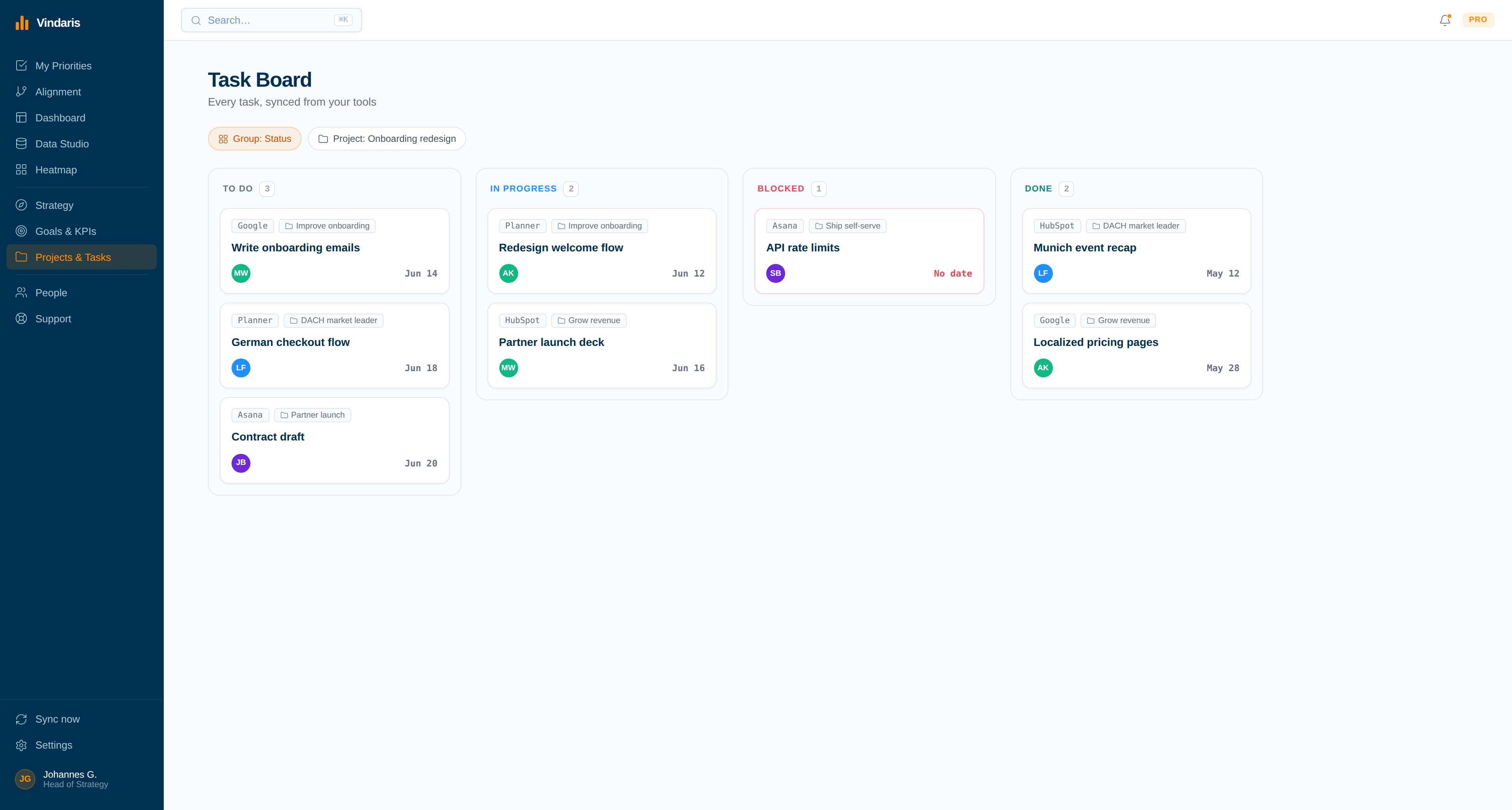
Work syncs in from Jira, Planner, Asana, HubSpot, and Google Tasks bidirectionally. Nobody maintains a second system, which is why the program survives month three.
The second system has to see everything the first one missed.
“We got everything we needed to see across Jira, Planner, and the KPIs we still track by hand, in one dashboard.”
Free resources for this problem
A template you can download, a playbook to run, and the thinking behind both. No email required.
Common questions about relaunching OKRs.
Why do most OKR rollouts fail?
The most common cause is architectural: OKRs live in a separate tracker that depends on people manually updating it, while the real work happens in other tools. The program then decays as soon as discipline dips. Culture and training matter, but a system that requires weekly manual maintenance fails even in disciplined teams.
What should we do differently in a relaunch?
Start with fewer objectives, write key results that can be measured from work or numbers you already track, and connect the work tools before kickoff rather than after. When progress derives from real work, check-ins and scoring stop depending on willpower, which is what failed last time.
We tried a dedicated OKR tool and abandoned it. How is Vindaris different?
Most OKR tools ask teams to maintain OKRs as a second workflow. Vindaris syncs bidirectionally with the tools where work already happens, so the OKR layer updates itself. The people doing the work never have to open Vindaris for the program to stay current.
How long does a relaunch take to set up?
Connecting your first tool takes about 90 seconds, and mapping existing work to a small set of objectives is typically done in an afternoon. Most teams relaunch at a quarter boundary with one or two pilot teams before widening.
Relaunch OKRs that update themselves.
Connect your first tool in 90 seconds. Free forever for goal management.
Relaunch OKRs freeNo credit card | No migration | No minimum contract