In Lattice, goals sit beside reviews. Not on top of the work.
An excellent people platform with goals attached. Goals live next to performance, not above delivery. Vindaris puts them on top of the work instead.





Last reviewed August 2026
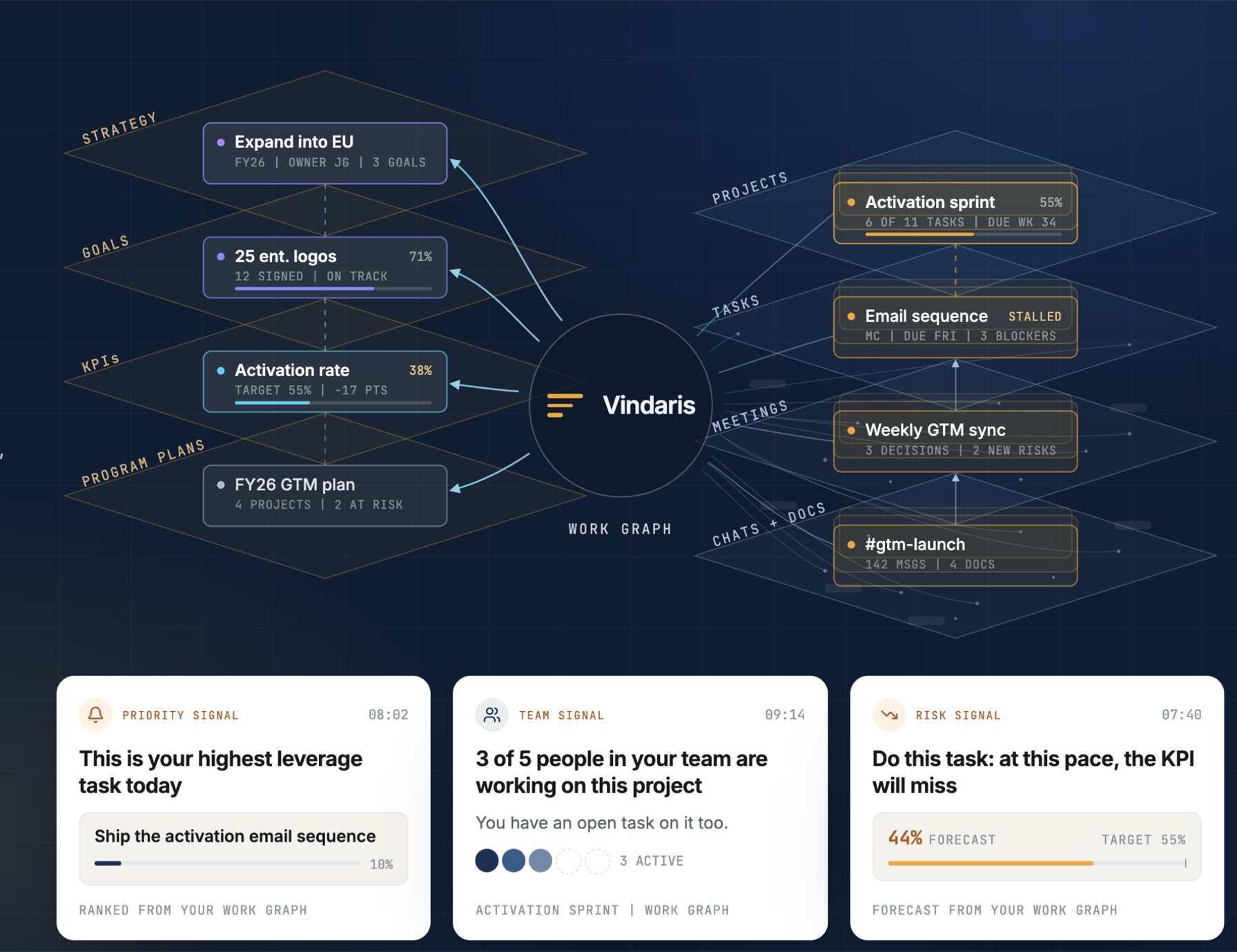
Lattice is a performance management platform: reviews, 1:1s, engagement, and growth, with goals as one HR module. Vindaris is intelligent strategy execution software: strategy, goals and KPIs mapped down to every project and task, with the Work Graph flagging execution risks before they show up in an update. Lattice answers how people are performing. Vindaris answers whether the strategy is being executed.
A people platform first. Goal execution comes second.
Lattice is one of the strongest HR platforms available: reviews, one-to-ones, engagement surveys, career frameworks, compensation. Companies buy it for people operations and get goals in the box.
Lattice does performance reviews, 1:1s, engagement surveys, and growth plans well, and goals are one module inside that suite. The module is designed for the HR cadence: employees set goals at the start of a cycle and update them around review season. That fits performance management. It does not fit running company strategy, where goals have to move every week and status has to be trustworthy between reviews.
Because goal progress in Lattice is typed by the goal owner, it is only as current as the last time someone remembered to update it - and people remember around review time. Between cycles, the operational work that actually moves a goal lives in Jira, Asana, Planner, or a spreadsheet, and Lattice never sees it. Leadership ends up reading goal status that reflects an HR ritual rather than the state of the work.
In Lattice, a goal's status is an HR-cycle input. It is captured for reviews, not derived from delivery. Between cycles it goes stale, and the gap between what the goal says and what the work is doing is invisible until the next review surfaces it - usually too late to act.
What teams consistently praised
- Excellent performance, engagement and people tooling.
- Goals connected to reviews and career conversations.
- Strong manager enablement and one-to-one flows.
- Well-adopted by HR teams across mid-size companies.
Where teams hit the limit
- Goals are an HR module rather than an execution system.
- Progress is updated around the review cycle.
- No representation of the delivery work underneath.
- Execution reporting is thin for operators.
A people platform is the wrong place for execution.
- Goals live beside performance reviews, not above delivery.
- Progress is updated around the review cycle.
- Integrations serve HR systems more than delivery tools.
- Dashboards show what people reported, which is not what happened.
- Operators get a thin execution view.
- Goals live on the work, not in a module beside the review cycle.
- Progress updates continuously instead of around review season.
- Execution risk is flagged from task movement, weeks before a review.
- Keep Lattice for performance; run strategy execution where it can be traced.
- Any framework, including KPIs and Rocks that an HR goals module cannot hold.
Lattice models the person. It does not model the work.
Lattice's objects orbit the performance process: the review, the cycle, the competency, the 1-on-1. Goals are one more object in that orbit, which sets their update rhythm to the cycle rather than to the work.
| Object | Lattice | Vindaris |
|---|---|---|
| Central object | The review cycle and the employee record | The goal graph and the work beneath it |
| Goal update cadence | Around review season, by the goal owner | Continuous, from connected task state |
| Goal types | Objectives within the goals module | OKRs, KPIs, EOS Rocks, OGSM, SMART, Balanced Scorecard |
| Connection to delivery | None. Delivery lives in tools Lattice does not read | Bidirectional sync with Jira, Asana, Planner, HubSpot, Google |
| Risk detection | Not modelled | Pace, focus and capacity measured against plan |
Between review cycles a Lattice goal holds whatever value it was last given, which can be months old by the time anyone looks. That is acceptable for a development goal, where the review is the point. It is not acceptable for a company KPI, where the months between reviews are exactly when the miss becomes unavoidable.
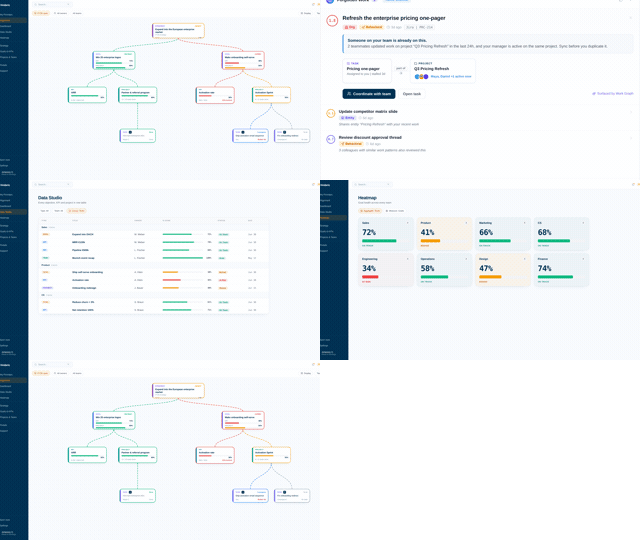
Five views that keep strategy and execution in sync.
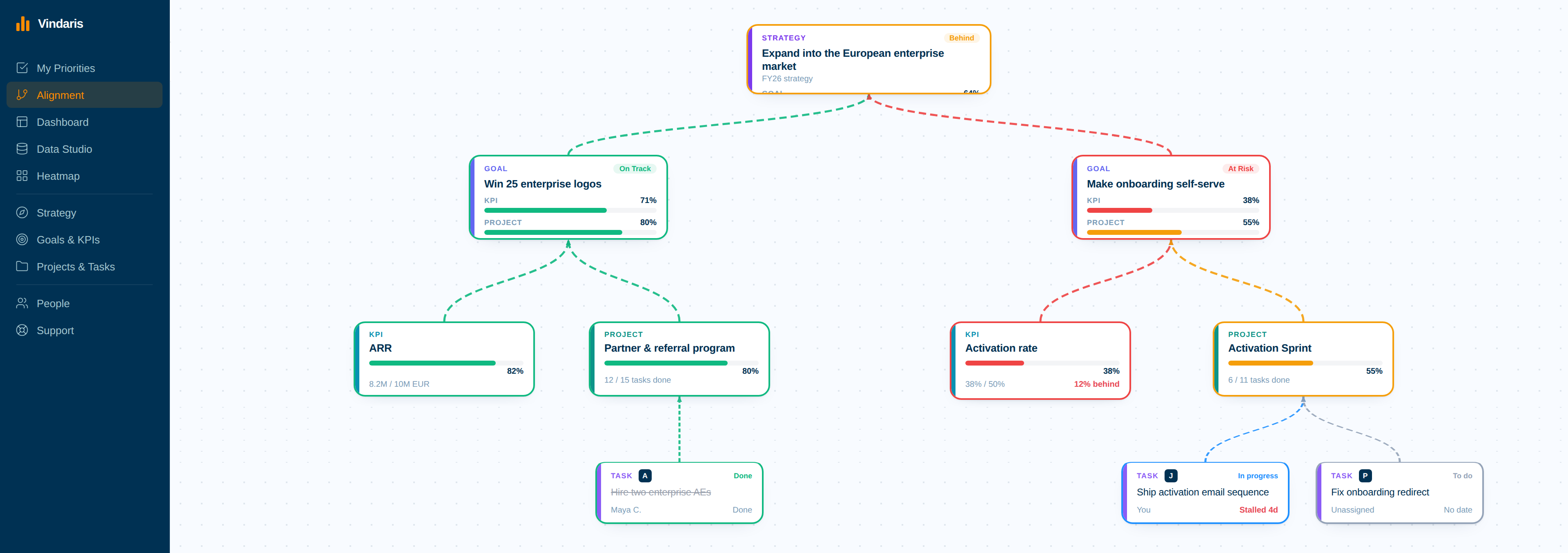
See every goal connected to the work moving it.
Drag and drop your alignment structure. Roll up work progress, KPIs and goals without enforcing any framework syntax.
Alignment Canvas →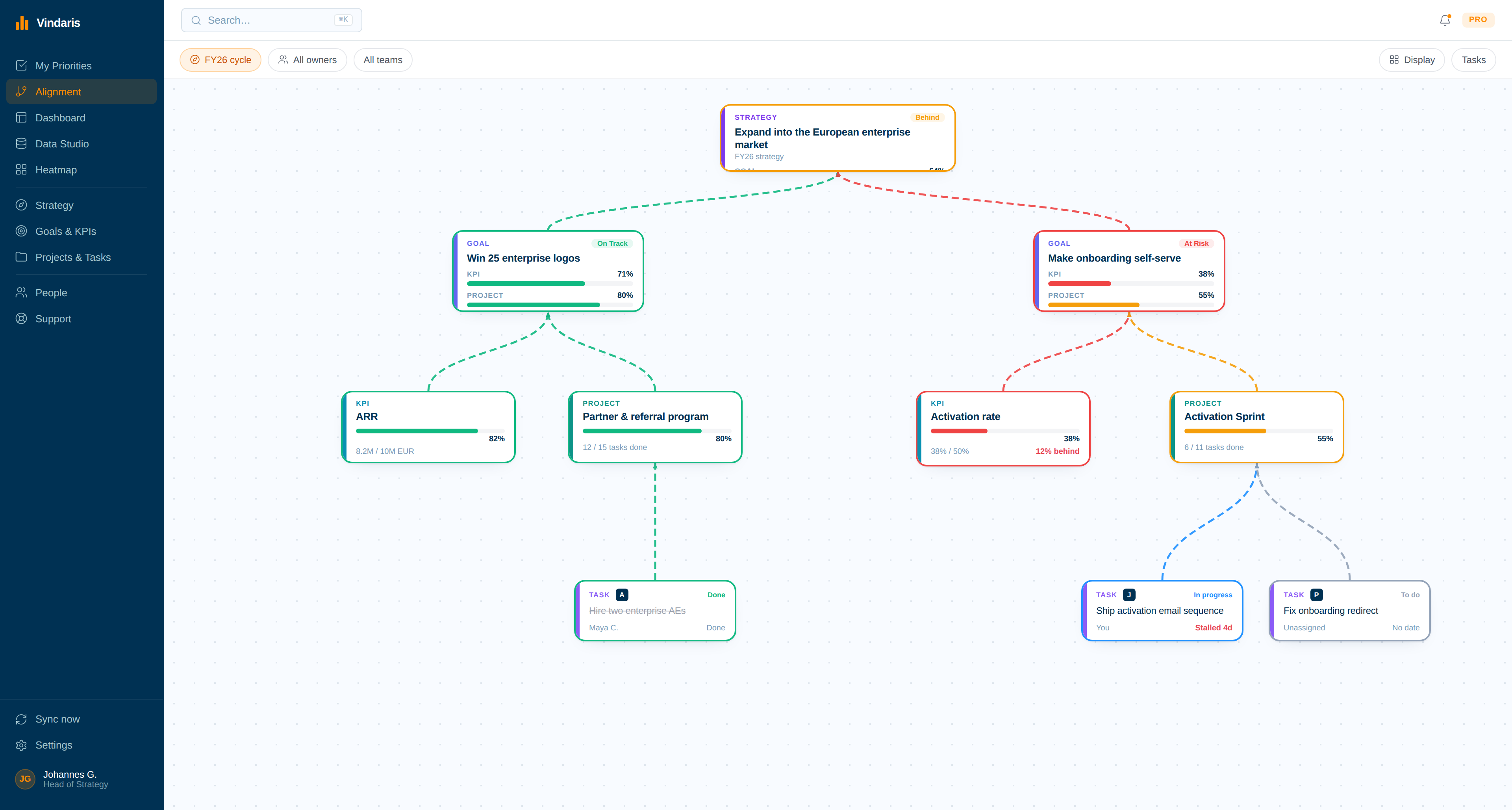
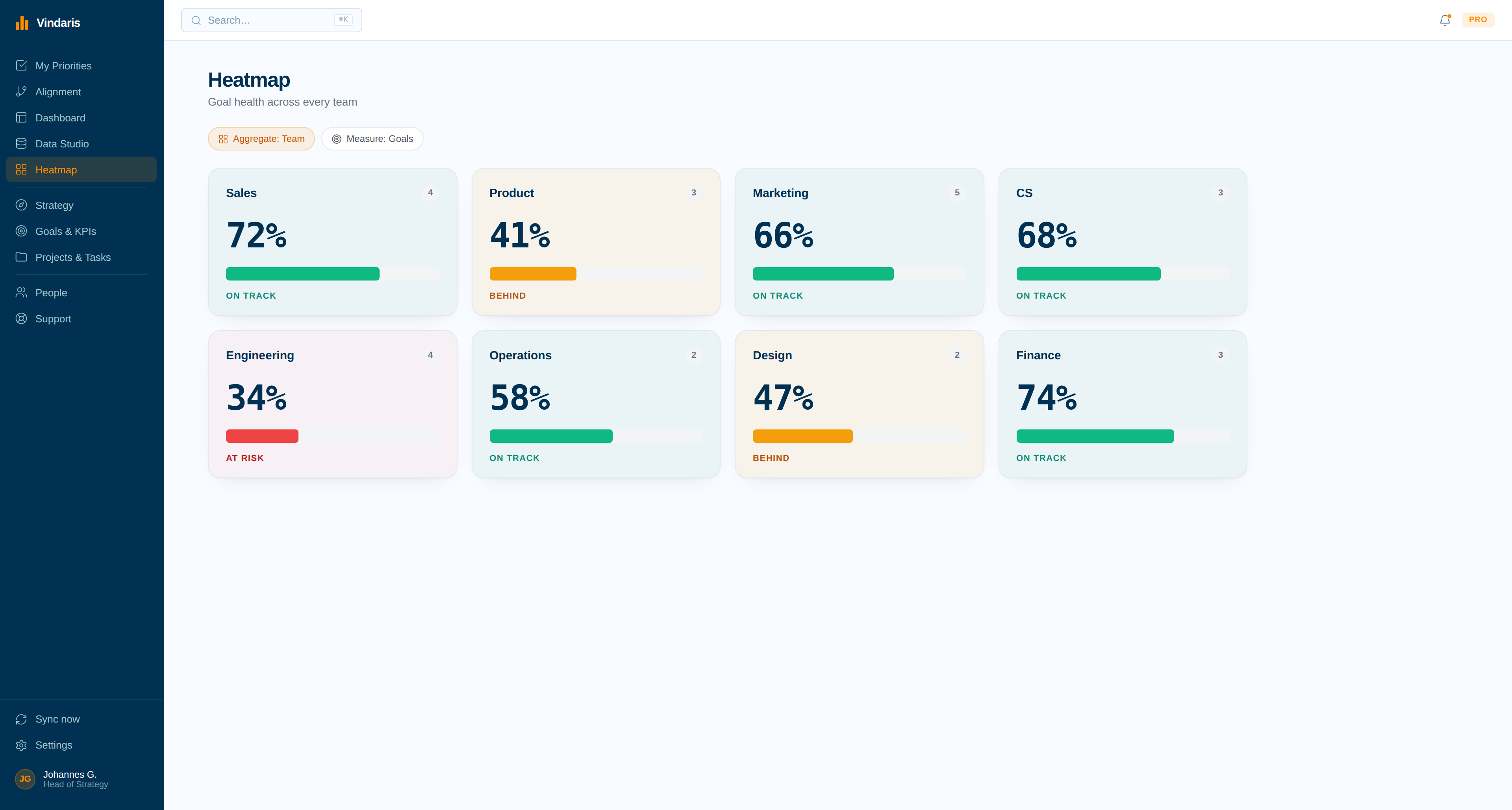
Spot risk while there is still time to fix it.
Run heatmaps across teams, goals, KPIs and projects. Save views and get notified when risk levels change, from task movement rather than a reported number.
Combine tasks and projects across your systems.
Sync HubSpot, MS Planner, Google Tasks, Asana and more into one view. Bidirectional sync keeps everything current while teams stay in their own tools.
All integrations →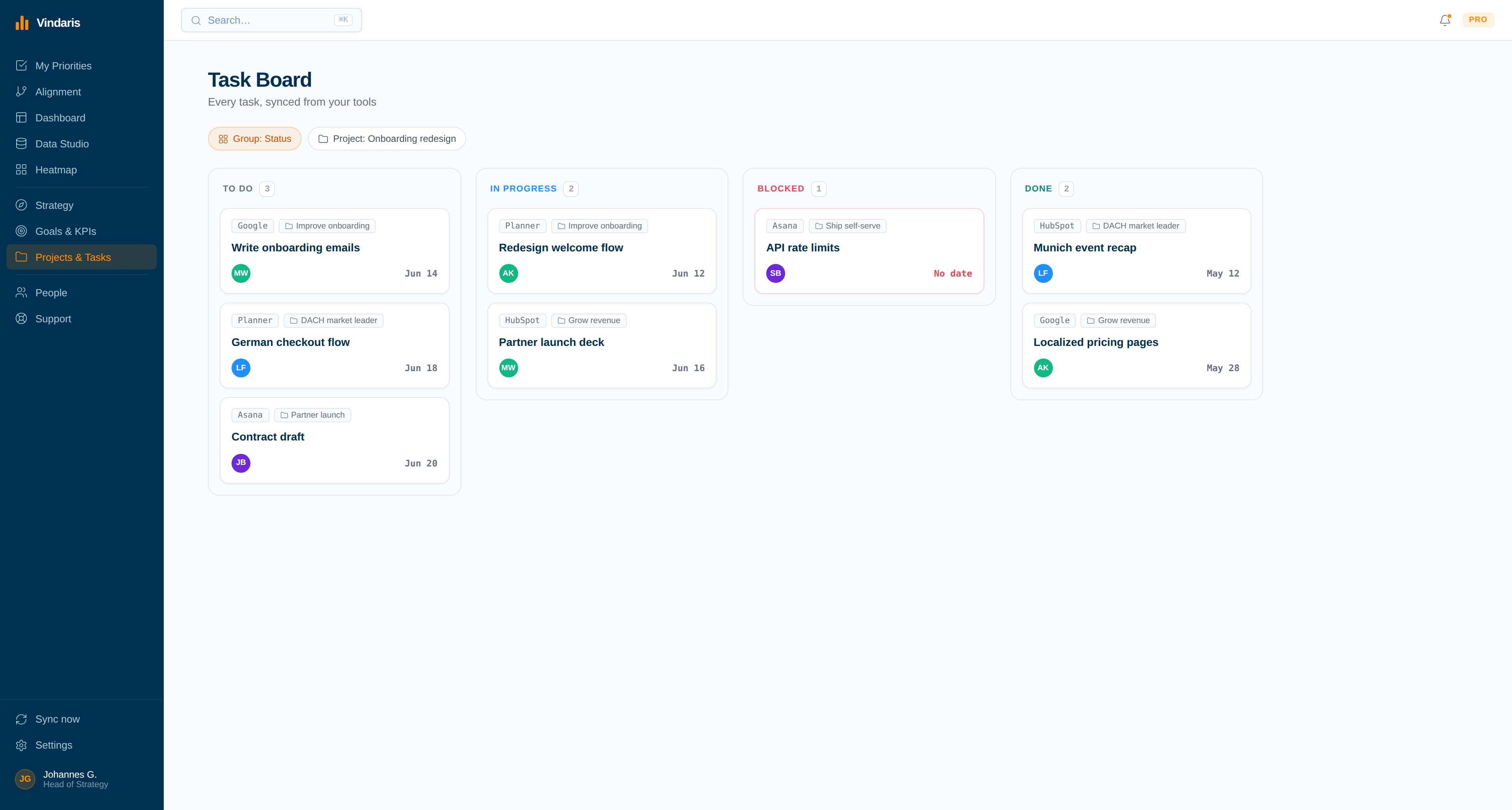
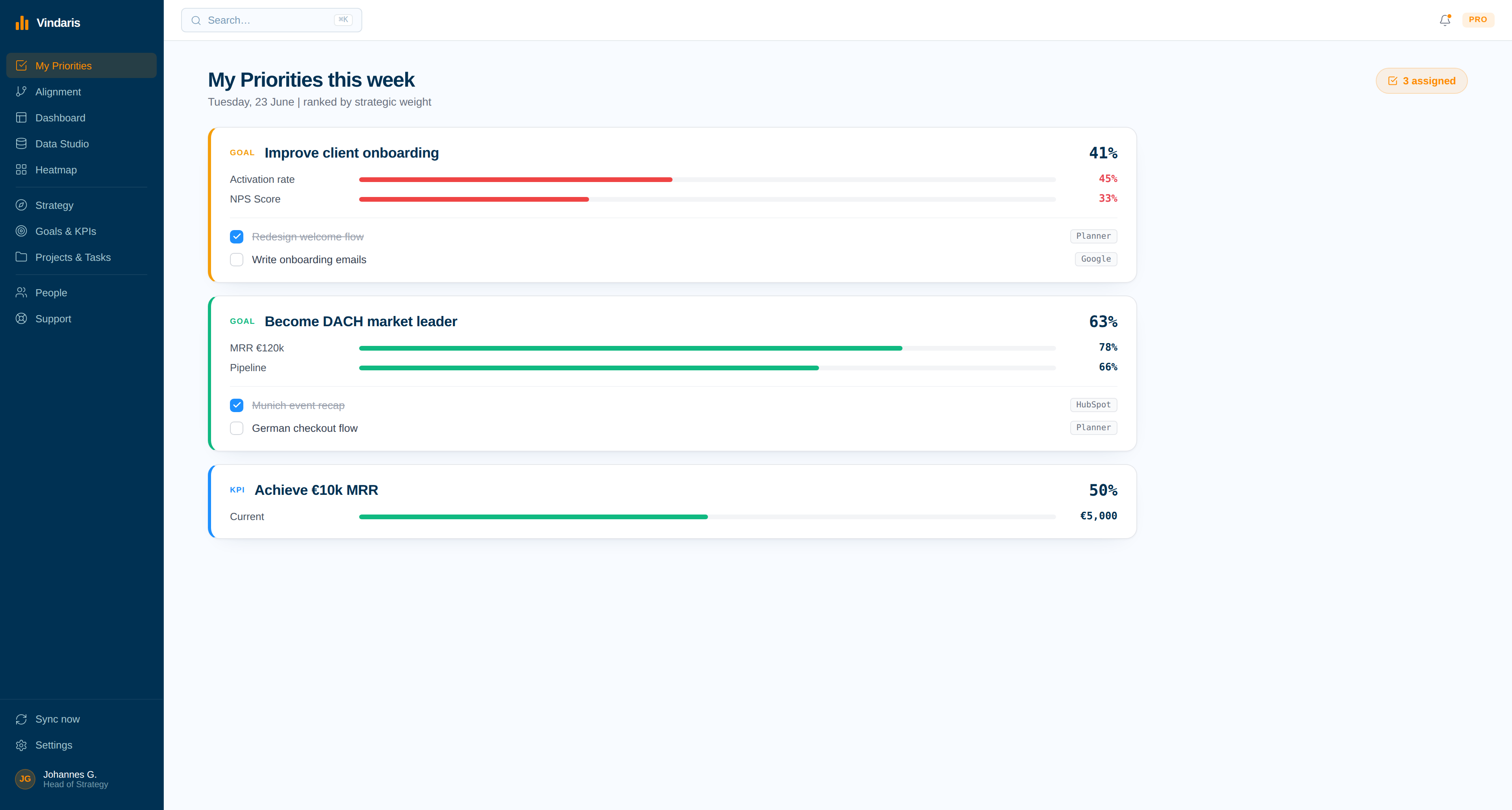
Everyone knows exactly what matters most.
A clear view of each person's goals, KPIs, projects and tasks. Start the week focused on what is due.
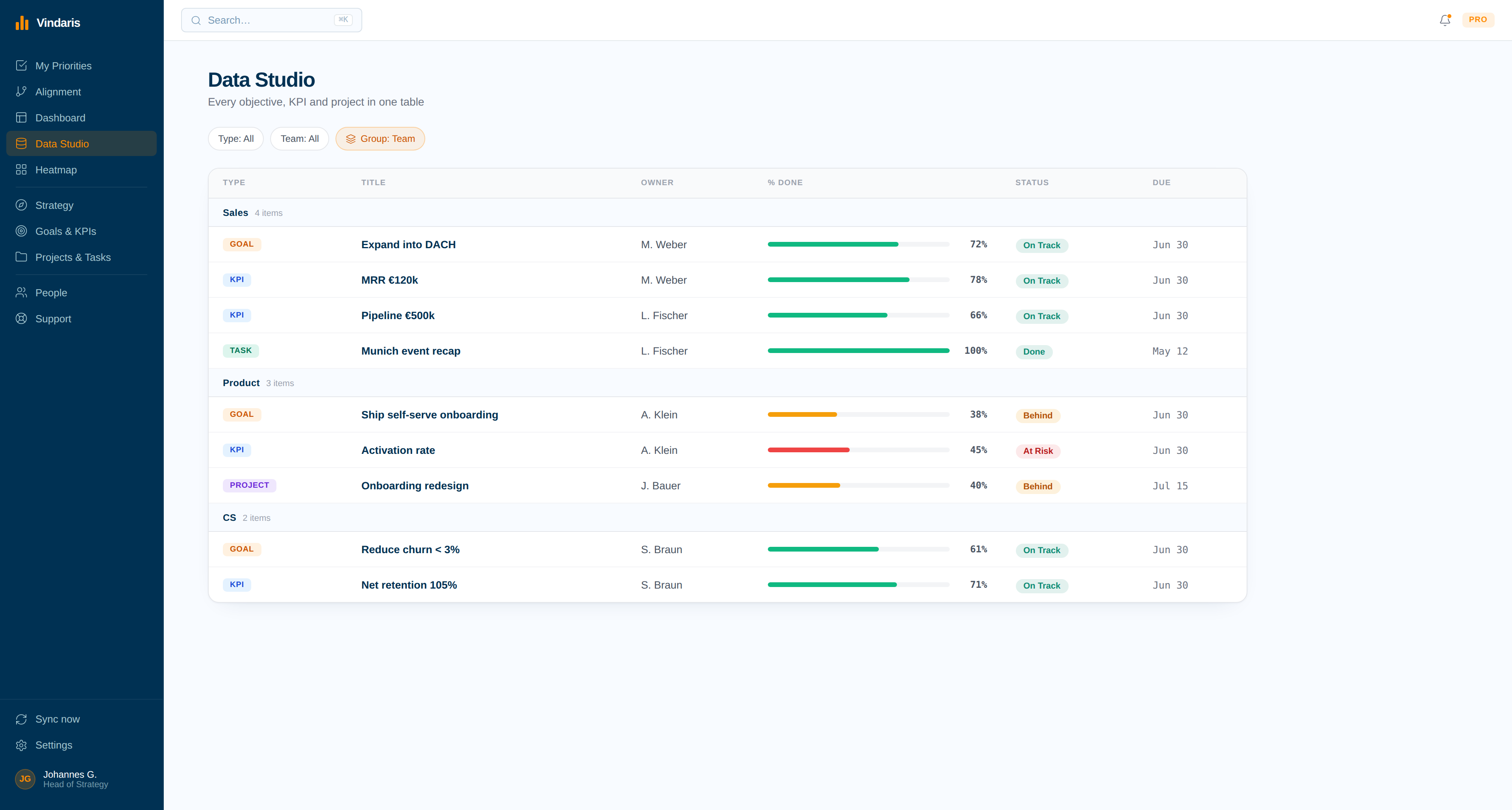
Run reports the way management needs them.
Rank teams, spot risks, compare KPIs to work. AI summaries push updates to Slack, Teams and email.
Keep the people platform. Move execution out of it.
Lattice is a strong performance platform and Vindaris does not replace it. What moves out is the set of goals that were never really development goals.
This is the step that does the work. Growth and competency goals belong in Lattice next to the review. Company objectives, KPIs and cross-team initiatives do not, and they are the ones going stale between cycles. Split the list before exporting anything.
Lattice exports goals with owners, targets and current values. Bring the company half in as-is; the OKR structure carries over and owners map to Vindaris users.
Connect Jira, Asana, Planner, HubSpot or Google. This closes the gap that made the goals module feel like paperwork, because the work moving each objective becomes visible from inside the objective.
When review season comes round, the company-goal half no longer needs a data-gathering exercise beforehand. Progress has been current all quarter, so the conversation starts from what happened rather than from what people can reconstruct.
Free forever for up to 5 people. No credit card required.
Start free Book a demo No credit card requiredVindaris vs Lattice, feature by feature.
Lattice wins on people operations. This table compares what each product knows about the work beneath the goal.
| Feature | Vindaris | Lattice |
|---|---|---|
| How progress is measured | Read from task-level work and Slack context in the tools your team already uses. | Manual entry by goal owner, typically updated around review cycles. |
| Goal frameworks supported | Framework-agnostic: OKR, KPI, EOS Rocks, OGSM, SMART, Balanced Scorecard, or hybrid. | OKRs within the goals module; no KPI, OGSM, or hybrid support. |
| Connection to real work | Native work layer with bidirectional sync to HubSpot, Planner, Google, Jira, Asana. | No native work layer; goals live in an HR module separate from delivery tools. |
| Risk detection | Automatic execution-risk flags from task movement, focus and pace against plan. | No automatic detection; depends on the owner updating status before a review. |
| Status reporting | Live views and AI risk summaries pushed to Slack, Teams, and email. | Performance review dashboards; goal progress is one input among many. |
| Capacity and bandwidth | Built-in bandwidth and capacity planning. | Not covered in the goals module. |
| Ownership model | Single-owner accountability enforced structurally. | Goal owner tied to the employee record. |
| Free plan | Free forever, including 2 integrations and up to 5 people. | No free tier; pricing is per-seat, typically bundled with HR modules. |
| Best fit | Teams that need execution status from real work, not review-cycle updates. | Companies that want goals as part of a performance review suite. |
The category as a whole is compared in the best strategy execution software guide, and the argument underneath it is set out in the strategy execution gap whitepaper.
Priced per employee, or priced for the people running execution.
Lattice prices per employee across the HR suite, typically with goals bundled into a performance package. You are buying headcount coverage, not execution coverage.
| Plan | Lattice | Vindaris |
|---|---|---|
| Free tier | No free tier. | Free forever. Up to 5 people, 2 integrations, all core features. |
| Entry paid plan | Per-employee monthly pricing, bundled with performance and engagement modules. | Connect, EUR 10 per user per month. All integrations, unlimited sync. |
| Upper plan | Add-on modules for engagement, compensation and analytics. | Pro, EUR 20 per user per month. Unlimited users in one organization. |
| Published pricing | Entry rates published; real configurations quoted. | Yes, on the website. No quote required to evaluate. |
| Minimum commitment | Annual, across the full employee base. | None. No seat minimum, no annual term, no setup fee. |
Vindaris is free forever for up to 5 people with 2 integrations, then EUR 10 per user per month, and it is bought by the teams that own execution rather than by HR for everyone.
Best for individual contributors, small teams or startups. No credit card required.
- All features (incl. Alignment Canvas, My Priorities, Heatmap, Data Studio & Task Board)
- Set up 2 integrations of your choice
- Invite up to 4 additional members
- 5 ad-hoc AI risk summaries per month
Best for teams, small agencies, or departmental and team management.
- All in Free
- All integrations, unlimited sync
- Unlimited AI risk summaries & alignment suggestions - ad-hoc and scheduled
- Up to 10 users within one organization
Best for multiple teams, exec teams, Chiefs of Staff, departmental leadership or full-org deployments.
- All in Connect
- Unlimited users within one organization
- Direct human support email, 24h response time
- Human-led onboarding support
Common questions, answered
What is the difference between Lattice and Vindaris?
Can Vindaris replace Lattice?
Why are goals in Lattice disconnected from real work?
Can I migrate from Lattice to Vindaris?
Free resources for this topic
A template you can download, a playbook to run, and the thinking behind both. No email required.
Or start with the full picture: strategy execution software that connects your plan to the work delivering it.
Moving execution out of Lattice is a choice. Repeating its architecture is optional.
Free forever for up to 5 people. No credit card required.