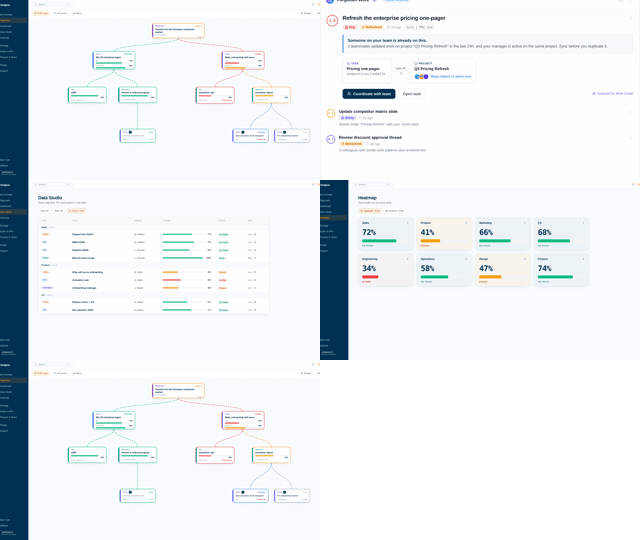
Status reporting eats your week. Automate it out of it.
Someone chases updates. Someone reformats them for leadership. By the time the deck is presented, the numbers are a week old. Vindaris derives status from the real work in your tools and delivers it where people already read, with nobody spending Thursday assembling it.
Free forever | No credit card required | Your team keeps their tools
Where the reporting hours actually go.
Most online status reporting tools take the last step off your hands, the formatting. The hours were already gone by then.
Updates live in five tools and ten heads. Every report starts with someone messaging owners for numbers and waiting.
By the time updates are collected, reconciled, and formatted, they describe last week. Decisions get made on old data or postponed for fresher data that never comes.
The hours spent assembling status are the same hours that could have gone into fixing what the status revealed. The better your reporting discipline, the less time you have to act on it.
From assembling the report to reading it.
Vindaris turns reporting from a weekly production into a byproduct of work your team already does, inside the same strategy execution management layer that connects goals to delivery.
Plug in HubSpot, Microsoft Planner, Google Tasks, or Asana. The tasks and projects behind every goal sync in automatically. See the full list of integrations.
Confirm which work feeds which goal on the same canvas your strategy execution runs on. From then on progress is derived from the work itself, rather than from anyone's memory of it.
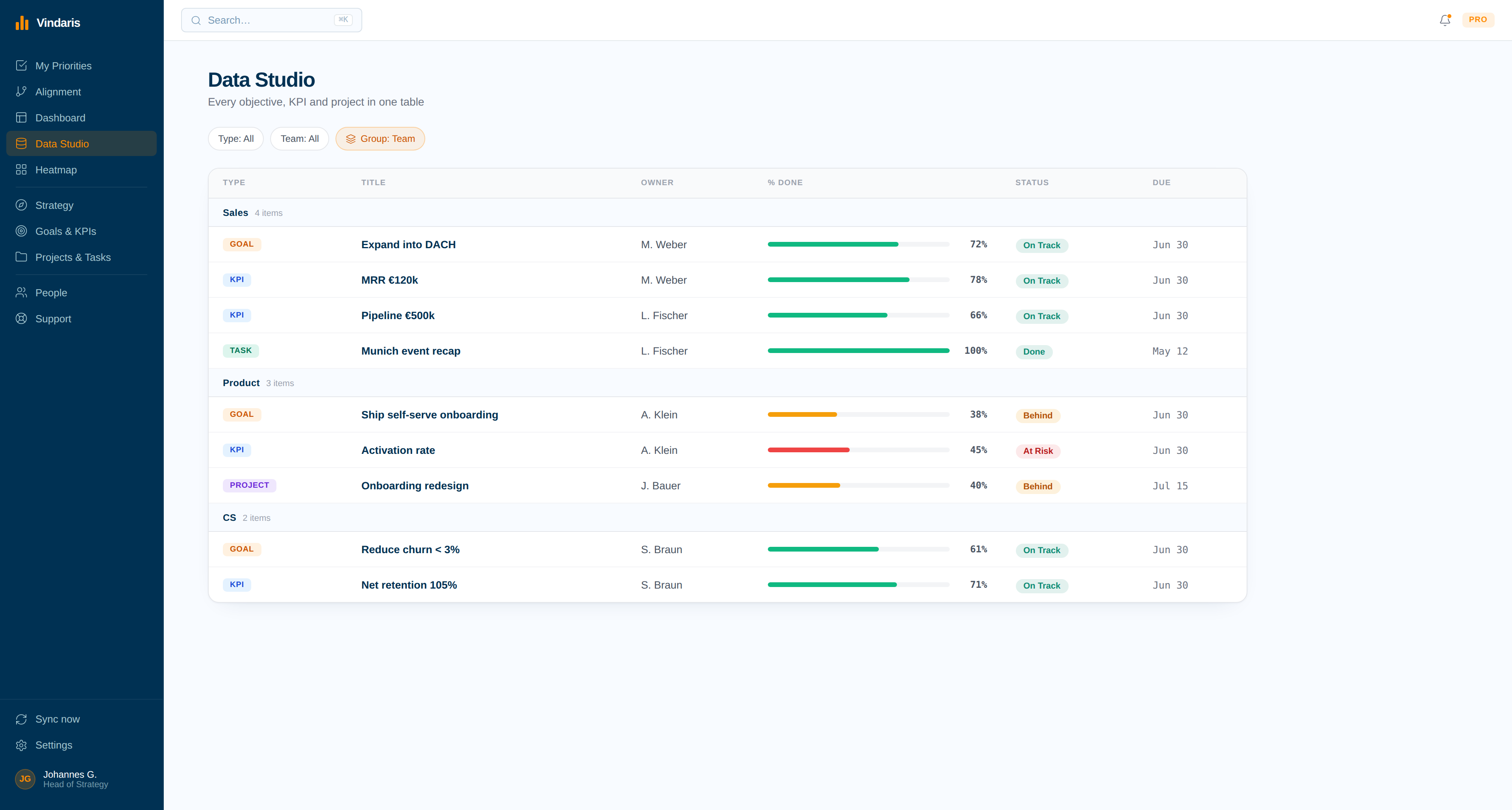
Assemble the view leadership wants from live goal and work data. It updates itself; there is no version 14_final_v2.
AI summaries push to Slack, Teams, or email on your cadence. Stakeholders stay current without logging in, and without asking you.
The leadership report that builds itself.
Reports assemble from real goal and work data, so the Monday summary reflects Friday's reality. What used to take an afternoon takes zero.
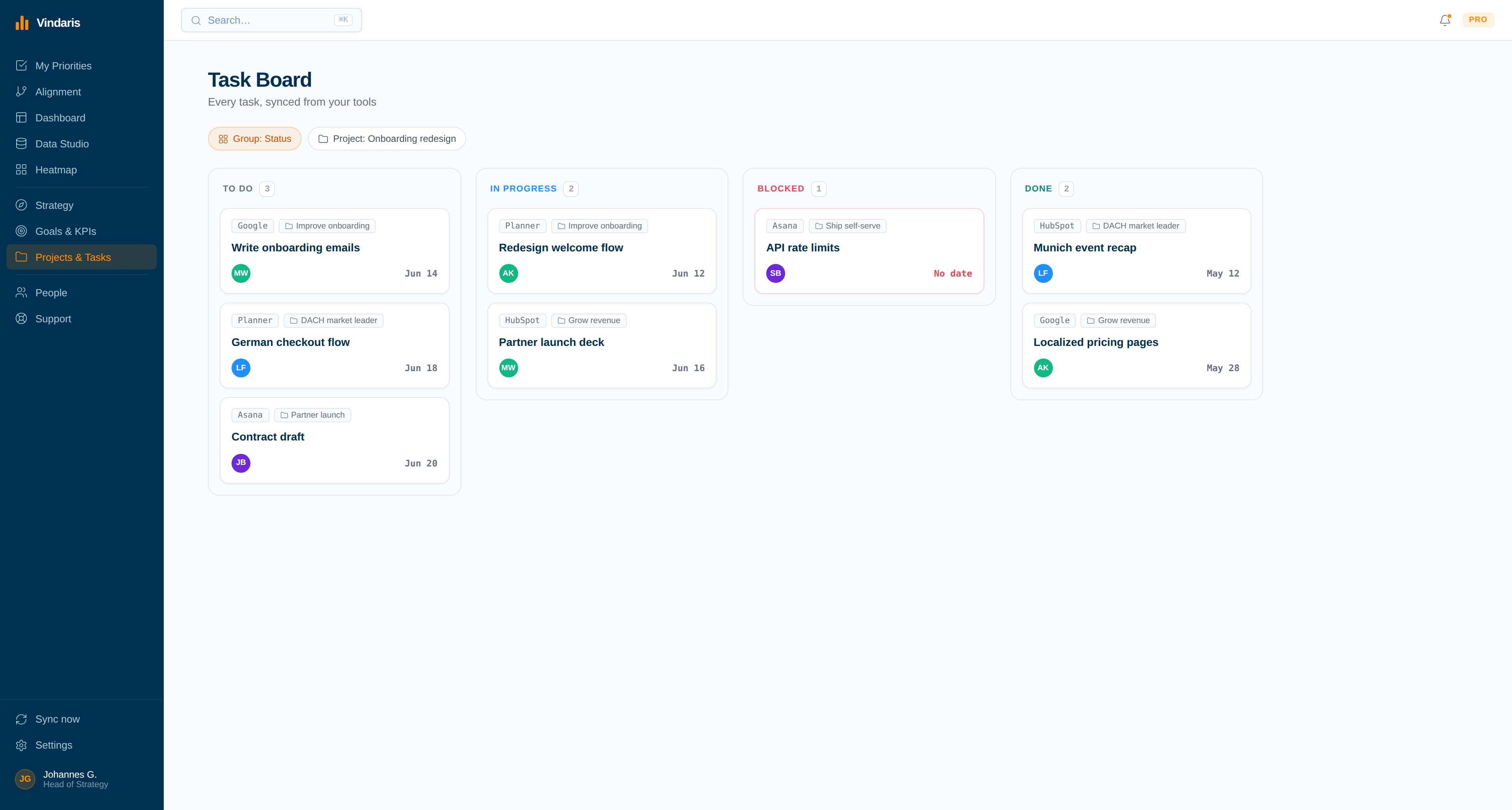
One view across every tool you sync.
Work from Planner, Asana, HubSpot, and Google Tasks lands in one board, already mapped to goals. The reconciliation step of reporting simply disappears.
Reporting became a byproduct, not a job.
“Reports build themselves now, and the Work Graph told us something our CRM reports never would have: which step separated our best reps from the rest.”
Free resources for this problem
A template you can download, a playbook to run, and the thinking behind both. No email required.
Common questions about automating status reporting.
How does Vindaris automate status reporting?
Work from your connected tools syncs into Vindaris and maps to goals and KPIs. Progress is derived from that work as it moves, Data Studio assembles it into live reports, and AI summaries push to Slack, Teams, or email on the cadence you choose. The collecting, reconciling, and formatting steps are removed rather than sped up.
Can stakeholders get updates without logging in?
Yes. Summaries are delivered into Slack, Teams, or email, so leadership and stakeholders stay current inside the tools they already read. Vindaris is designed so that the people consuming status never need to open it.
What if some KPIs are still tracked by hand?
You can keep manual KPIs alongside synced work. Teams typically automate the task and project side first and log a handful of hand-tracked KPIs in their weekly check-in, all of which flow into the same reports.
Does automated reporting replace review meetings?
It replaces the status-collection part of them. The meeting itself gets shorter and more useful, because everyone arrives with the same live picture and the time goes into decisions. See how this fits the broader goal tracking picture, and use our QBR and MBR templates to restructure the meeting around it.
What separates online status reporting tools from each other?
Where the numbers come from. Most tools give you a place to write status and a template to format it, so someone still gathers the updates first. A smaller group derives status from the work already happening in your delivery tools, which is the difference between a reporting surface and a reporting system. The status laundry problem is what the first group leaves in place, and better business reviews covers the meeting that sits on top of it.
Get your Thursdays back. Let the report build itself.
Connect your first tool in 90 seconds. Free forever for goal management.
Automate your reporting freeNo credit card | No migration | No minimum contract