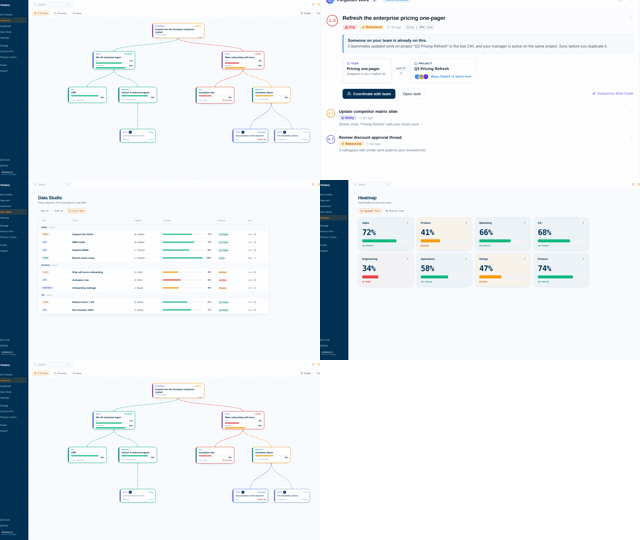
OKR software that surfaces the hidden task needed to move your Key Results today.
Vindaris maps every Objective and Key Result down to the tasks delivering them in Jira, Asana, Planner and Slack. It then reads what is happening beneath each one: work that stalled, effort going into work no Objective asked for, Key Results with nothing under them, and check-ins that lapsed. That reading is what puts one task at the top of each person's day.
Down to the individual task and the Slack thread around it, so the task it surfaces is the one the Key Result is genuinely waiting on.





What is OKR software?
OKR software stores Objectives and Key Results, tracks progress against them, and shows how they align across teams. The category has converged on that definition, which is why most products in it differ on interface rather than on architecture. What separates them in practice is where the progress number comes from.
How is OKR software different from a spreadsheet?
A spreadsheet holds the same objectives perfectly well. What it cannot do is roll progress up across teams without someone maintaining the formulas, or tell you that a key result stopped moving. Most teams move off spreadsheets when the maintenance cost of the sheet exceeds the value of the reporting, which is usually around fifty people.
Do OKRs need to cascade?
Not structurally. Cascading is a convention, and a strict cascade tends to produce objectives that exist to justify the level above them. Vindaris supports a full cascade from company to contributor and equally supports a flat set, because one key result can serve two objectives without being duplicated.
How often should key results be updated?
Ideally never by hand. A key result updated weekly is accurate for a few hours after the update and drifts for the rest of the week. When progress is derived from the tasks feeding it, the question stops applying, which is the argument set out in the strategy execution gap whitepaper.
Can OKRs run alongside KPIs and EOS Rocks?
Yes, and most companies above a hundred people end up needing exactly that. Product teams want OKRs, operations tracks KPIs, and the leadership group may run Rocks. Vindaris treats the framework as a syntax choice over one goal structure, so all three coexist without translation.
 Click thru live demo
Pre-built workspace. No signup.
Click thru live demo
Pre-built workspace. No signup.
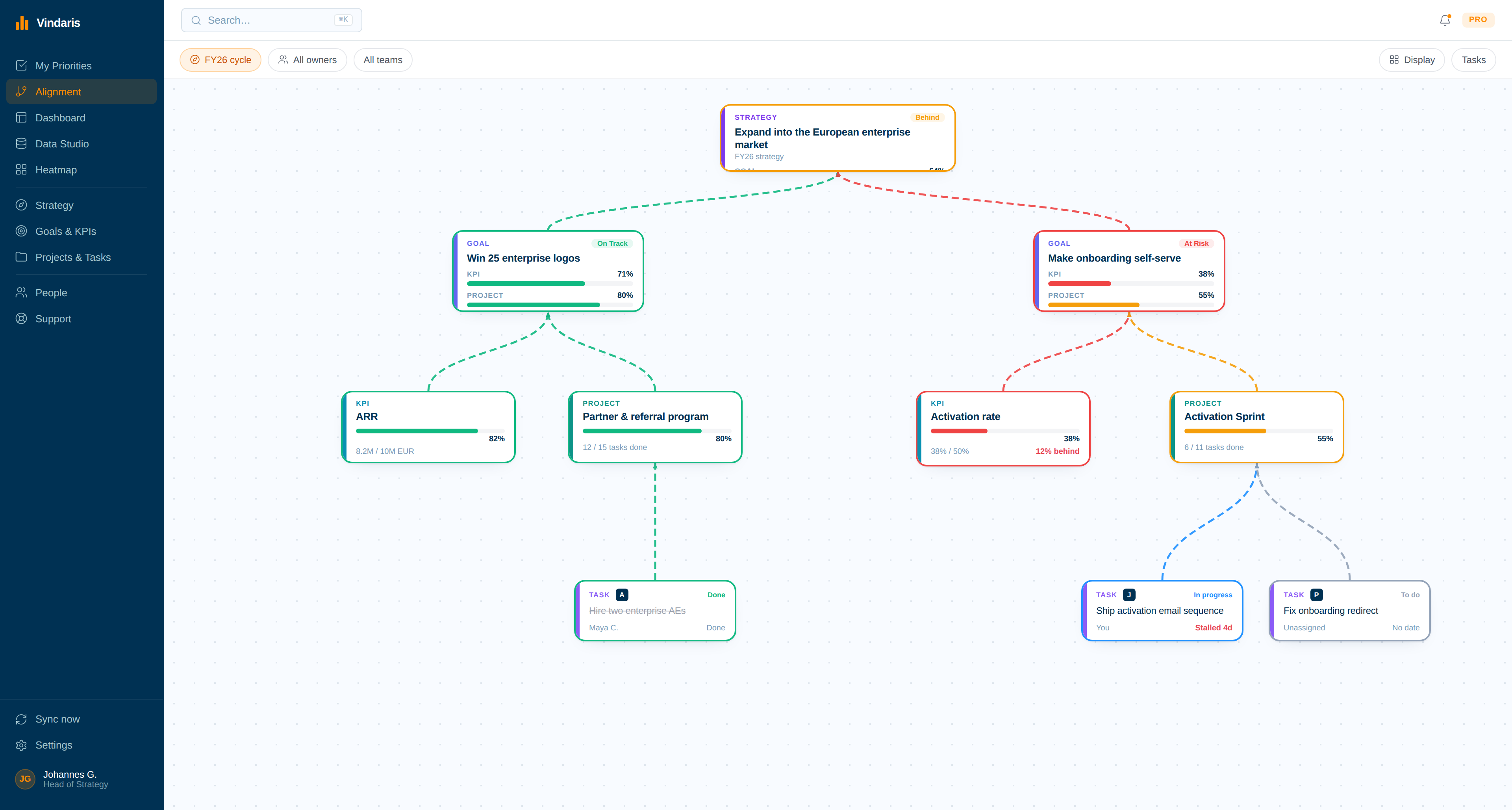
The whole cascade on one board: Objectives at the top, Key Results beneath them, and the projects and synced tasks doing the delivering. Click through the live workspace, no signup.
Grade the OKRs you already wrote.
OKRs rarely fail at the quarterly grading. They fail in the weeks between, when nobody notices the work behind a Key Result has gone quiet.
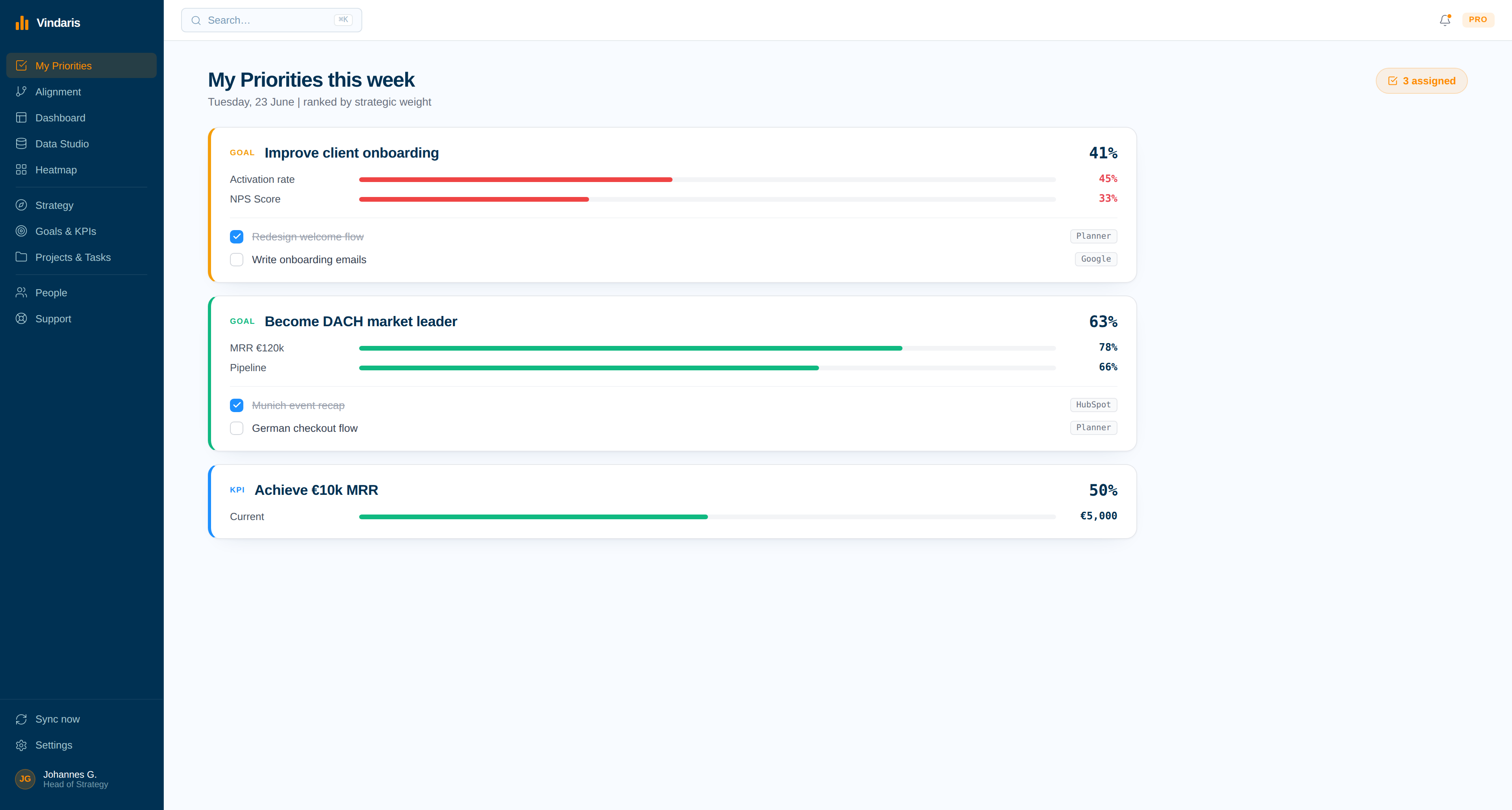
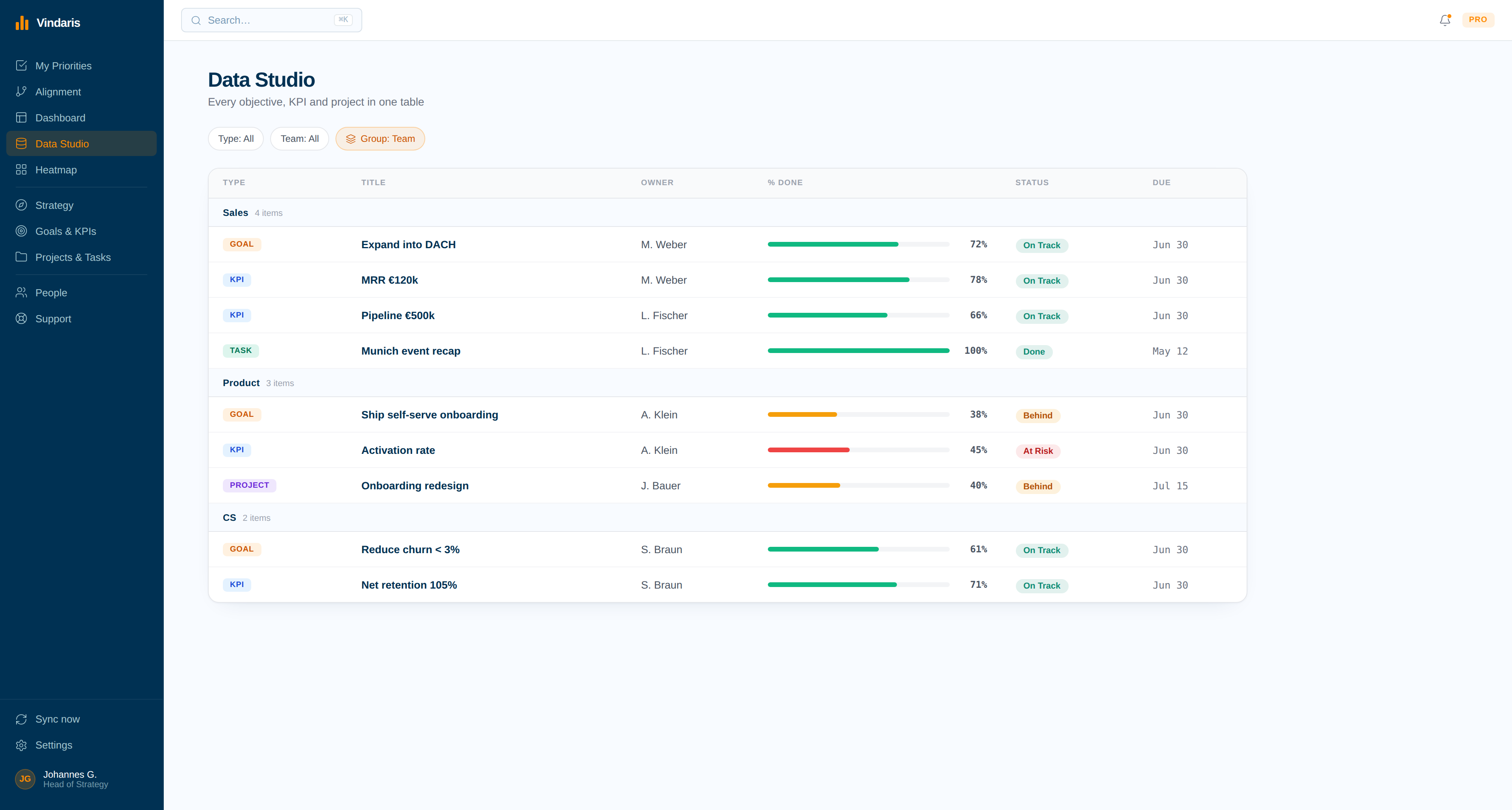
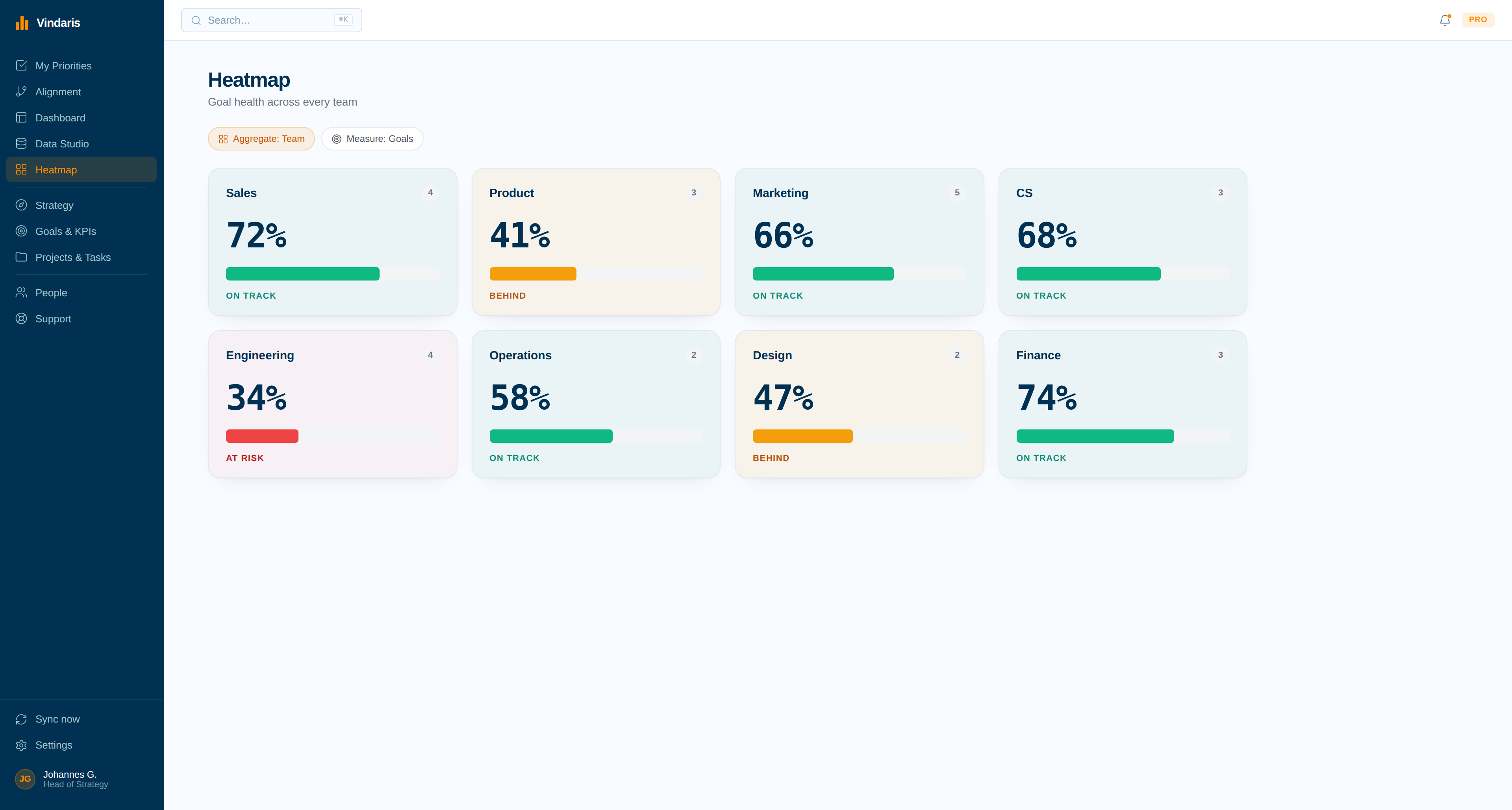
One connected system, from the Objective down to a single task.
Objectives and the work delivering them do not live in separate tools that someone reconciles every Friday. In Vindaris they share one model, so a closed ticket moves the Key Result above it without anyone touching the Key Result.
Objectives and work in one graph
Objectives, Key Results, projects and tasks connect on an open canvas with no enforced goal syntax. Cascade from company level to a single contributor, or keep it flat.
One name against each Key Result
Shared Key Results are where OKR programmes quietly fail: when three people own a number, nobody answers for it. Vindaris enforces one owner and tracks contributors separately, so accountability survives the quarter.
Work stays where it lives
Connect HubSpot, Jira, Planner, Asana and Google Tasks, then hang them under a Key Result. Sync runs both directions, so engineering keeps Jira and the Objective still knows what closed.
Define your Objectives and Key Results
Write your OKRs in the strategy narrative or build them directly on the Alignment Canvas. Cascade from company level down to teams and individuals. The structure is yours to define.
- No enforced hierarchy. One Key Result can serve two Objectives.
- Rename every level to match the language your company already uses.
Connect the tools your Key Results are delivered in
Plug in HubSpot, Microsoft Planner, Google Tasks, Asana or Jira. The tasks that move a Key Result arrive with their owners attached, so the OKR knows who is behind it as well as how far along it is.
- A task closed in Jira closes in Vindaris, and back again.
- Every synced task keeps a tag pointing at its source tool, so a Key Result can always be audited back.
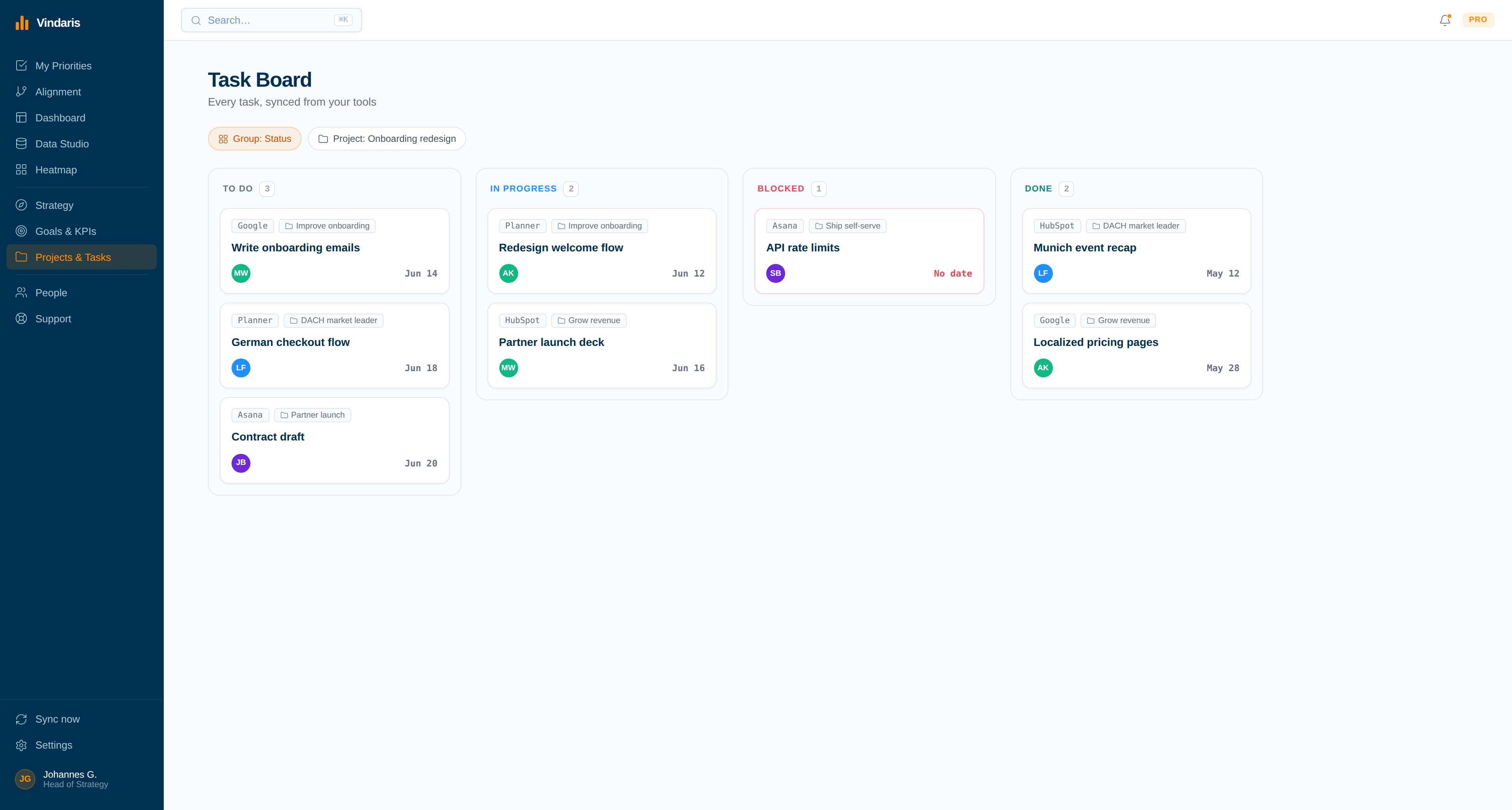
Map tasks to Key Results
Vindaris suggests which tasks and projects connect to each Key Result based on labels, owners and structure. Confirm the mapping, adjust what it got wrong, and every contributor gets a ranked list of what actually moves their numbers.
- Suggestions come from the work, not from a naming convention.
- Everyone sees their own slice ranked by what it affects upstream.
Get alerted when Key Results are at risk
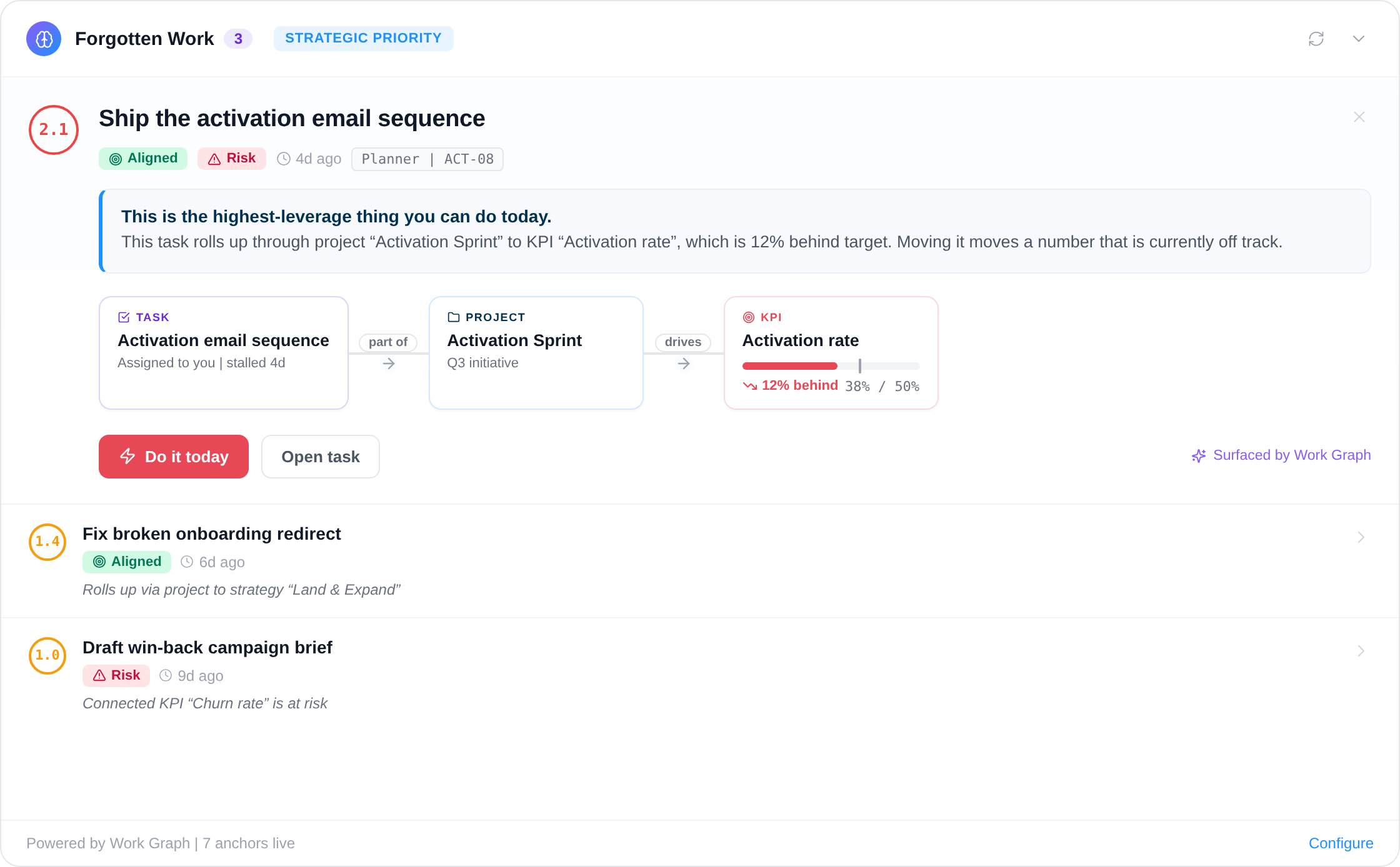
The Work Graph continuously evaluates task progress behind each Key Result. When work stalls or pace falls off, the owner is notified with the blocking work named, weeks before a check-in would have surfaced it.
- Twelve alert types, each with the blocking work named.
- Scheduled AI summaries land in Slack, Teams or email.
OKR management from drafting through grading.
Run Vindaris as OKR tracking software for a single team or as OKR management software for a whole organisation. The cycle is the same either way: draft, cascade, track through the quarter, and grade at the end against what the work actually produced.
Draft the quarter, then cascade it or keep it flat
Write Objectives and Key Results on the canvas with no enforced syntax, then cascade from company level down to teams and individuals, or leave the structure flat. One Key Result can serve two Objectives, and every level can be renamed to the language your company already uses.
How to track OKRs without maintaining a second system
Each Key Result connects to the tasks delivering it, so tracking is a by-product of the work rather than a weekly collection round. This is the practical answer to how to track OKRs at any size, and it is what separates an OKR management platform from a simple OKR tracking tool that stores the number but never knows where it came from.
Grade against the work, not against memory
At the end of the cycle the score reflects what the connected work produced, with the history of how it got there still attached. Score your drafts before the quarter starts with the free OKR Quality Grader, or run a cycle in the Excel OKR tracker first if you would rather try the shape before adopting an OKR platform.
OKRs alongside the frameworks the rest of the company runs
One workspace can hold OKRs for the product organisation and EOS Rocks for the leadership team, next to KPIs and SMART goals. That matters the moment one part of the company stops running OKRs, which is when a single-framework tool becomes a migration.
Write the quarter in plain language, get a cascade.
Describe the Objectives you just set the way you would say them out loud. Mention an Objective, Key Result, project or task with @ and Vindaris maps it onto the Alignment Canvas.
Four of the twelve alerts, in OKR terms.
The Work Graph reads the edges between each Key Result and the work beneath it. These are the four that fire most often on an OKR programme, and the third one is the alert nobody else sends.
Twelve deterministic and AI-driven alerts watching for slipping work, broken routines and misaligned focus.
Your framework, your language, your data in Europe.
Vindaris adapts to the OKR practice you already run, including the parts most tools argue with: shared Key Results, mid-quarter changes, and teams that score differently from each other.
Runs OKRs without locking you into them
Vindaris ships without a prescribed methodology, so Objectives and Key Results keep their names and their relationships. One workspace can hold OKRs for the product organization alongside EOS Rocks for the leadership team, which matters the moment one part of the company stops running OKRs.
Free forever, including two integrations.
Free covers a real OKR programme, not a trial of one: full Objectives, Key Results, KPIs, tasks and projects for up to 5 people. Pay when you add people, integrations or AI summaries.
Best for individual contributors, small teams or startups. No credit card required.
- All views: Canvas, My Priorities, Heatmap, Data Studio and Task Board
- Two integrations of your choice
- Up to four additional members
- Five ad-hoc AI risk summaries per month
Best for teams, small agencies, or departmental and team management.
- Everything in Free
- All integrations, unlimited sync
- Unlimited AI risk summaries and alignment suggestions
- Up to ten users in one organization
Best for multiple teams, exec teams, Chiefs of Staff or full-org deployments.
- Everything in Connect
- Unlimited users in one organization
- Direct human support, 24h response
- Human-led onboarding
Grade the OKRs you already wrote.
Real Excel and PowerPoint files, plus browser tools that run without an account. Useful whether you adopt Vindaris or keep running OKRs in a spreadsheet.
Common questions, answered
What is OKR software?
OKR software helps teams set Objectives and Key Results, track progress, and align work across the organization. Vindaris goes further by connecting each Key Result to the actual tasks and projects driving it, so you always know whether work is moving your goals forward.
How do OKRs connect to daily work?
In Vindaris, every Key Result links directly to tasks in tools like Jira, Microsoft Planner, or Google Tasks. Progress updates automatically from real work completion, so your OKR dashboard reflects what is actually happening rather than manual check-ins.
Can Vindaris track OKRs and KPIs together?
Yes. Vindaris supports OKRs, KPIs, Balanced Scorecard, OGSM, and other frameworks in one platform. You can run KPIs alongside OKRs and see how both connect to the same underlying work.
How is Vindaris different from other OKR tools?
Most OKR tools track goals in isolation. Vindaris connects goals to traceable work - tasks, projects, and deliverables live in the same system. It is free forever for goal and strategy management, hosted in Germany, and GDPR compliant.
What is the best OKR software for a small team?
The right OKR software for a small team is one that does not need an administrator. Vindaris is free for up to five people with two integrations, sets up in an afternoon, and connects Key Results to the tasks already running in your tools so nobody has to maintain a second system. For a comparison of the wider market, our independent review of the best OKR software covers eleven platforms.
Is Vindaris free OKR software?
Yes, free forever for up to five people, including the full canvas and two integrations, with no credit card. Startups typically run their first several quarters entirely on the free plan. Paid plans start when you add more people, more integrations or unlimited AI summaries.
How do you track OKRs without weekly check-ins?
Connect each Key Result to the tasks and projects delivering it, and progress comes from the work closing rather than from someone typing a percentage. Check-ins still have value for context and decisions, but the number no longer depends on them, so a skipped week does not leave a stale dashboard behind.
Does Vindaris sync with Jira and Asana?
Yes, in both directions. Vindaris syncs with Jira, Asana, HubSpot, Microsoft Planner, Google Tasks, Microsoft To Do, Slack and Teams. A ticket closed in Jira moves the Key Result above it in Vindaris, and a comment written in Vindaris reaches the owner inside the tool they already use. No team has to migrate.
Why do OKRs fail after the first quarter?
Usually because nothing connects the Objectives to the work between plannings. The quarter opens with a good set of OKRs, the work happens somewhere else, and by week three nobody can say which task moves which Key Result. The grading at the end then measures memory rather than progress. Connecting Key Results to real tasks is what keeps the second quarter from being a relaunch.
Know which Key Results will miss while there is still quarter left.
Connect your first tool in 90 seconds. Free forever for OKR management.
Start tracking OKRs freeNo credit card | No migration | No minimum contract