Cascade maps manual updates that no one ever enters.
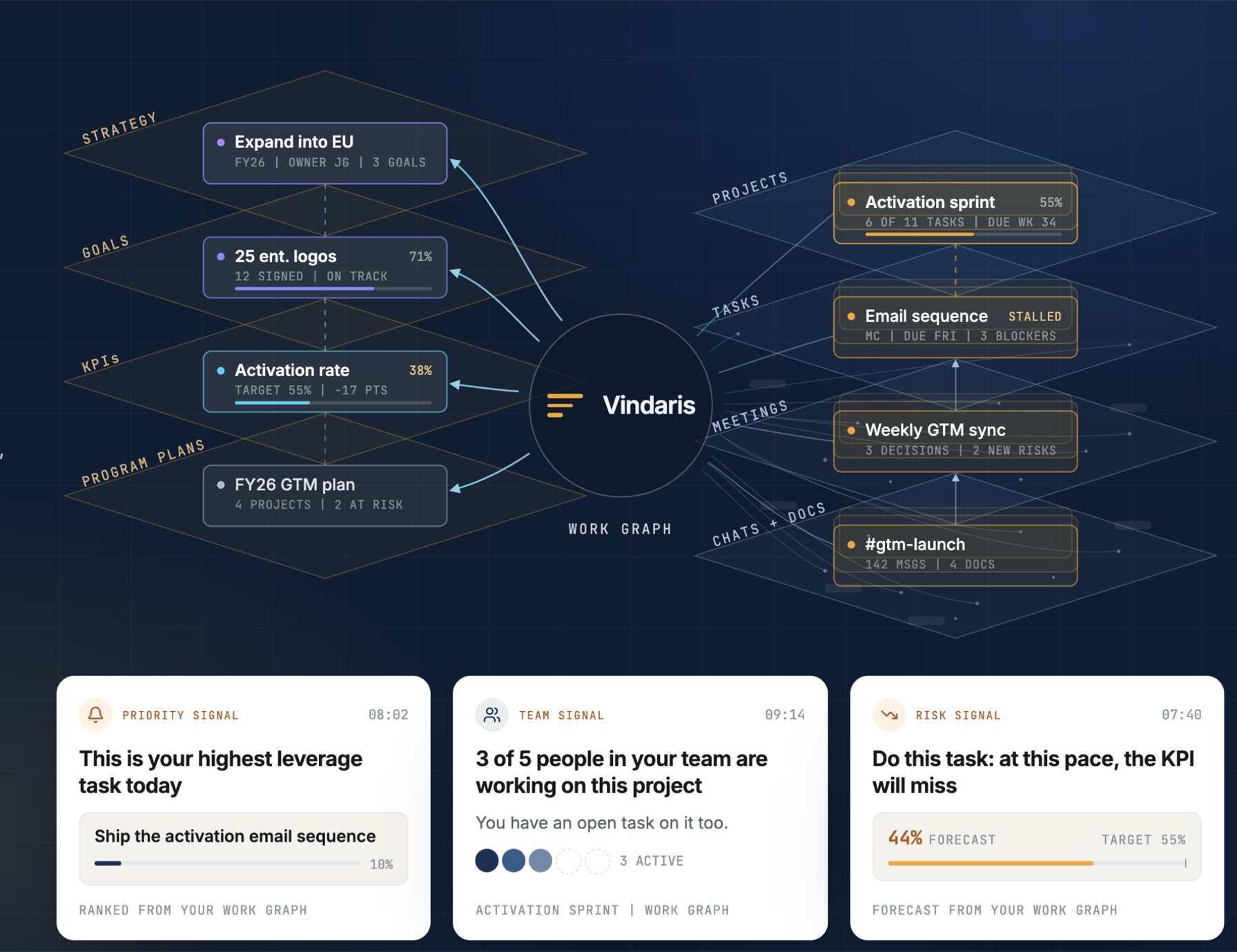
Vindaris takes the manual update out of the loop, so nothing waits on a status someone forgot to enter. It analyzes the work activity behind every goal, the tasks, conversations and threads in the tools your team already uses, builds your alignment automatically, keeps status live, and alerts you the moment work that should move a goal stalls. Cascade still waits for someone to type the progress in by hand.





Last reviewed August 2026
Cascade is a strategy execution platform with visual planning, timelines, OKRs, and executive dashboards. Vindaris connects goals to the operational work that moves them and derives status from that work. Cascade is a separate system you keep updated by hand on top of Jira and Asana. Vindaris derives status straight from those tools, so there is nothing extra to keep in sync.
Cascade shows the last number someone typed. Vindaris shows what the work is actually doing.
Cascade gives leadership a serious portfolio and planning surface: strategy maps, roadmaps, dashboards, roll-ups across a large org. That part earns its price.
Cascade's ambition is to be the strategy execution platform: a place where strategic plans, OKRs, KPIs, and timelines all live and roll up into executive dashboards. It has visual planning tools, Gantt-style views, and reporting that can impress in a boardroom. For a leadership team that wants a single view of the strategy, that ambition is real.
The challenge is that the planning layer sits alongside the work rather than reading from it. The tasks that actually deliver the strategy live in Jira, Asana, Planner, or HubSpot, and while Cascade has some integrations, they do not create the bidirectional, traceable link that makes status trustworthy. The risk is running a second system that needs updating by hand instead of drawing from the tools where the work already lives.
In Cascade, strategic plans and goals live in a planning layer next to the work. Some integrations exist, but status still depends largely on manual updates. When the planning layer stops matching the delivery reality - and without a native work connection it will - the executive dashboard tells a story the operational ground does not support.
What teams consistently praised
- Strong C-suite planning and portfolio views.
- Strategy maps that leadership actually reads.
- Deep roll-up across large, multi-layer organizations.
- Mature reporting for board and quarterly reviews.
Where teams hit the limit
- Progress is largely entered by hand, quarter after quarter.
- Risk surfaces when someone reports it, not when work stalls.
- Integrations sync a percentage rather than task-level context.
- Adoption depends on a discipline that decays under load.
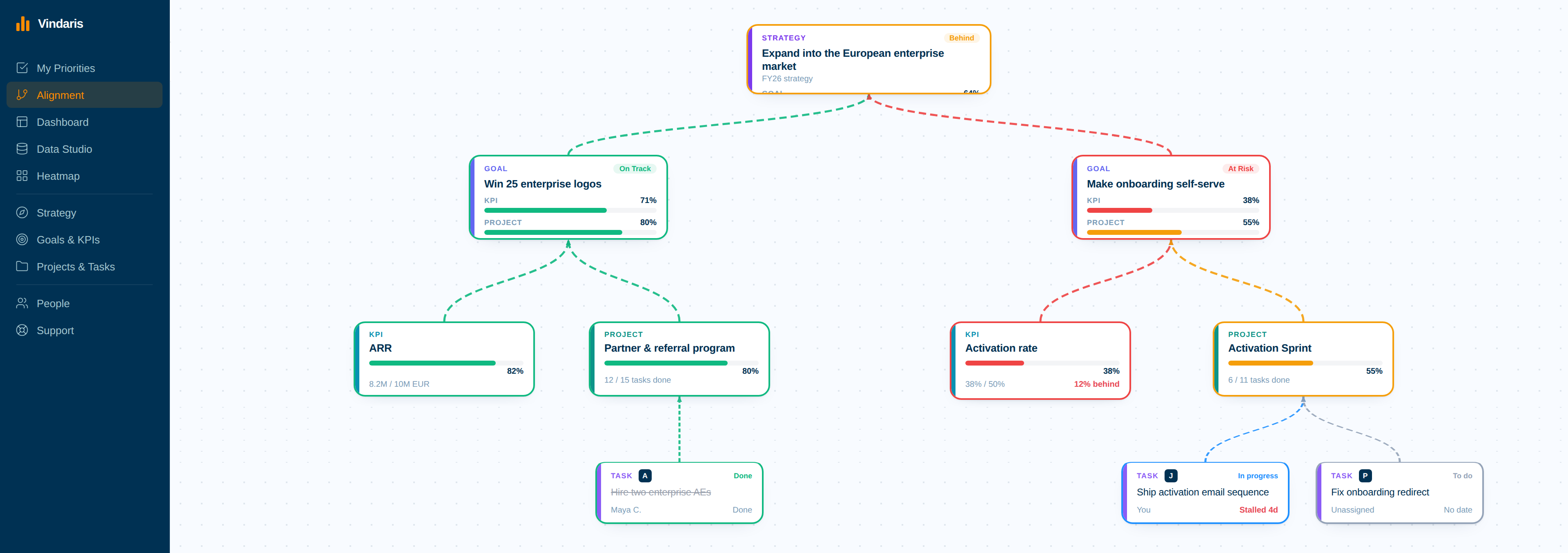
Vindaris is built for strategy execution. Cascade is a planning layer that only tracks the plan you typed in.
and most of the category
- Goals live in one system. Work lives in another.
- Teams update goals as a reporting exercise.
- Integrations move a percentage, not traceable links between effort and outcome.
- Dashboards show what teams reported, which is not what happened.
- Risk is discovered in the review, not before it.
- One layer, not a planning layer maintained alongside the delivery layer.
- Plan progress is derived from the work activity rather than rolled up from updates.
- Nothing to reconcile on Friday, because there is no second copy of the plan.
- Risk surfaces from stalled tasks before the portfolio view would show it.
- Any framework, with the plan structure coming from the goals themselves.
Vindaris derives status from the work, builds your alignment automatically, and flags a goal the moment it stalls.
Cascade's strength is that it gives strategy its own well-modeled home: focus areas, objectives, projects, measures, all laid out visually. The cost is that this home is a parallel structure to the one your delivery tools already contain, and parallel structures have to be kept in step by hand.
| Object | Cascade | Vindaris |
|---|---|---|
| Central object | The plan, modeled in its own layer | The work, with the plan as edges over it |
| Projects | Plan-layer records that mirror real projects | The real projects, synced from Jira, Asana or Planner |
| Progress source | Updates entered against plan records | Task state in the tool where the work happens |
| Reconciliation | Required, and usually weekly | Not applicable. There is one copy |
| Drift between plan and delivery | Invisible until someone compares them | Structurally impossible |
The divergence is the thing to watch. A Cascade project marked 60 percent is a claim about a real project somewhere else, made by whoever last updated it. When those two diverge, the executive dashboard and the delivery board tell different stories and both look authoritative. Vindaris has no second copy to diverge from.
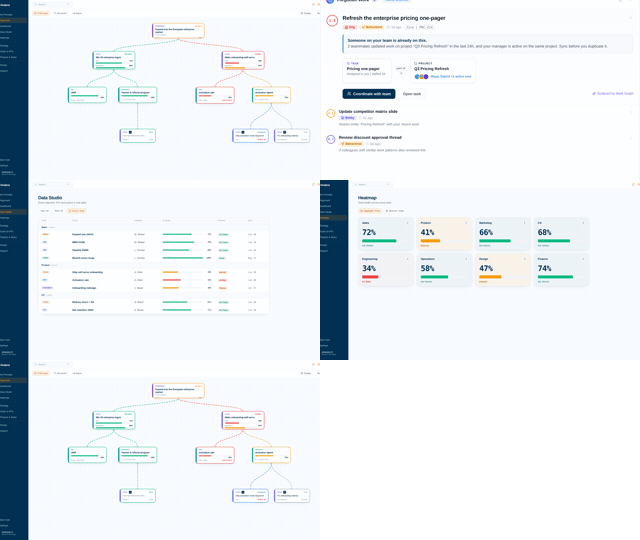
Five views that keep strategy and execution in sync.
See every goal connected to the work moving it.
Drag and drop your alignment structure. Roll up work progress, KPIs and goals without enforcing any framework syntax.
Alignment Canvas →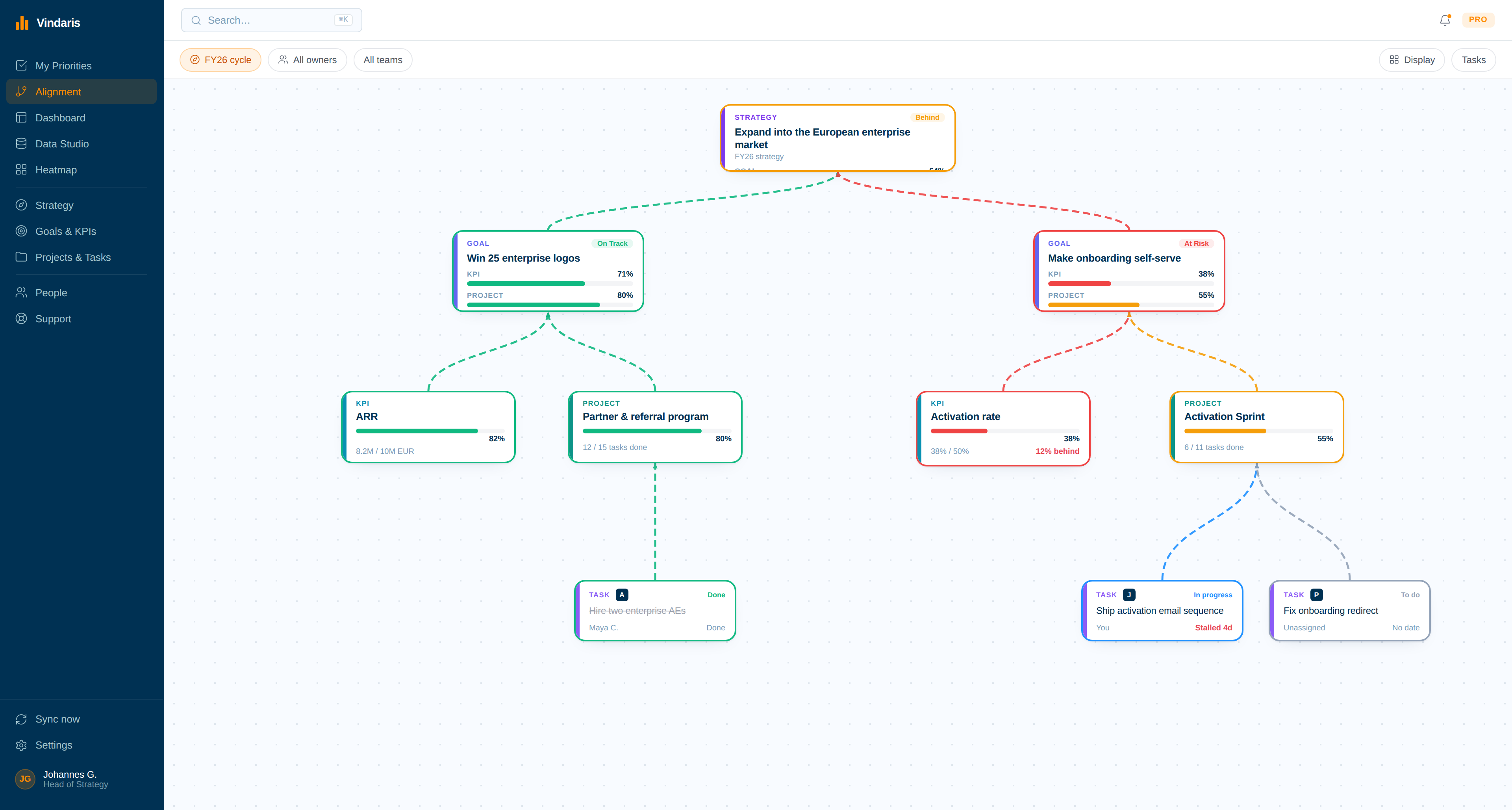
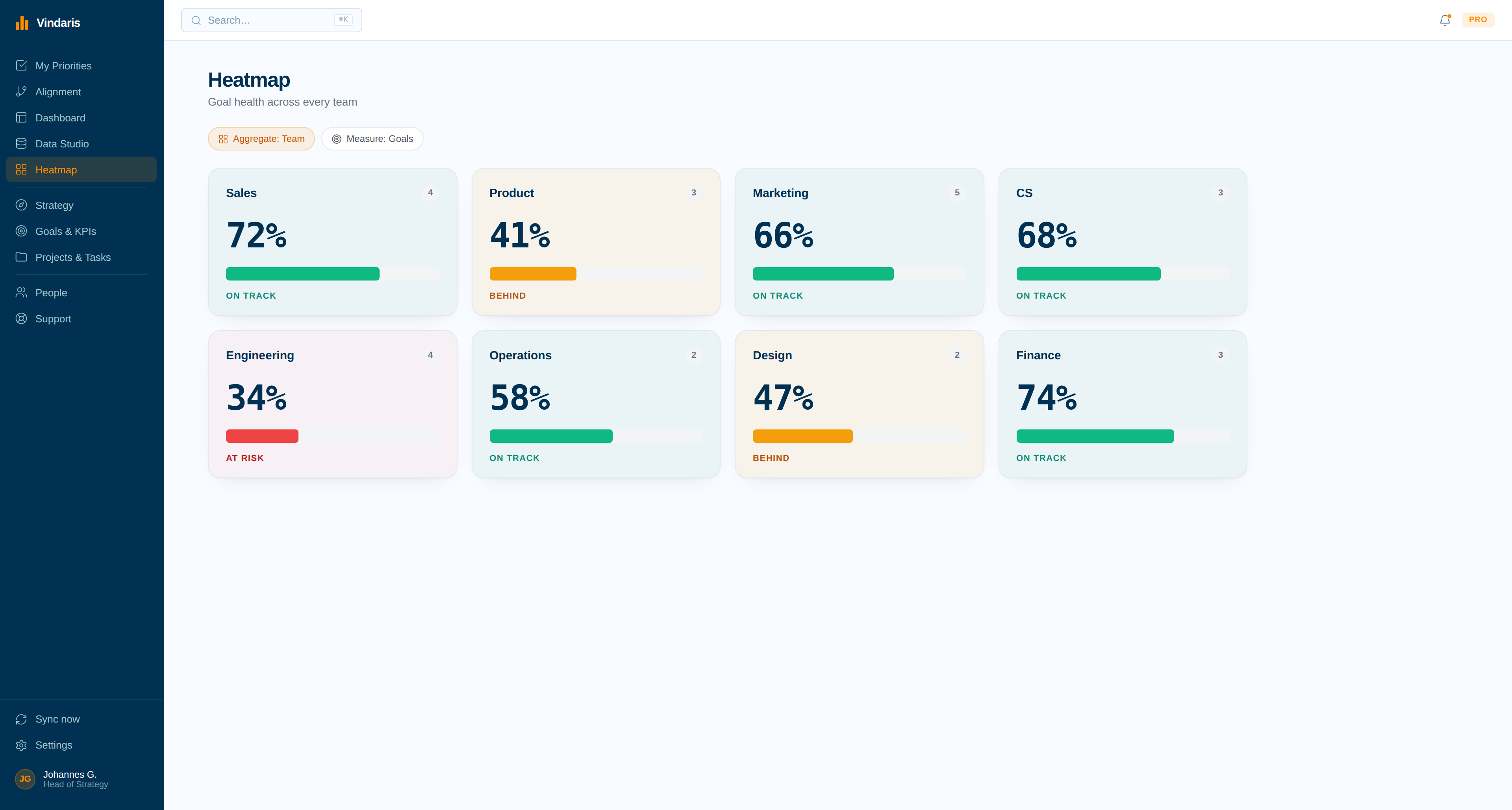
Spot risk while there is still time to fix it.
Run heatmaps across teams, goals, KPIs and projects. Save views and get notified when risk levels change, from task movement rather than a reported number.
Combine tasks and projects across your systems.
Sync HubSpot, MS Planner, Google Tasks, Asana and more into one view. Bidirectional sync keeps everything current while teams stay in their own tools.
All integrations →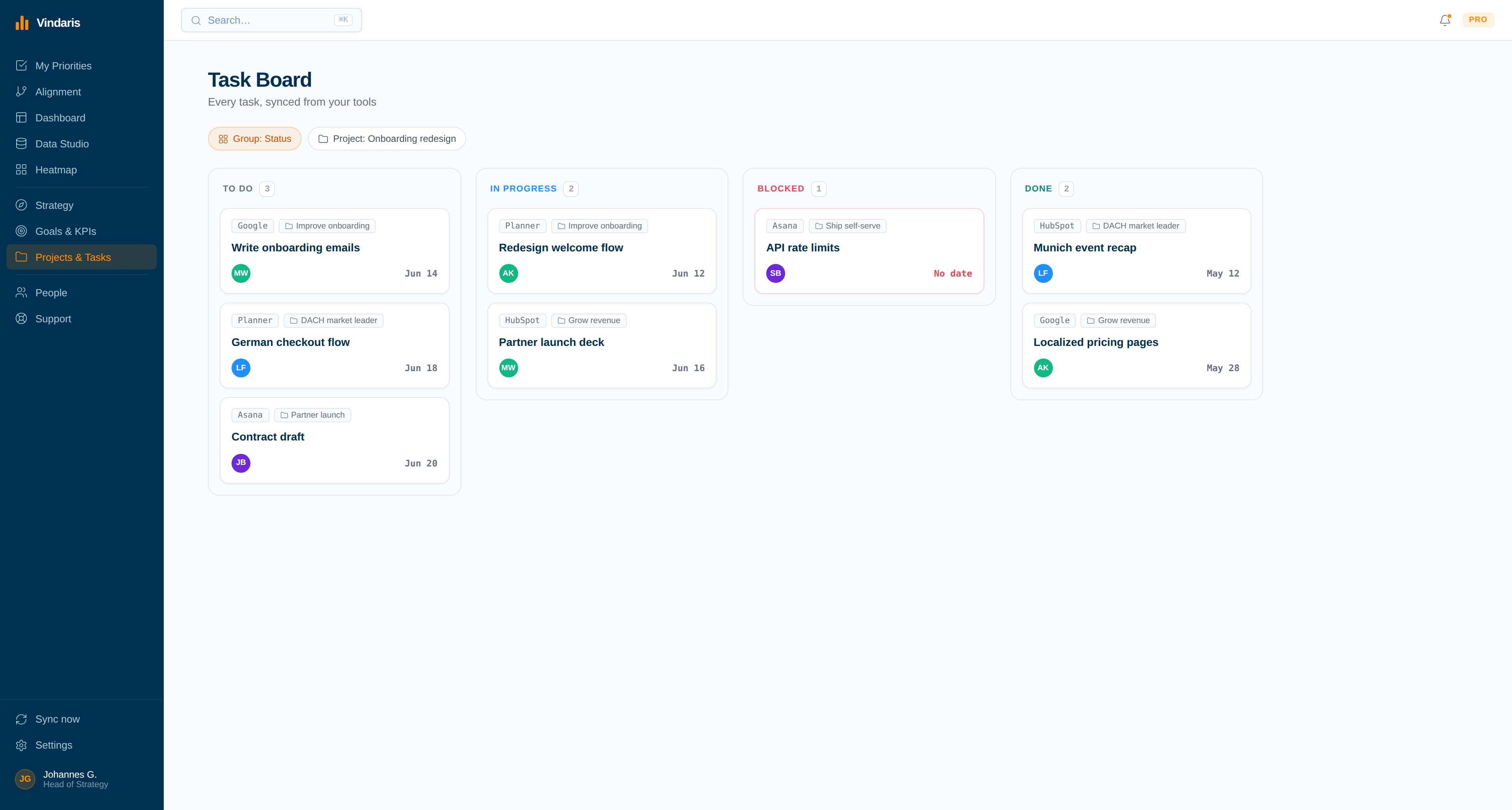
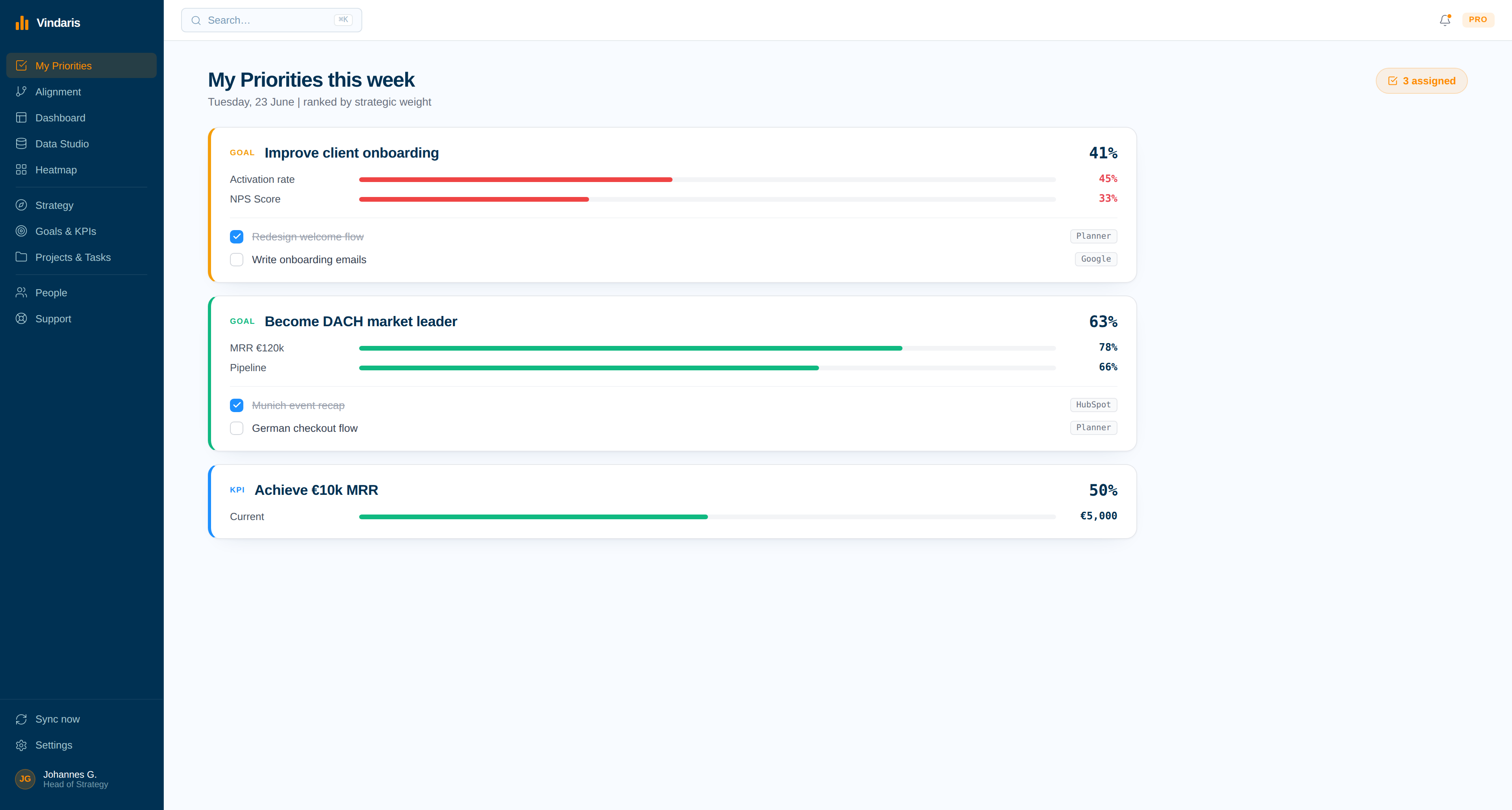
Everyone knows exactly what matters most.
A clear view of each person's goals, KPIs, projects and tasks. Start the week focused on what is due.
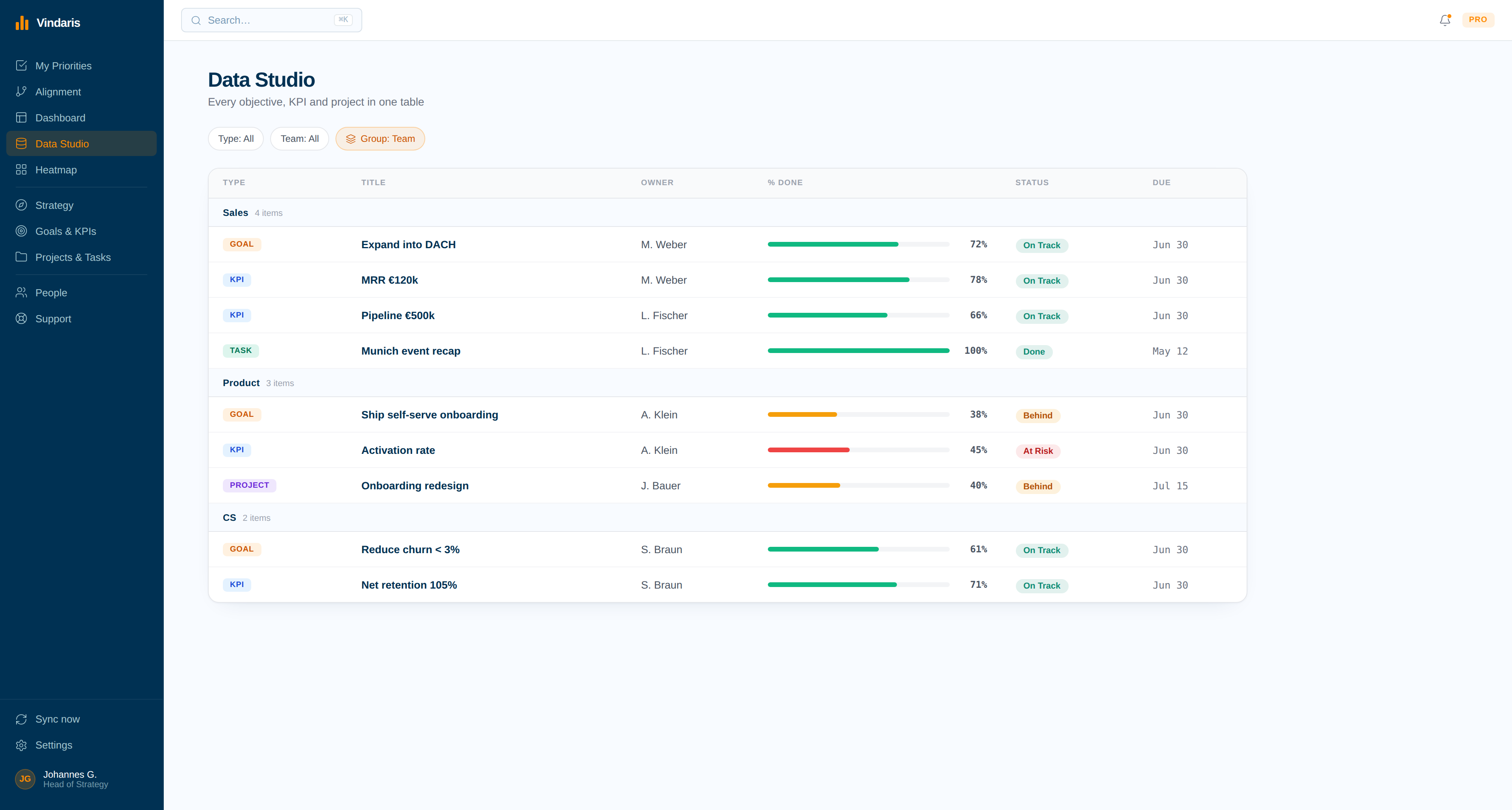
Run reports the way management needs them.
Rank teams, spot risks, compare KPIs to work. AI summaries push updates to Slack, Teams and email.
Move the plan without rebuilding the reporting habit.
Cascade users have usually invested real effort in modeling the plan. That structure carries over; what stops is maintaining it separately from the work.
Cascade exports focus areas, objectives, projects and measures, and its API covers the same ground for a scripted move. The hierarchy imports intact, so the shape of the plan you spent a quarter designing is preserved.
Every Cascade project is a pointer to work happening in Jira, Asana, Planner or a spreadsheet. Connect those. This is the step where the plan stops being a description of the work and starts being attached to it.
Vindaris proposes matches between each plan-layer project and the synced project it was mirroring. Confirm them and the duplicate disappears: one project, visible from both the delivery board and the strategy view.
The recurring job of walking the plan and updating it against reality has no input left. Measures move when their work moves. The portfolio review starts from a view nobody had to prepare.
Free forever for up to 5 people. No credit card required.
Start free Book a demo No credit card requiredVindaris vs Cascade, feature by feature.
Cascade wins on planning surface. This table compares what each product knows about the work behind the plan, which is the row that decides whether the dashboard is true.
| Feature | Vindaris | Cascade |
|---|---|---|
| How progress is measured | Read from task-level work and Slack context in the tools your team already uses. | Manual updates by goal owners; some metric tracking via integrations. |
| Goal frameworks supported | Framework-agnostic: OKR, KPI, EOS Rocks, OGSM, SMART, Balanced Scorecard, or hybrid. | OKRs, KPIs, and strategic plans with visual planning tools. |
| Connection to work activity | Native work layer with bidirectional sync to HubSpot, Planner, Google, Jira, Asana. | Some integrations exist but no native bidirectional work layer. |
| Risk detection | Automatic execution-risk flags from task movement, focus and pace against plan. | Limited automatic detection; largely depends on manual status updates. |
| Status reporting | Live views and AI risk summaries pushed to Slack, Teams, and email. | Strategy dashboards, Gantt-style views, and executive reports. |
| Capacity and bandwidth | Built-in bandwidth and capacity planning. | Not covered natively. |
| Ownership model | Single-owner accountability enforced structurally. | Owner per objective and plan item. |
| Free plan | Free forever, including 2 integrations and up to 5 people. | Free tier available for small teams. |
| Best fit | Teams that need execution status derived from the work in their tools. | Teams that want visual strategic planning with Gantt-style project views. |
The category as a whole is compared in the best strategy execution software guide, and the argument underneath it is set out in the strategy execution gap whitepaper.
A planning platform seat, or a connected execution seat.
Cascade prices per user and positions upward, with the fuller strategy-execution configurations quoted rather than listed. Evaluation tends to start with a conversation.
| Plan | Cascade | Vindaris |
|---|---|---|
| Free tier | Free tier, historically generous, with the strategy features gated above it. | Free forever. Up to 5 people, 2 integrations, all core features. |
| Entry paid plan | Per-user pricing that steps up sharply for the enterprise configuration. | Connect, EUR 10 per user per month. All integrations, unlimited sync. |
| Upper plan | Higher tiers add planning depth, governance and support, not a work layer. | Pro, EUR 20 per user per month. Unlimited users in one organization. |
| Published pricing | Partially. Entry tiers published, enterprise quoted. | Yes, on the website. No quote required to evaluate. |
| Minimum commitment | Annual for the tiers most buyers end up on. | None. No seat minimum, no annual term, no setup fee. |
Vindaris publishes every tier: free forever for up to 5 people, EUR 10 per user per month for Connect, EUR 20 for Pro, with no seat minimum and no annual term.
Best for individual contributors, small teams or startups. No credit card required.
- All features (incl. Alignment Canvas, My Priorities, Heatmap, Data Studio & Task Board)
- Set up 2 integrations of your choice
- Invite up to 4 additional members
- 5 ad-hoc AI risk summaries per month
Best for teams, small agencies, or departmental and team management.
- All in Free
- All integrations, unlimited sync
- Unlimited AI risk summaries & alignment suggestions - ad-hoc and scheduled
- Up to 10 users within one organization
Best for multiple teams, exec teams, Chiefs of Staff, departmental leadership or full-org deployments.
- All in Connect
- Unlimited users within one organization
- Direct human support email, 24h response time
- Human-led onboarding support
Common questions, answered
What is the difference between Cascade and Vindaris?
Does Vindaris have strategic planning tools like Cascade?
Why is Cascade's planning layer a risk?
Can I migrate from Cascade to Vindaris?
Free resources for this topic
A template you can download, a playbook to run, and the thinking behind both. No email required.
Or start with the full picture: strategy execution software that connects your plan to the work delivering it.
Switching from Cascade is a choice. Repeating its architecture is optional.
Free forever for up to 5 people. No credit card required.