


The strategy execution software market in 2026 looks nothing like it did in 2024. If you are searching for the best OKR tools in 2026 or running a goal management software comparison, you will find fewer names on the list. Some vendors shut down. Others pivoted into adjacent categories. A handful remain, but their positioning has shifted.
Last reviewed August 2026.
This post maps out what happened, what still exists, and what actually works for teams trying to connect strategic goals to daily execution. We have evaluated most of these tools over the past eighteen months, either through direct use or through conversations with teams migrating away from them.
What happened to the market
Between late 2024 and mid-2026, the strategy execution category lost several major players. The consolidation was not random. It followed a pattern: tools that treated goal-setting as a standalone activity - disconnected from where work actually happens - struggled to retain users. Weekly check-ins and red/yellow/green status updates were not enough to justify another subscription.
The survivors either integrated deeply into existing workflows or expanded their scope to cover planning, execution, and reporting in a single surface. The demand that survived is for tools that surface execution risk, not tools that store goals.
Microsoft Viva Goals: gone
Microsoft announced the sunset of Viva Goals in late 2024 and completed the wind-down in early 2026. The product, originally Ally.io (acquired in 2022), never gained the internal traction Microsoft hoped for. It sat awkwardly between Microsoft Planner, Project, and the broader Viva suite without a clear differentiation story.
For teams still looking for a Viva Goals alternative, the options depend on what you actually used it for. If it was primarily OKR tracking with Teams integration, most replacements will cover that. If you relied on its data integrations for automated key result updates, the field narrows considerably.
WorkBoard: silent retreat
WorkBoard has not made a significant product announcement since mid-2025. Their website still exists, but enterprise customers report difficulty getting responses from sales and support teams. Several mid-market companies we spoke with migrated away in Q1 2026 after failing to get contract renewals processed.
This is not an official shutdown - WorkBoard has not announced anything publicly. But for practical purposes, teams evaluating a WorkBoard alternative should treat the platform as end-of-life until proven otherwise. The lack of communication is the signal.
Cascade: pivot to strategic planning
Cascade rebranded and repositioned itself away from pure OKR execution toward strategic planning and portfolio management. The product still exists, but it serves a different buyer now. If you were using Cascade for team-level goal tracking and weekly check-ins, the current version is overbuilt for that use case.
Their focus shifted toward C-suite strategic planning workflows - scenario modeling, initiative prioritization, resource allocation. This is a legitimate market, but it leaves mid-market teams without an execution-focused tool. If that describes your situation, consider looking at a Cascade alternative that maintains the execution layer.
Quantive (formerly Gtmhub): identity crisis
Quantive went through two rebrandings and at least one major pivot since 2023. They moved from "OKR platform" to "strategy execution" to their current positioning around "strategic intelligence." Each pivot brought new features and deprecated old ones.
The product still functions, but long-time users report confusion about the roadmap. Pricing increased substantially in 2026, pushing smaller teams out. If you are evaluating a Quantive alternative, the main question is whether you need their data connectivity features (which remain strong) or whether a simpler goal-to-task connection would serve you better.
ClearPoint: niche stability
ClearPoint has stayed consistent, serving government agencies and large nonprofits with balanced scorecard and strategic planning needs. It works well within that niche. The interface feels dated compared to newer tools, but the reporting depth is genuine.
For organizations outside the public sector, ClearPoint can feel heavy. The setup overhead is significant, and the tool assumes a specific strategic planning methodology that not every team follows. Teams exploring a ClearPoint alternative typically want something lighter that still provides structured goal tracking without the balanced-scorecard rigidity.
What still works in 2026
The tools that survived and grew share common traits. They do not treat goals as a standalone artifact. They connect objectives to the actual tasks, projects, and decisions that drive progress.
Here is what separates functioning strategy execution tools from the ones that disappeared:
Integration with work systems. Goals that update automatically based on work completed in project management tools, CRMs, or data platforms. Manual weekly updates are a tax that teams eventually stop paying.
Lightweight setup. If it takes a consultant engagement to configure the tool, adoption will stall at the leadership layer. The teams doing the work will never log in.
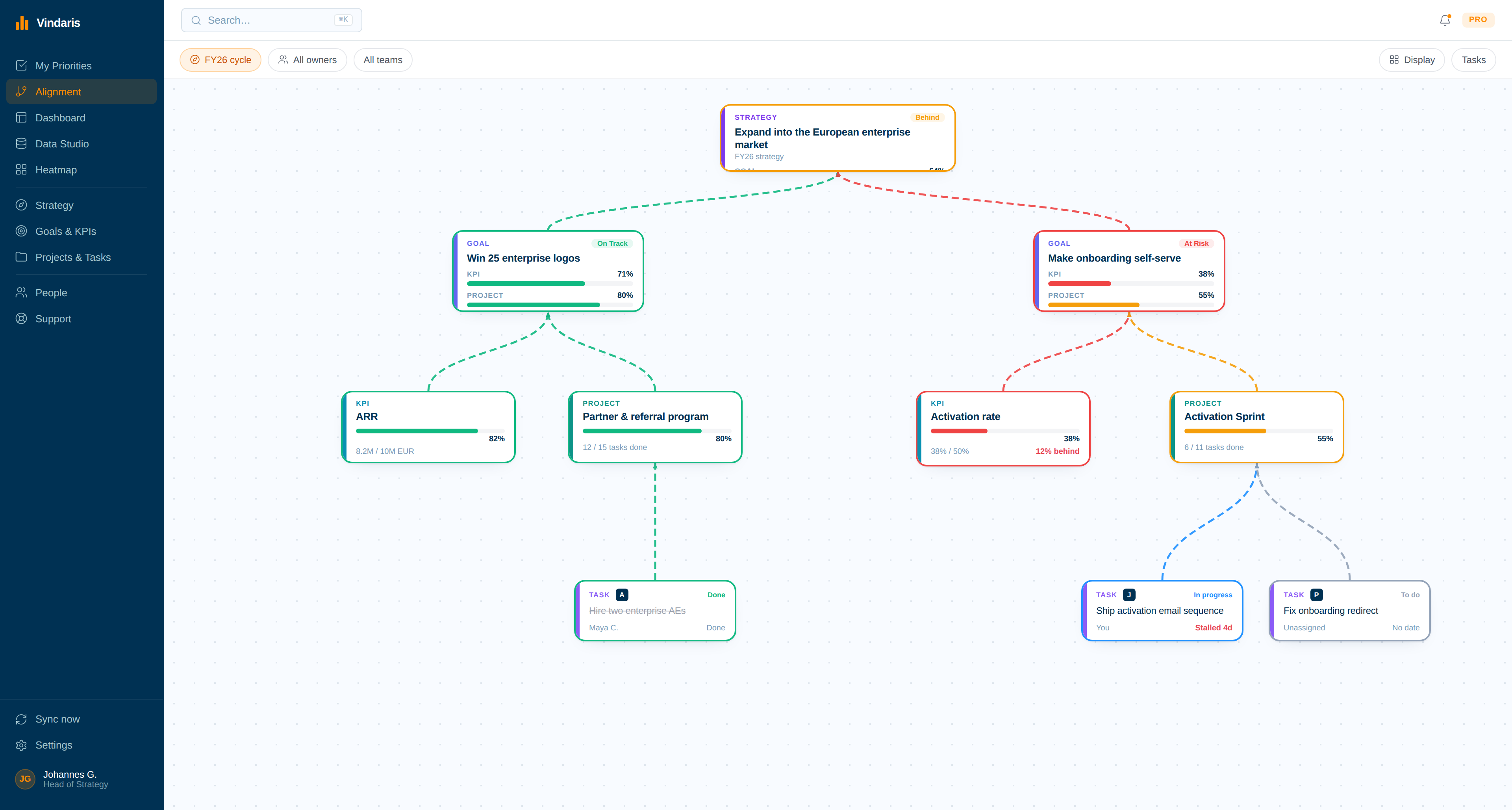
Visible connection between strategy and tasks. People need to see how their daily work maps to company objectives. Not through a motivational poster, but through actual structural links in the software.
Reporting that works for multiple audiences. Executives want a dashboard. Managers want progress views. Individual contributors want to know which of their tasks matter most. One view does not serve all three.
The remaining players
A handful of tools continue to operate credibly in this space:
Perdoo remains focused on OKRs and KPIs for mid-market companies. Their product is stable, the interface is clean, and they have not tried to become something they are not. Limitation: the task layer is thin. You still need a separate project management tool.
Profit.co serves enterprise OKR use cases with deep configurability. Good for large organizations that want to map OKRs across many levels. Limitation: complexity. Smaller teams find it overwhelming.
Weekdone continues to serve small teams with a lightweight OKR implementation. Limitation: it does not scale well past 50-100 people, and the strategic planning layer is minimal.
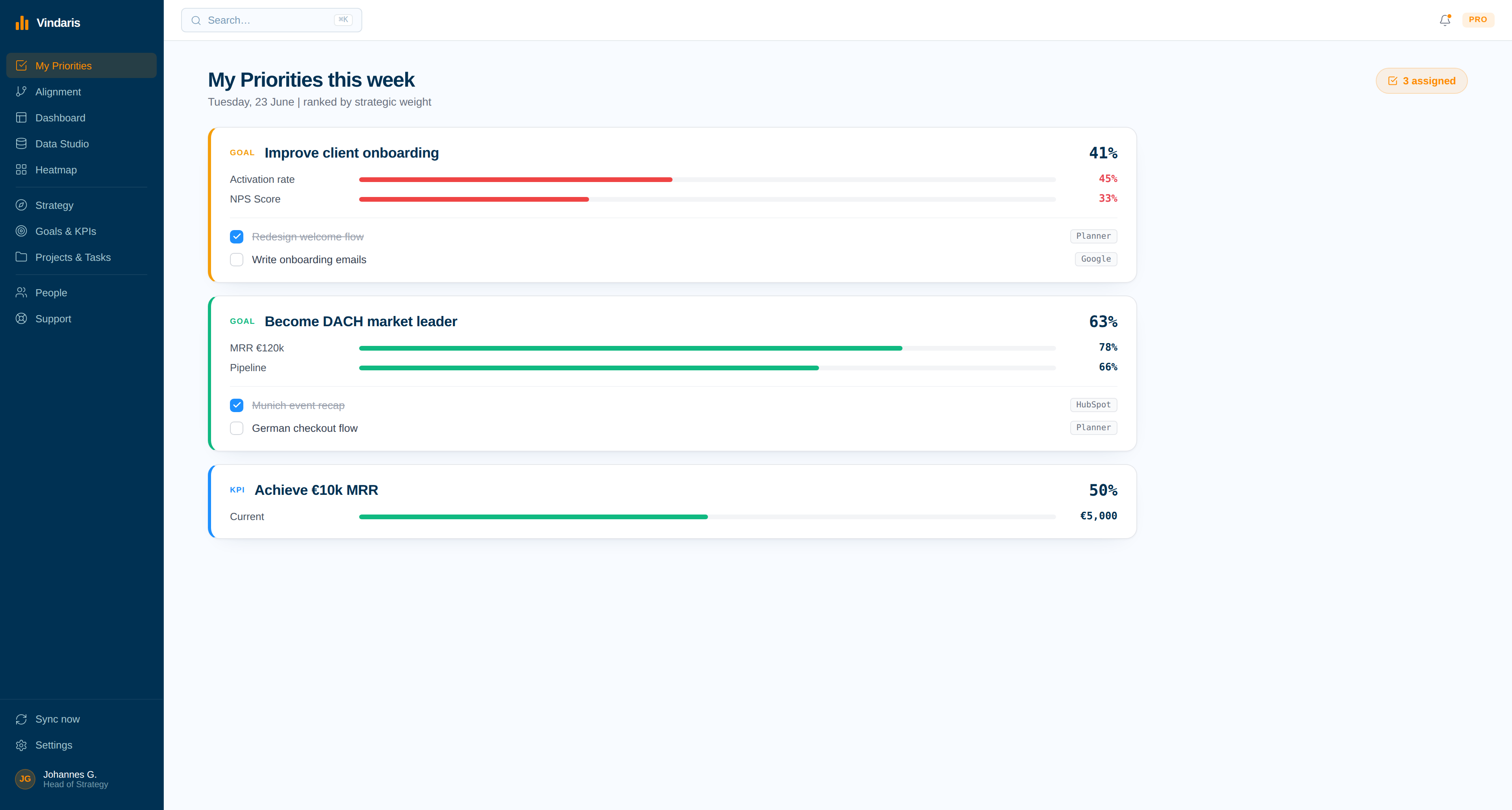
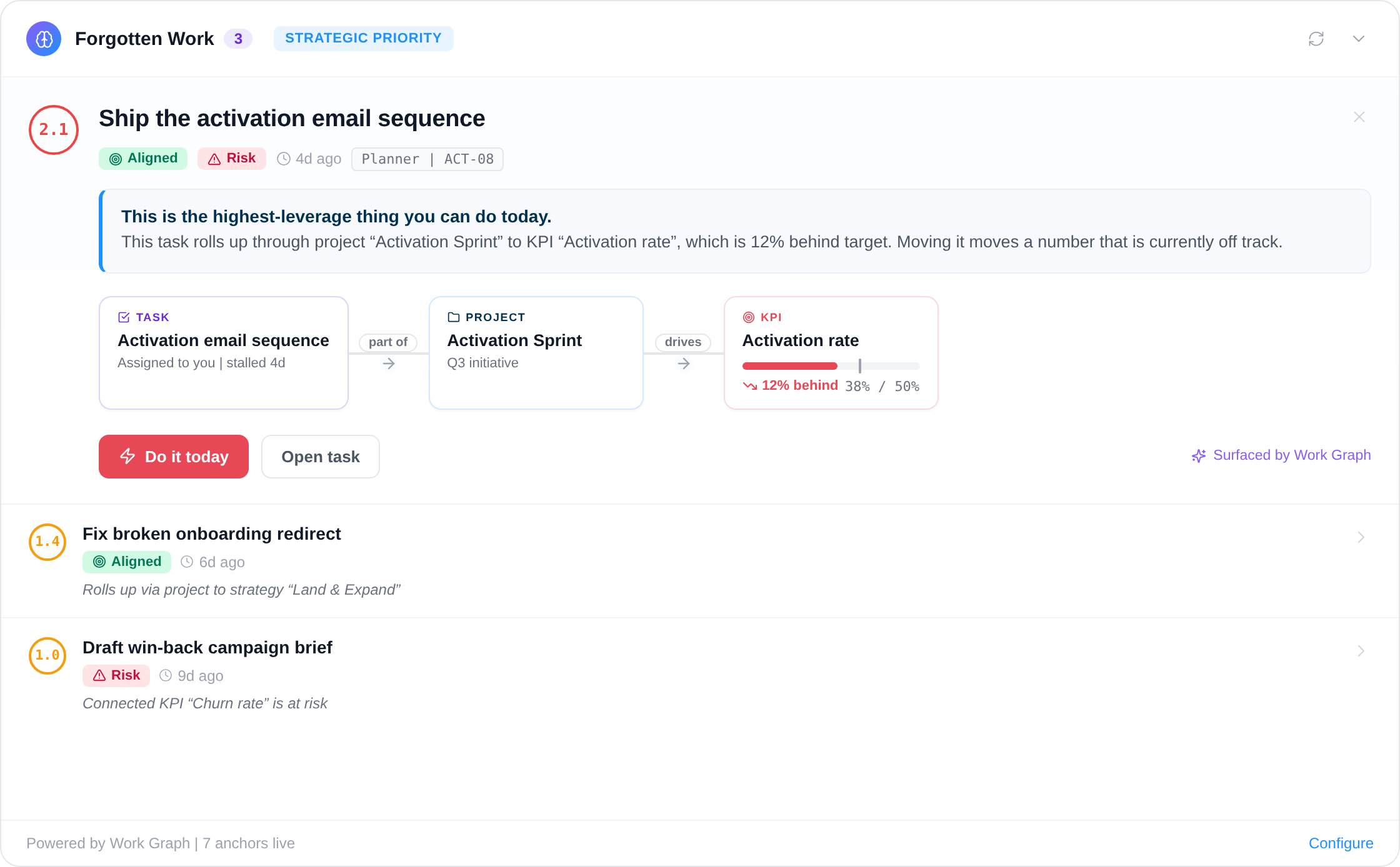
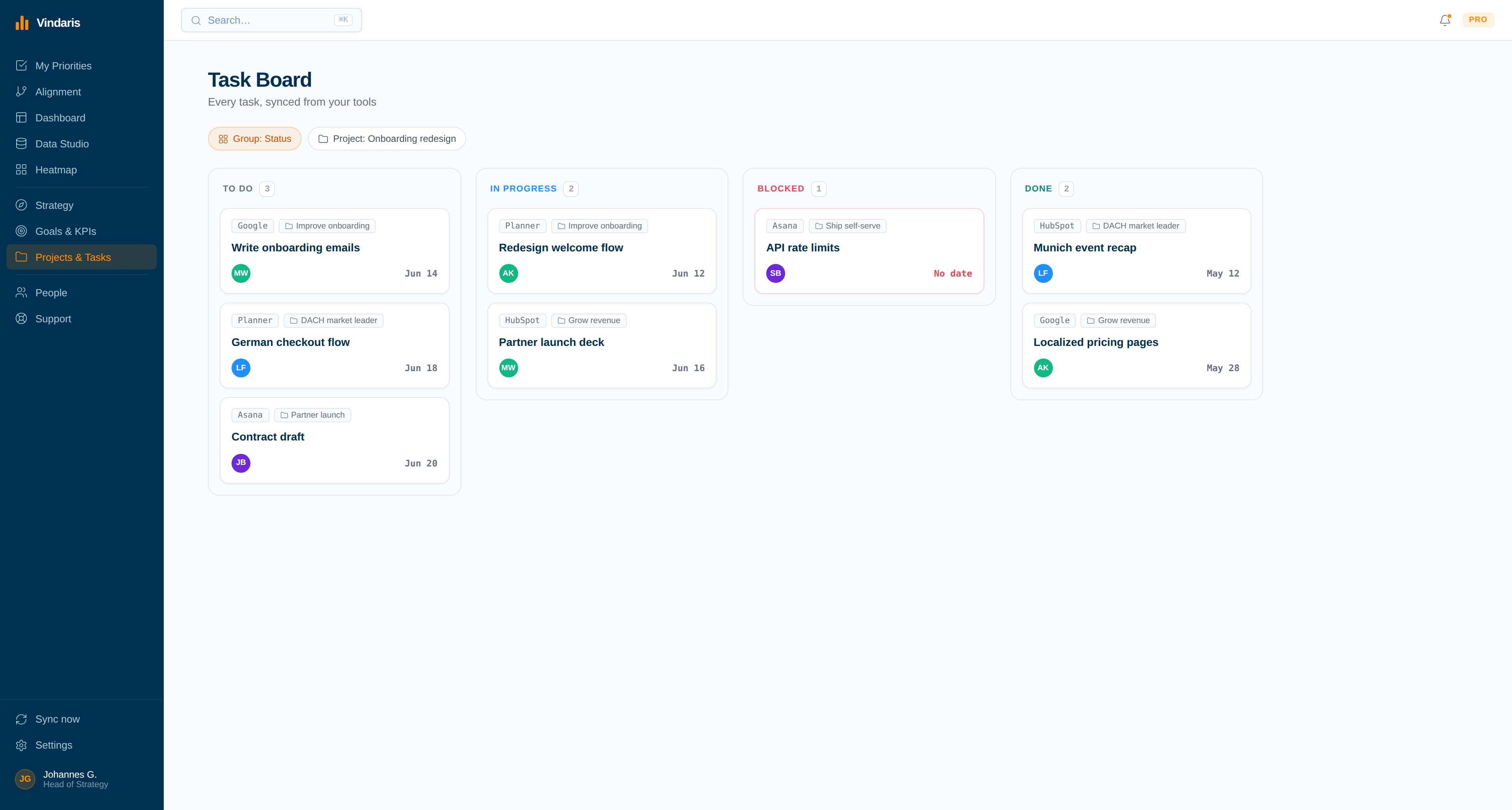
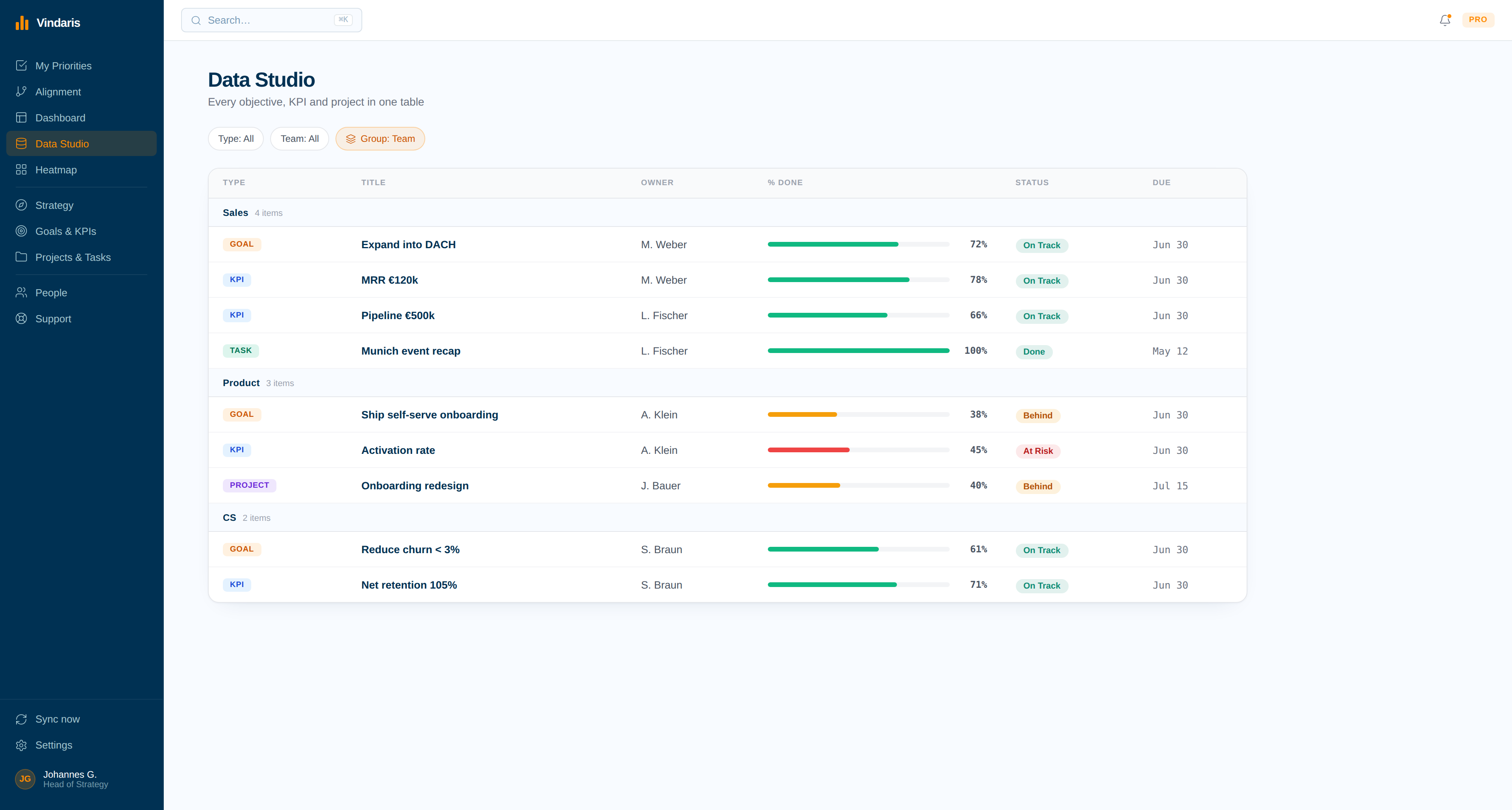
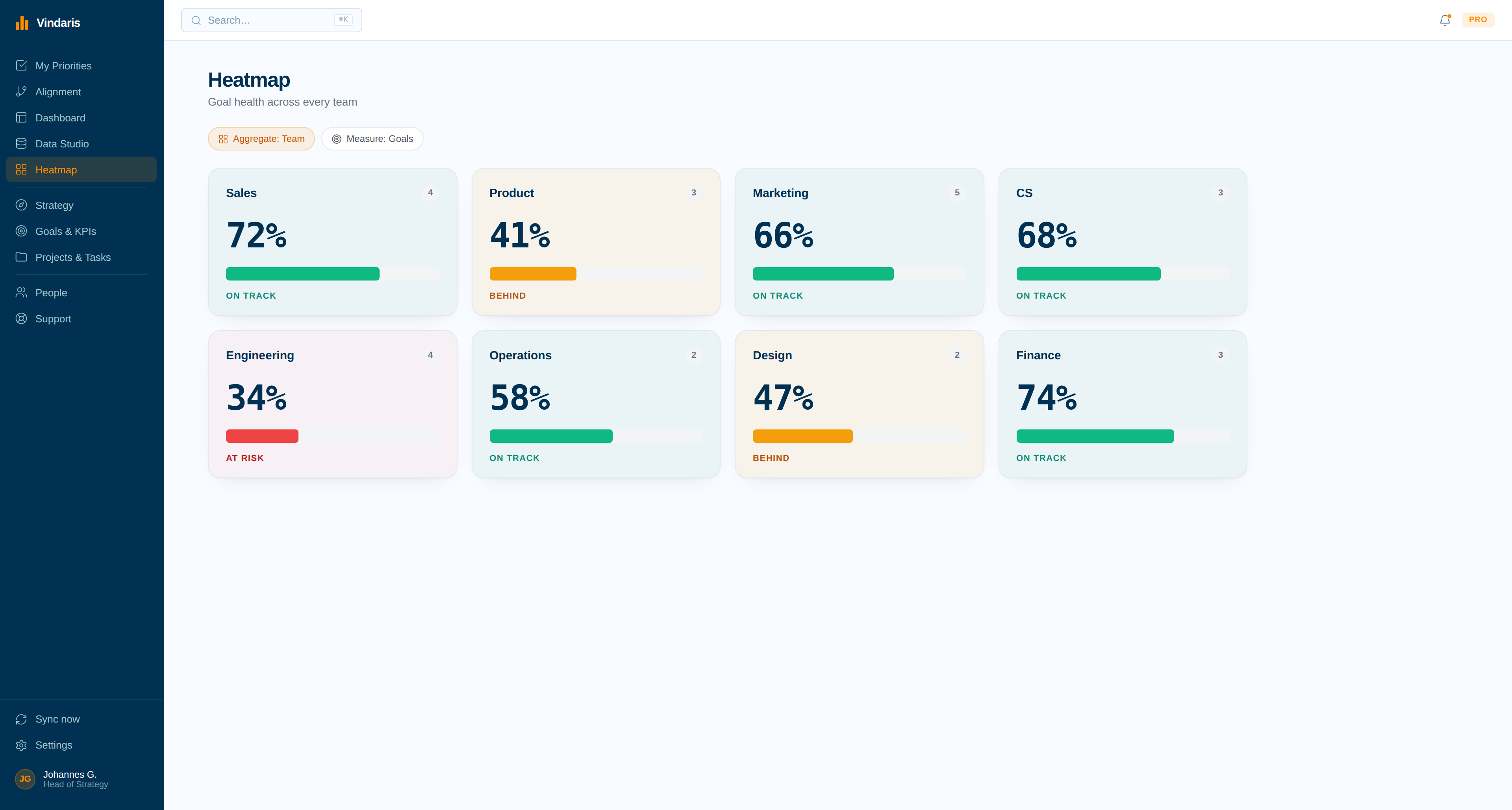
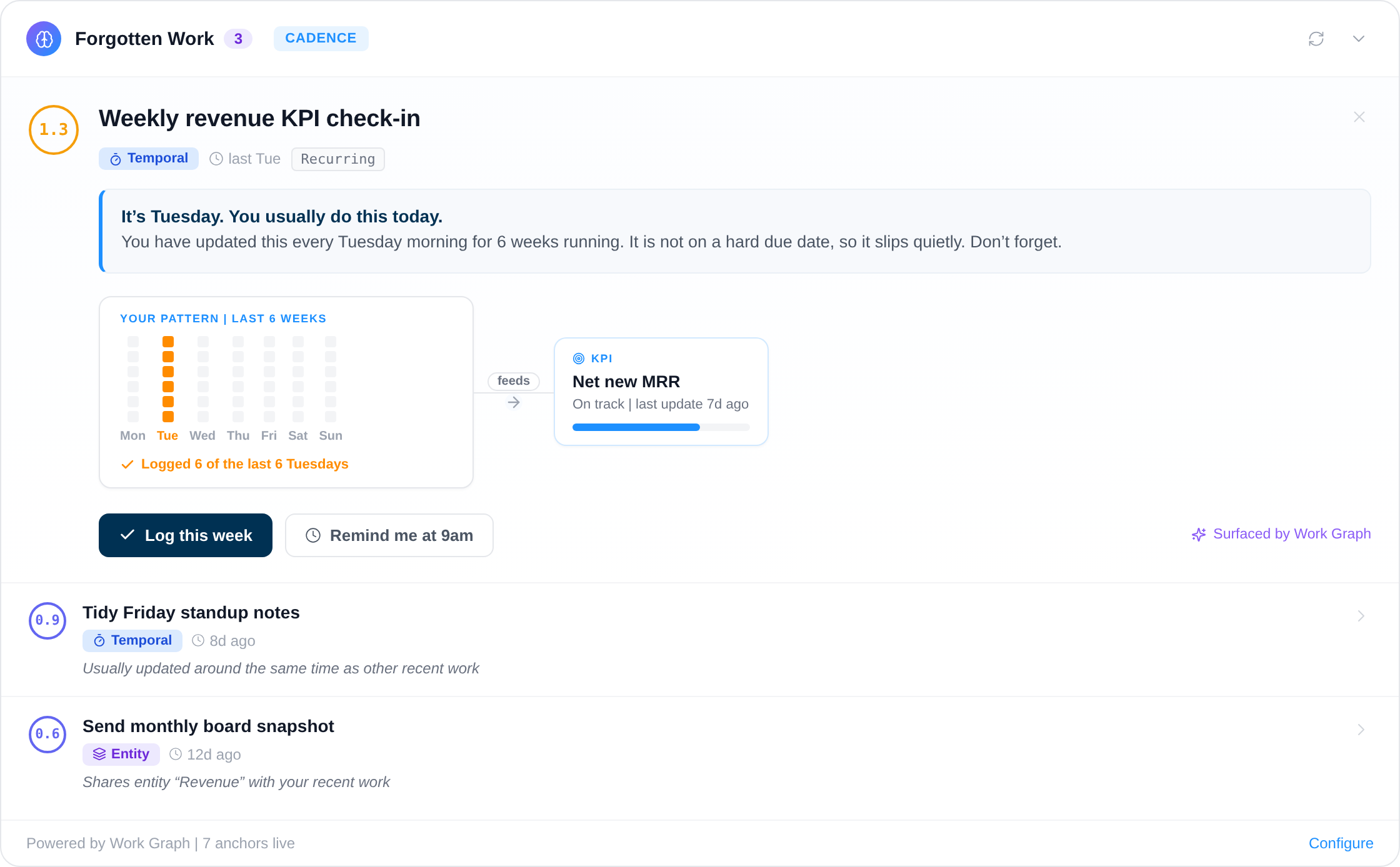
Vindaris connects strategic goals directly to task execution, designed for the gap that opened when tools like Viva Goals and WorkBoard disappeared. Rather than treating goals and work as separate systems that need syncing, Vindaris structures them as one hierarchy - from company objectives down to individual tasks. The focus is on making the connection between strategy and daily work visible and maintainable without requiring manual status updates.
How to evaluate what you need
Before picking a tool, answer these questions honestly:
How many people will actually use it? If only leadership will interact with the tool, you need a reporting and planning platform. If execution teams will use it daily, you need something that integrates with or replaces their task management.
What broke about your last tool? Most teams we talk to did not leave their previous strategy tool because it lacked features. They left because adoption died. People stopped updating. The data went stale. Whatever you pick next needs to solve that specific failure mode.
Do you need OKR methodology specifically? Some teams want the OKR framework. Others just want clear goals connected to measurable outcomes connected to work. These are different requirements, and not every tool handles both well.
What is your planning cadence? Annual strategic planning with quarterly OKR cycles is one pattern. Continuous planning with rolling objectives is another. Your tool needs to match your rhythm, not impose one.
Where the market goes from here
The pure-play OKR tool is likely finished as a category. What remains is a spectrum: on one end, lightweight goal-tracking features built into project management suites (Asana, Monday, Jira). On the other end, strategic planning platforms for executives (Cascade's new direction, Planview, AchieveIt).
The middle ground - tools that connect high-level strategy to granular execution for the entire organization - is where the actual need exists. That is also where the fewest credible options remain after the 2024-2026 shakeout.
Teams buying today are not choosing between fifteen equivalent OKR platforms anymore. They are choosing between a few distinct approaches, each with real trade-offs.