Quantive tracks percent complete. Not the work behind it.
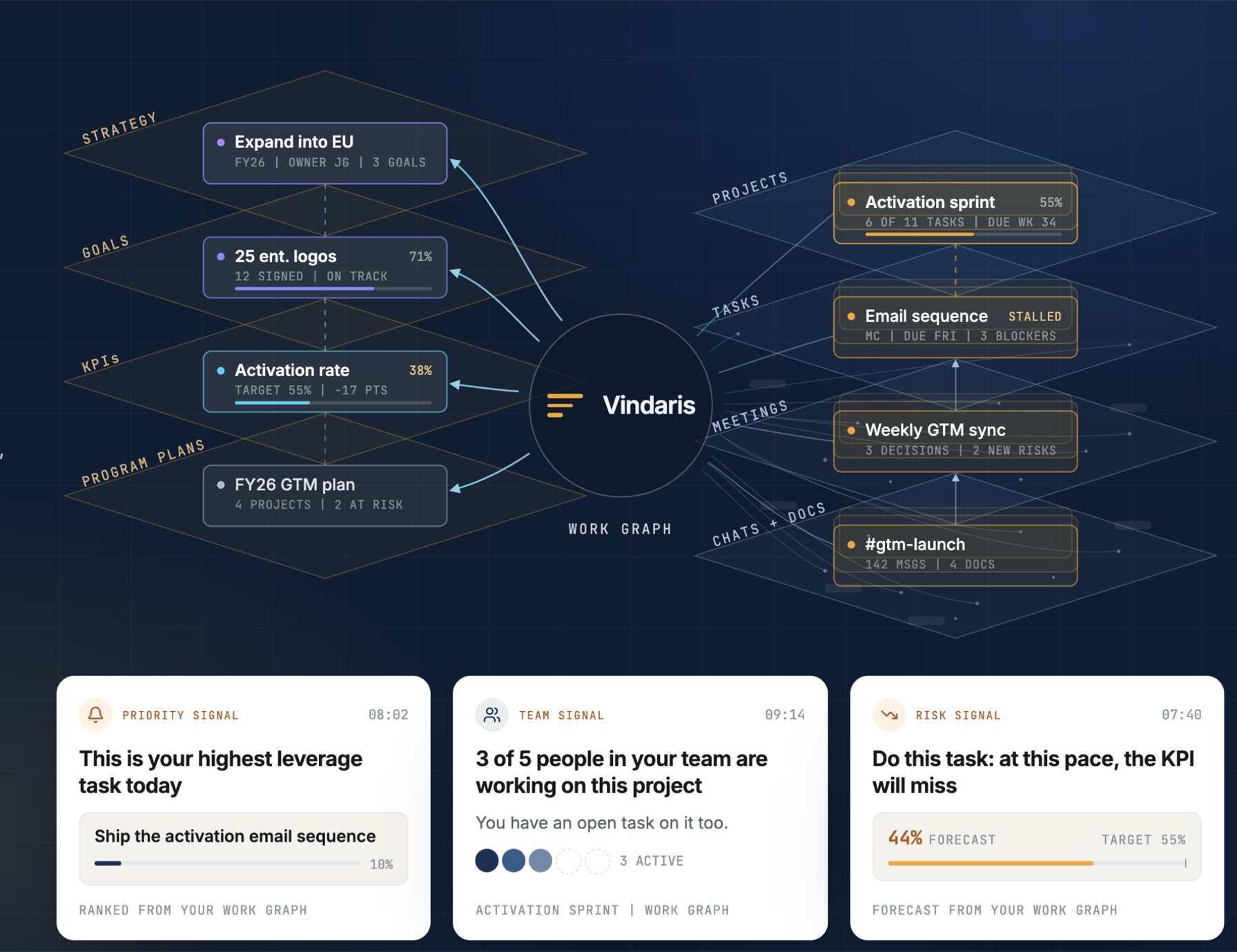
Vindaris feeds your OKRs from the work itself, not a check-in cycle. It analyzes the work activity behind every goal, the tasks and conversations beneath it, derives live status, and flags a goal the moment its work stalls. Quantive is a mature enterprise OKR suite, but it still relies on what people type in each cycle.





Last reviewed August 2026
Quantive, formerly Gtmhub, was acquired by WorkBoard in 2025 as part of a consolidation of the enterprise OKR market. For existing customers this raises the usual acquisition questions: product migration, re-contracting, and a roadmap now controlled by a different company. Many teams treat it as the natural moment to re-evaluate the category rather than the vendor.
A deep OKR suite, fed by a shallow signal.
Quantive built one of the most complete OKR feature sets in the category, and enterprises adopted it for good reasons. Progress still resolves to percent complete from a check-in, so the tasks and Slack threads underneath the goal stay outside the model.
Quantive, formerly Gtmhub, was one of the more technically capable OKR platforms on the market. Good API coverage, a real integration marketplace, and a data-oriented approach to key results that suited teams with analysts. WorkBoard acquired it in 2025 to consolidate the enterprise OKR market.
Acquisitions in this category follow a familiar pattern. The acquired product is maintained for twelve to eighteen months, then merged into the acquirer's platform. Features get rationalized, pricing is renegotiated, and the roadmap answers to a company you did not choose. The product you bought is rarely the product you have two years later. If you are already re-evaluating, that is the moment to ask whether the replacement should differ structurally rather than cosmetically.
Quantive and WorkBoard share one architectural limitation. Both are goal-tracking layers. They store objectives, collect reported progress, and render dashboards. Neither carries a native work layer, so the effort that should prove whether a goal is being met lives in Jira, Asana, Planner or a spreadsheet. Merging two goal trackers produces a larger goal tracker.
What teams consistently praised
- Mature, complete enterprise OKR feature set.
- Strong alignment and cascading across large orgs.
- Long integration list and flexible reporting.
- Well understood by consultants and OKR coaches.
Where teams hit the limit
- Progress resolves to a percentage from a check-in.
- No task-level model beneath the key result.
- Acquisition and product consolidation created roadmap uncertainty.
- Feature depth increases the cost of keeping data current.
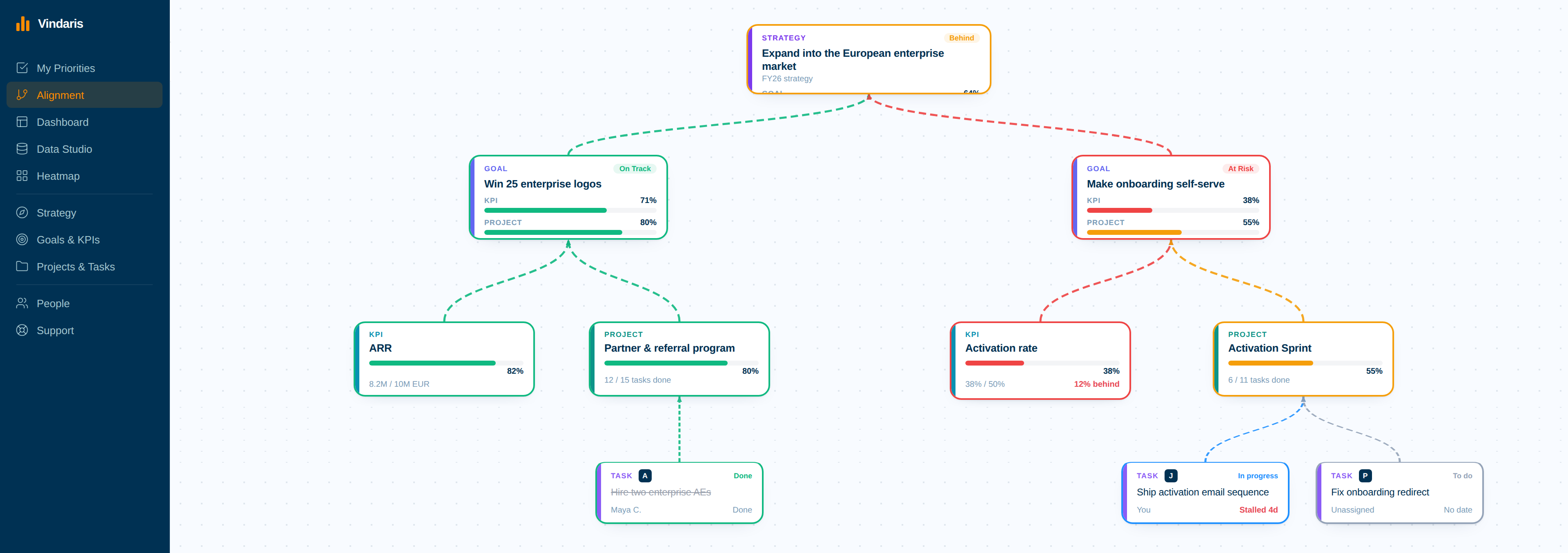
Feature depth does not fix the data source.
- Goals live in one system. Work lives in another.
- Teams update goals as a reporting exercise.
- Integrations move a percentage, not traceable links between effort and outcome.
- Dashboards show what teams reported, which is not what happened.
- Roadmap direction changed after acquisition.
- A roadmap that is not being merged into an acquirer's platform.
- A native work layer, not connectors that move key-result values without context.
- Published pricing and a free tier, so re-evaluation costs nothing.
- Risk detected from task movement rather than dashboard thresholds.
- Configuration that does not require an owner to keep it accurate.
Quantive models the objective. It does not model the task.
Quantive, formerly Gtmhub, was the most data-oriented product in the category. Its insight boards and connector marketplace could pull a key-result value from almost anywhere. The architecture treats work as a data source rather than as a modelled object, which is the distinction that survived the acquisition.
| Object | Quantive | Vindaris |
|---|---|---|
| Central object | The objective, with connected metric feeds | The task, and the edges up to the goal |
| What a connector moves | A number | Tasks, owners, state and the relationships between them |
| Behind a key-result value | The query that produced it | The projects and tasks that produced the outcome |
| Risk signal | A threshold crossed on a reported number | Pace, focus and capacity against plan |
| Upkeep | An owner maintaining connectors and insight boards | Sync runs itself once the tools are connected |
Pulling a number from a warehouse tells you the metric moved. It does not tell you which work moved it, which is the question a quarterly review actually turns on. Vindaris syncs the work itself, so the objective and the delivery are the same graph rather than a metric and its source.
Five views that keep strategy and execution in sync.
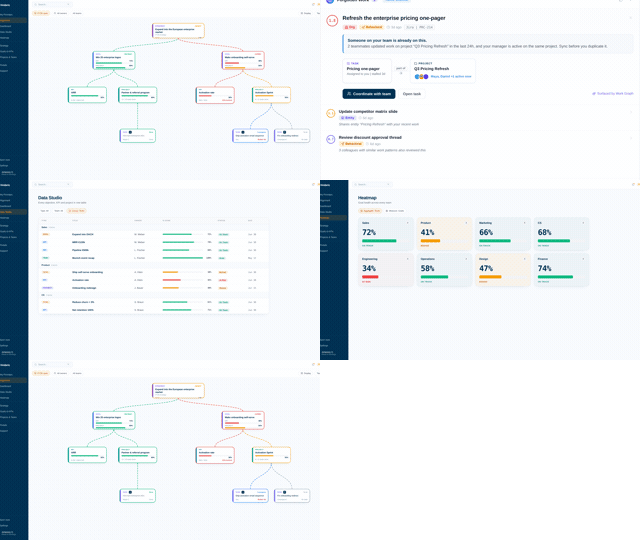
See every goal connected to the work moving it.
Drag and drop your alignment structure. Roll up work progress, KPIs and goals without enforcing any framework syntax.
Alignment Canvas →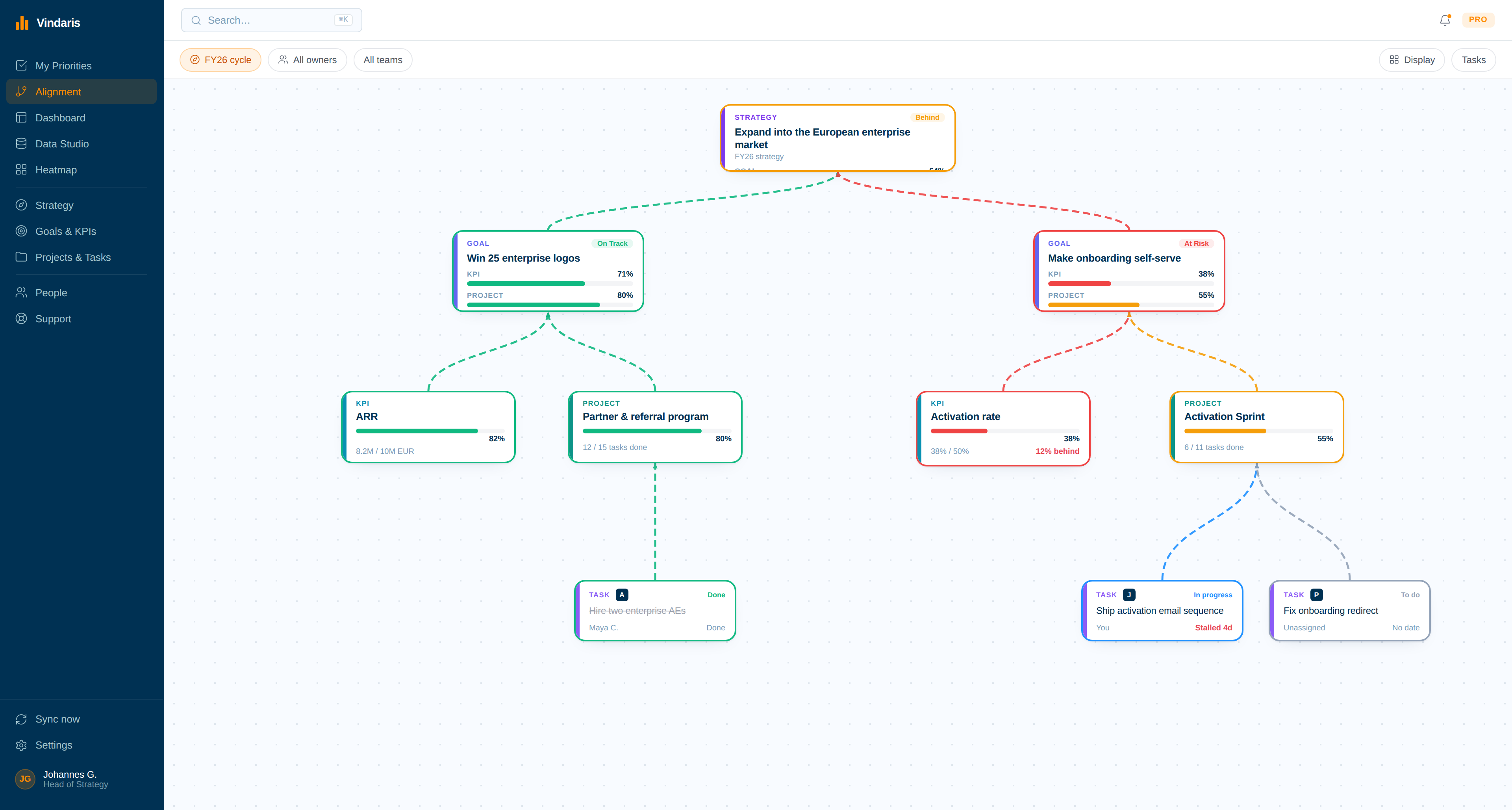
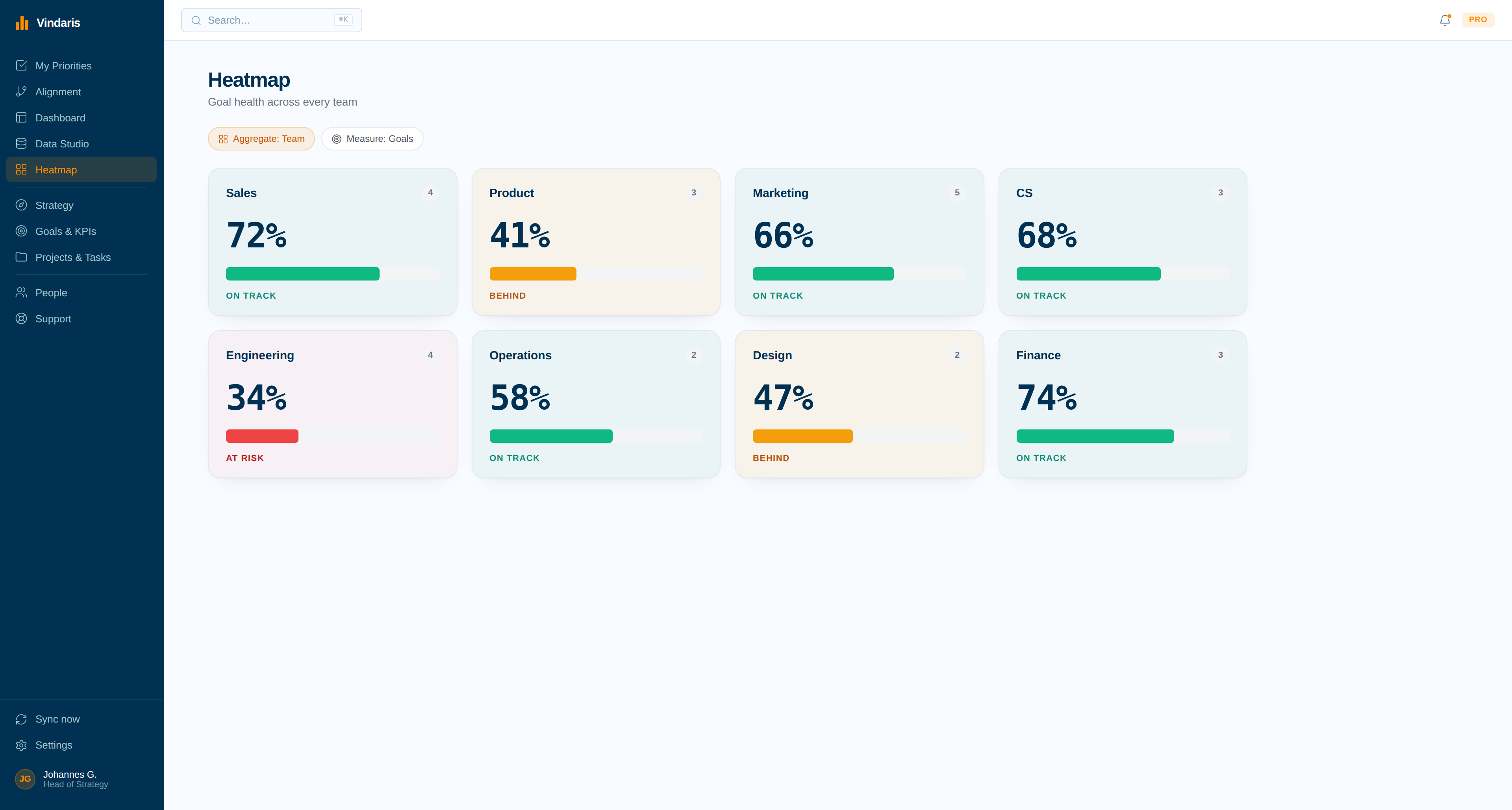
Spot risk while there is still time to fix it.
Run heatmaps across teams, goals, KPIs and projects. Save views and get notified when risk levels change, from task movement rather than a reported number.
Combine tasks and projects across your systems.
Sync HubSpot, MS Planner, Google Tasks, Asana and more into one view. Bidirectional sync keeps everything current while teams stay in their own tools.
All integrations →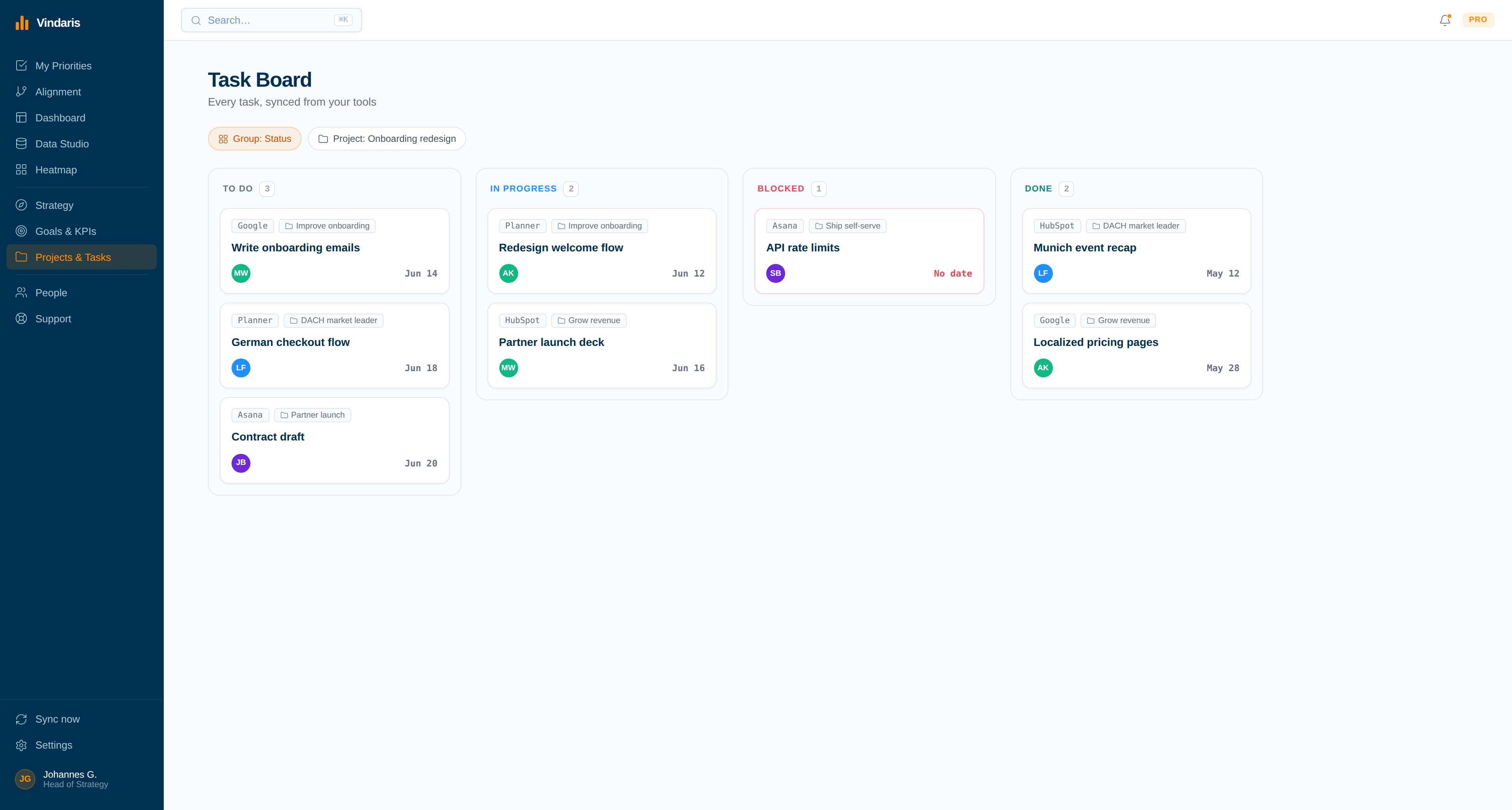
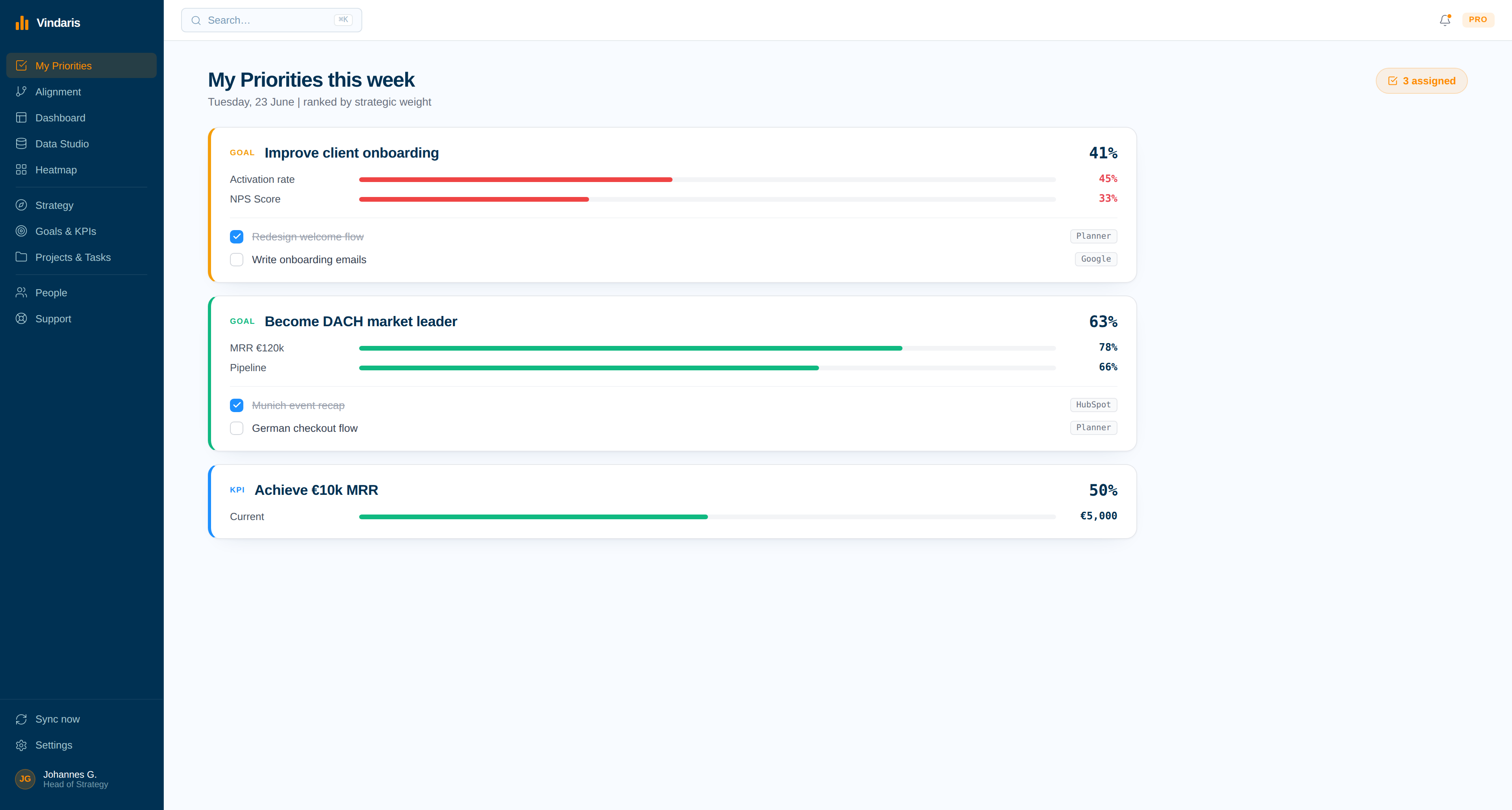
Everyone knows exactly what matters most.
A clear view of each person's goals, KPIs, projects and tasks. Start the week focused on what is due.
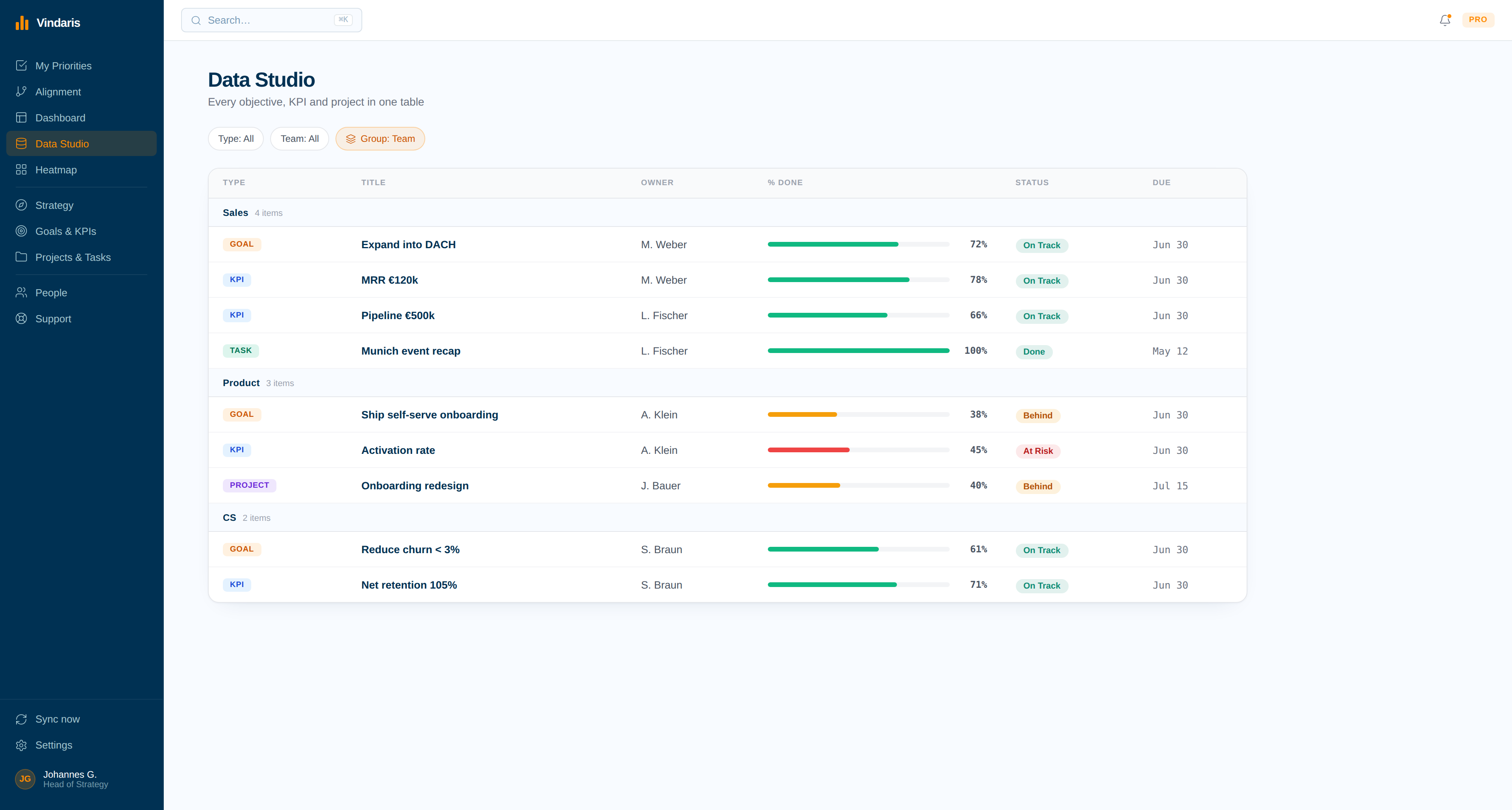
Run reports the way management needs them.
Rank teams, spot risks, compare KPIs to work. AI summaries push updates to Slack, Teams and email.
Bring the OKR tree. Leave the check-in behind.
Existing customers are facing a migration either way. This one ends somewhere with published pricing and a roadmap that is not owned by a competitor.
Quantive's API is one of the better ones in the category, so a scripted export of objectives, key results, owners and current values is straightforward. The standard export covers the same ground if you would rather not write code.
The metric connectors and insight boards do not need recreating. They existed to move numbers into the goal layer; Vindaris syncs the work those numbers describe, so the goal reads from source rather than from a query someone maintains.
Connect Jira, Asana, Planner, HubSpot or Google. Tasks arrive with owners and projects attached, and the objectives gain a layer underneath them that Quantive never modelled.
Quantive's flexibility came with an upkeep cost: someone had to keep the connectors and boards accurate or the data quietly rotted. That role does not transfer, because there is no query layer to maintain.
Free forever for up to 5 people. No credit card required.
Start free Book a demo No credit card requiredVindaris vs Quantive, feature by feature.
Quantive wins on feature breadth. This table compares what each product knows about the work beneath the key result.
| Feature | Vindaris | Quantive |
|---|---|---|
| How progress is measured | Read from task-level work and Slack context in the tools your team already uses. | Check-ins, metric connectors and manual updates against stored objectives. |
| Goal frameworks supported | Framework-agnostic: OKR, KPI, EOS Rocks, OGSM, SMART, Balanced Scorecard, or hybrid. | OKR-first, with KPI tracking layered on top. |
| Connection to work activity | Native work layer with bidirectional sync to HubSpot, Planner, Google, Jira, Asana. | No native work layer. Delivery stays in Jira, Asana, Planner and spreadsheets. |
| Risk detection | Automatic execution-risk flags from task movement, focus and pace against plan. | Dashboard thresholds on reported numbers, not detection from task movement. |
| Status reporting | Live views and AI risk summaries pushed to Slack, Teams, and email. | Insight boards and data-warehouse style connectors. |
| Capacity and bandwidth | Built-in bandwidth and capacity planning. | Not covered. |
| Ownership model | Single-owner accountability enforced structurally. | Objective owner, with shared key results common in practice. |
| Free plan | Free forever, including 2 integrations and up to 5 people. | No free tier. Enterprise pricing on quote, now under WorkBoard. |
| Best fit | Teams leaving an acquired tool who want the next one to be structurally different. | Organizations already committed to the WorkBoard platform and its roadmap. |
The category as a whole is compared in the best strategy execution software guide, and the argument underneath it is set out in the strategy execution gap whitepaper.
An acquired enterprise contract, or a published price.
Quantive's pricing now sits inside WorkBoard's commercial model, which means quote-based enterprise terms and a renewal conversation with a company you did not originally choose.
| Plan | Quantive | Vindaris |
|---|---|---|
| Free tier | Free tier withdrawn. Historically available, then discontinued. | Free forever. Up to 5 people, 2 integrations, all core features. |
| Entry paid plan | Not published. Quoted, now under WorkBoard. | Connect, EUR 10 per user per month. All integrations, unlimited sync. |
| Upper plan | Not published. Enterprise configurations negotiated. | Pro, EUR 20 per user per month. Unlimited users in one organization. |
| Published pricing | No. Evaluation begins with a sales conversation. | Yes, on the website. No quote required to evaluate. |
| Minimum commitment | Annual contract, with renewal terms set post-acquisition. | None. No seat minimum, no annual term, no setup fee. |
Vindaris publishes every tier: free forever for up to 5 people, EUR 10 per user per month for Connect, EUR 20 for Pro. No minimum contract, so the evaluation costs nothing but the time.
Best for individual contributors, small teams or startups. No credit card required.
- All features (incl. Alignment Canvas, My Priorities, Heatmap, Data Studio & Task Board)
- Set up 2 integrations of your choice
- Invite up to 4 additional members
- 5 ad-hoc AI risk summaries per month
Best for teams, small agencies, or departmental and team management.
- All in Free
- All integrations, unlimited sync
- Unlimited AI risk summaries & alignment suggestions - ad-hoc and scheduled
- Up to 10 users within one organization
Best for multiple teams, exec teams, Chiefs of Staff, departmental leadership or full-org deployments.
- All in Connect
- Unlimited users within one organization
- Direct human support email, 24h response time
- Human-led onboarding support
Common questions, answered
What happened to Quantive Results?
What is the best Quantive alternative?
How is Vindaris different from Quantive and WorkBoard?
Can I migrate from Quantive to Vindaris?
Free resources for this topic
A template you can download, a playbook to run, and the thinking behind both. No email required.
Or start with the full picture: strategy execution software that connects your plan to the work delivering it.
Switching from Quantive is a choice. Repeating its architecture is optional.
Free forever for up to 5 people. No credit card required.