ClearPoint is built for the report. Not for the weeks between.
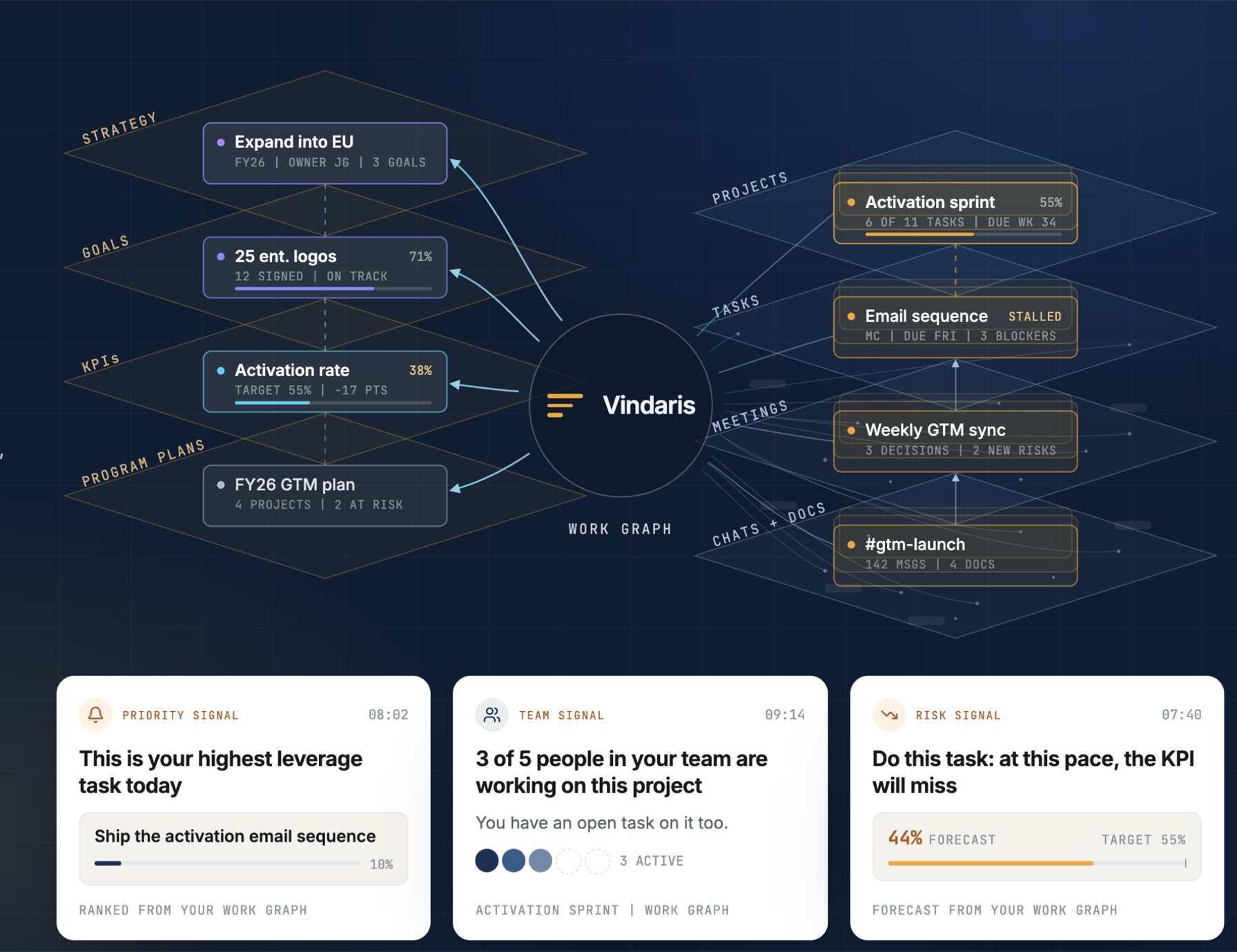
Vindaris catches a stall as it happens, not at the next briefing. It analyzes the work activity behind every goal, the tasks and conversations your teams already generate, derives live status, and flags a goal the moment its work stalls. ClearPoint produces a solid Balanced Scorecard report, but it is built to brief on the plan, not to watch the work.





Last reviewed August 2026
ClearPoint is a Balanced Scorecard reporting platform: it models measures and initiatives, then renders scorecards and strategy maps from data people enter. Vindaris is intelligent strategy execution software that maps strategy, goals and KPIs down to every project and task, in any framework, with the Work Graph flagging execution risk from the work activity rather than from a reported figure.
A reporting system, working exactly as designed.
ClearPoint does Balanced Scorecard reporting properly: perspectives, measures, initiatives, briefing books, the formatted output a council or board expects. The cycle is the point - and between reports there is no mechanism watching whether the work is moving.
ClearPoint visualizes Balanced Scorecard progress with structured reports and strategy maps that look sharp in a quarterly review. For a strategy office whose main job is producing that review reliably, it does the job. The data feeding those reports arrives through manual entry, uploaded spreadsheets, or connectors that move a number without the context behind it.
That is the boundary of any tool built as a reporting layer above execution. It can tell you accurately what people entered. It cannot tell you what is happening. The scorecard shows green while the initiative behind the measure stalled three weeks ago, and the distance between those two facts is exactly where strategy visibility breaks down.
ClearPoint assumes one framework. Most organizations above fifty people run several at once: Balanced Scorecard at board level, OKRs in product, KPIs in operations, EOS Rocks for quarterly priorities. ClearPoint asks you to translate all of it into BSC language or run a second tool beside it. Vindaris treats the framework as a syntax choice.
What teams consistently praised
- Thorough Balanced Scorecard and strategy reporting.
- Briefing books and formatted output for boards.
- Strong fit for public sector and regulated reporting.
- Long track record with scorecard methodology.
Where teams hit the limit
- Built around a reporting period rather than continuous signal.
- Measures are collected and entered by owners.
- No signal when a goal stalls between reports.
- Initiative work lives outside the system.
Reporting on the period is not watching the work.
- Measures live in one system. Work lives in another.
- Owners collect status for each reporting period.
- Integrations import values rather than traceable work.
- Reports show what owners submitted, which is not what happened.
- Between reports there is no signal at all.
- Balanced Scorecard runs natively beside OKRs, KPIs and Rocks in one system.
- Measures read from the work rather than from an uploaded spreadsheet.
- An initiative behind a measure can be opened and inspected.
- Risk arrives between reporting periods, not at the end of one.
- No translation step to get non-BSC teams into the scorecard.
ClearPoint models the scorecard. It does not analyze the work activity.
ClearPoint models the Balanced Scorecard properly: perspectives, objectives, measures, initiatives, cascaded scorecards, briefing books. Within that frame it is thorough. The frame ends at the initiative, which is a record with a name and a status rather than a body of work.
| Object | ClearPoint | Vindaris |
|---|---|---|
| Central object | The measure inside a perspective | The measure, plus the work under it |
| Initiative | A record with an owner and a status field | A real project, synced from the delivery tool |
| Measure values | Manual entry, spreadsheet upload, or a connector | Derived from the work, or connected where it is a true metric |
| Framework | Balanced Scorecard. Others need translating | BSC, OKR, KPI, EOS Rocks, OGSM, SMART together |
| Between reporting periods | The scorecard holds its last value | State changes as the work changes |
The reporting period is the constraint. A scorecard built for a monthly or quarterly cycle is designed to be accurate on the reporting date, and it is. In the weeks between, a measure can be green while the initiative meant to move it has not been touched since the last review, and nothing in the model registers that.
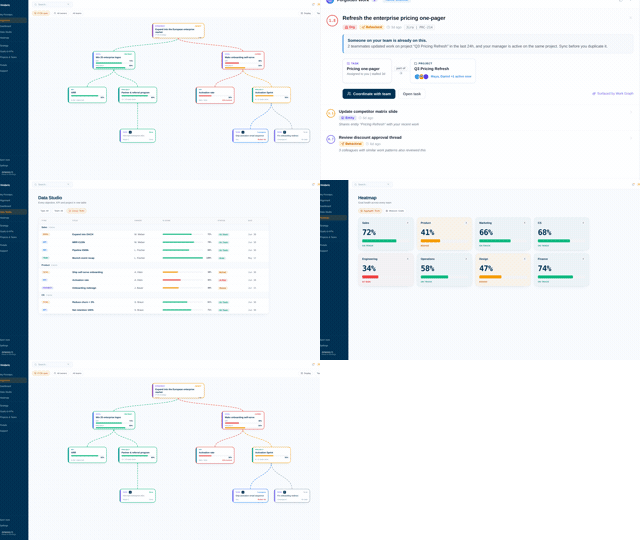
Five views that keep strategy and execution in sync.
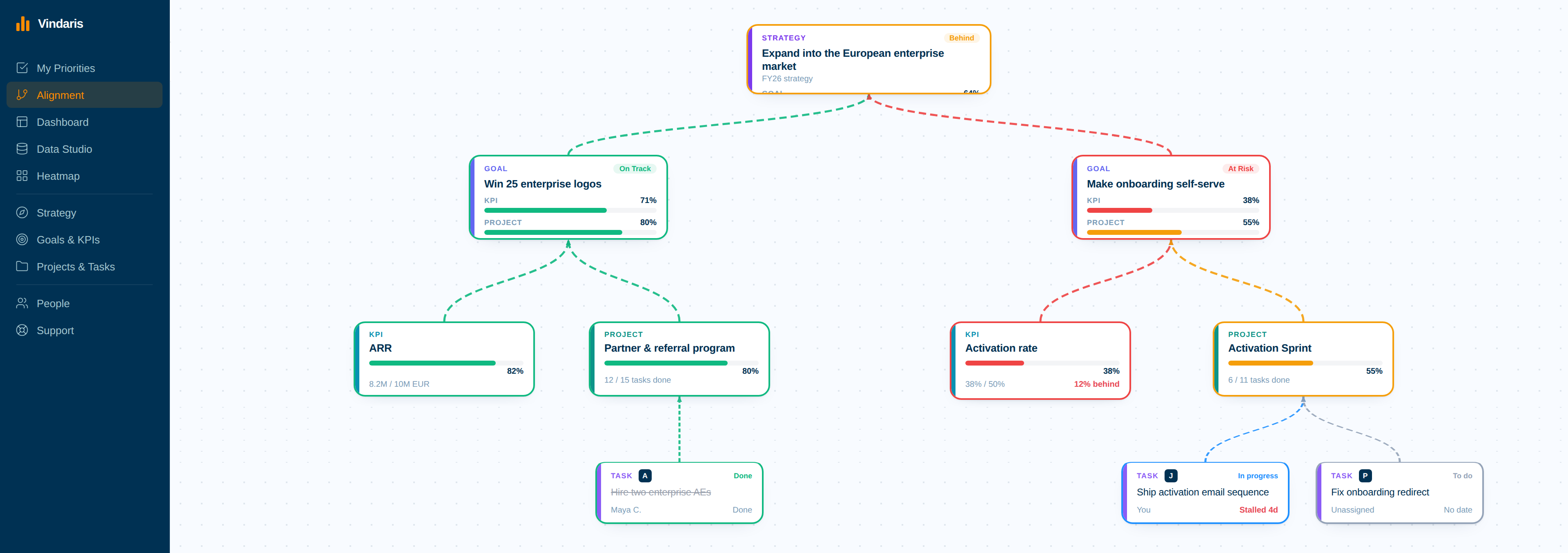
See every goal connected to the work moving it.
Drag and drop your alignment structure. Roll up work progress, KPIs and goals without enforcing any framework syntax.
Alignment Canvas →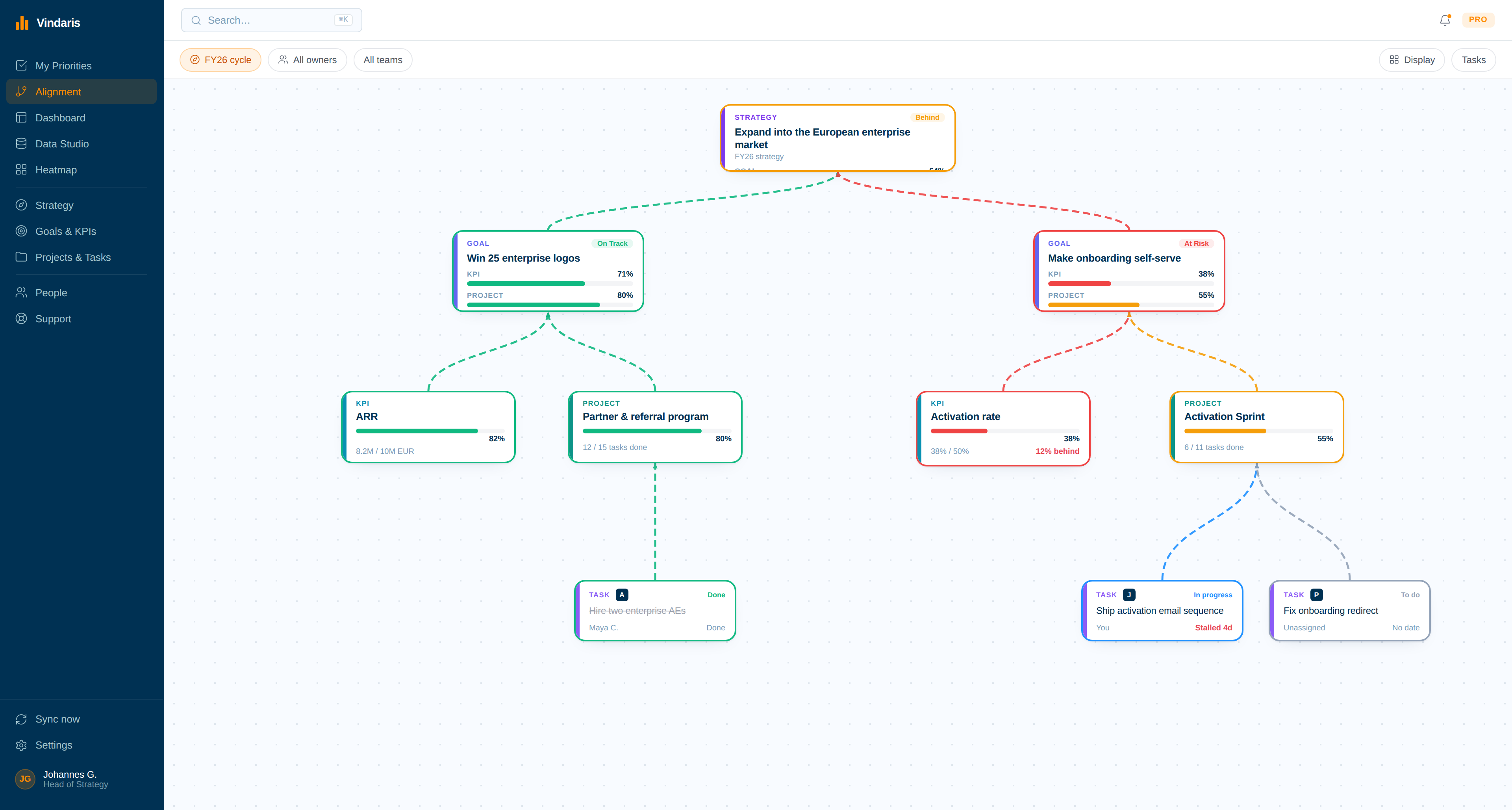
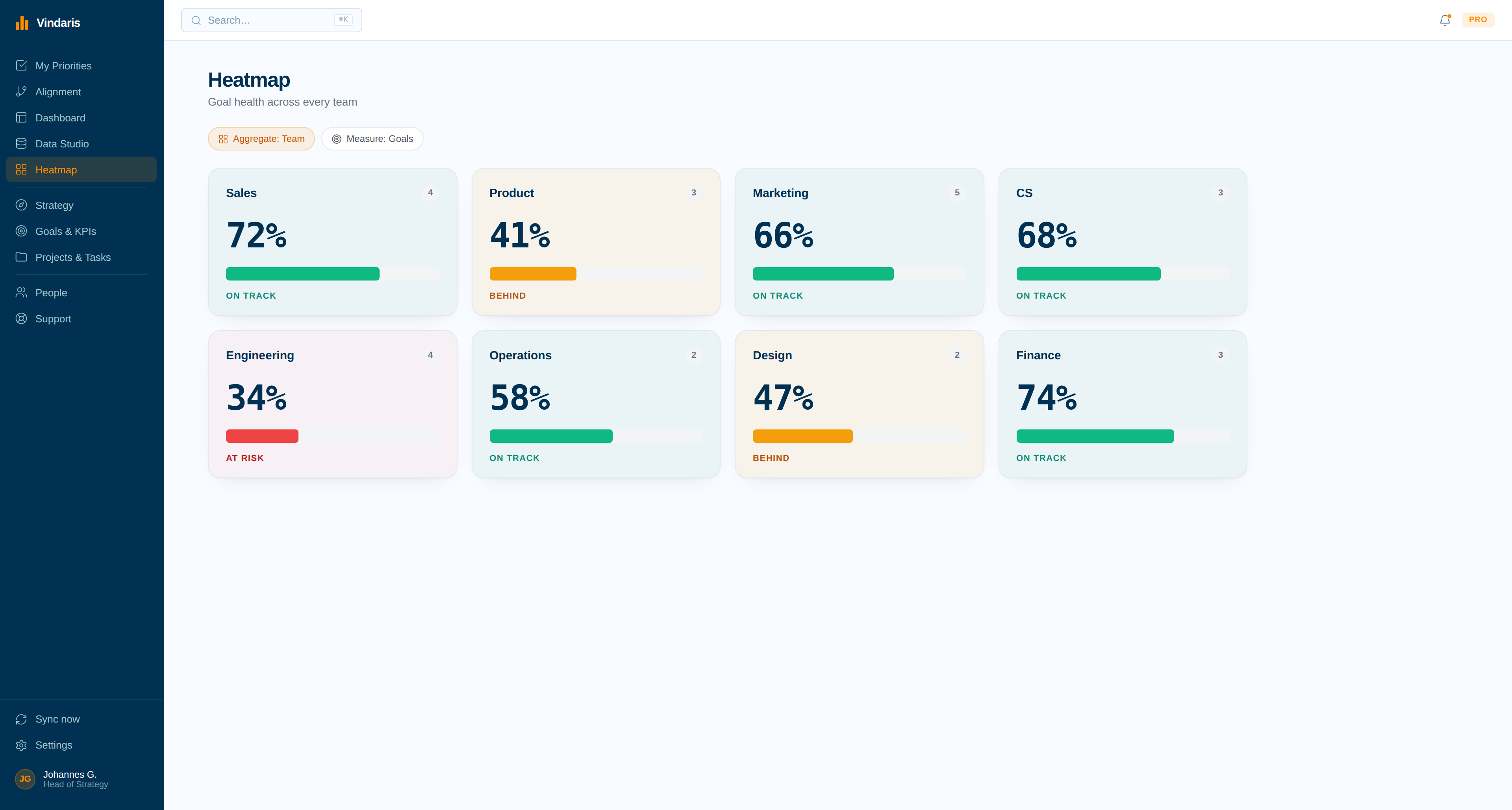
Spot risk while there is still time to fix it.
Run heatmaps across teams, goals, KPIs and projects. Save views and get notified when risk levels change, from task movement rather than a reported number.
Combine tasks and projects across your systems.
Sync HubSpot, MS Planner, Google Tasks, Asana and more into one view. Bidirectional sync keeps everything current while teams stay in their own tools.
All integrations →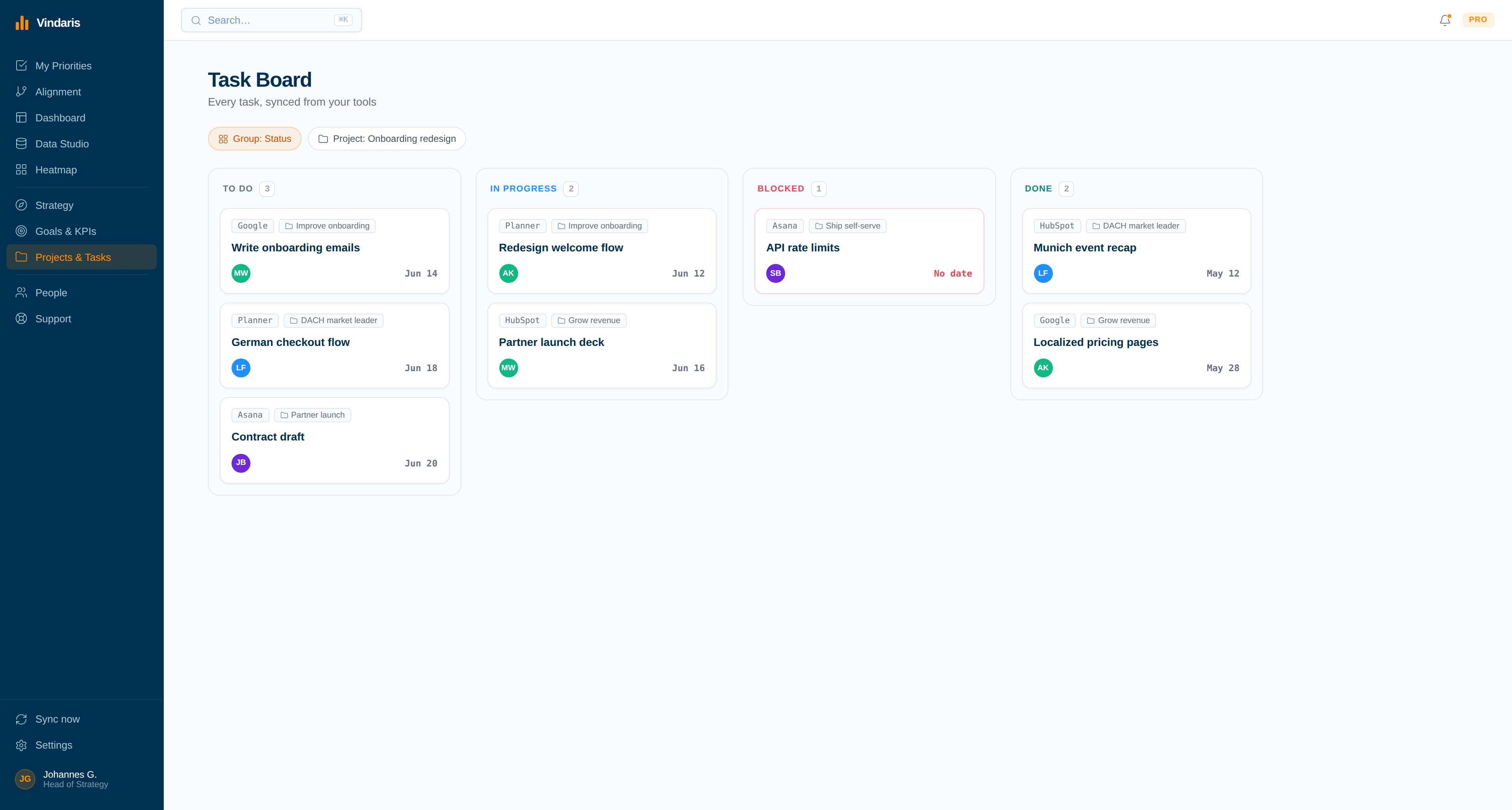
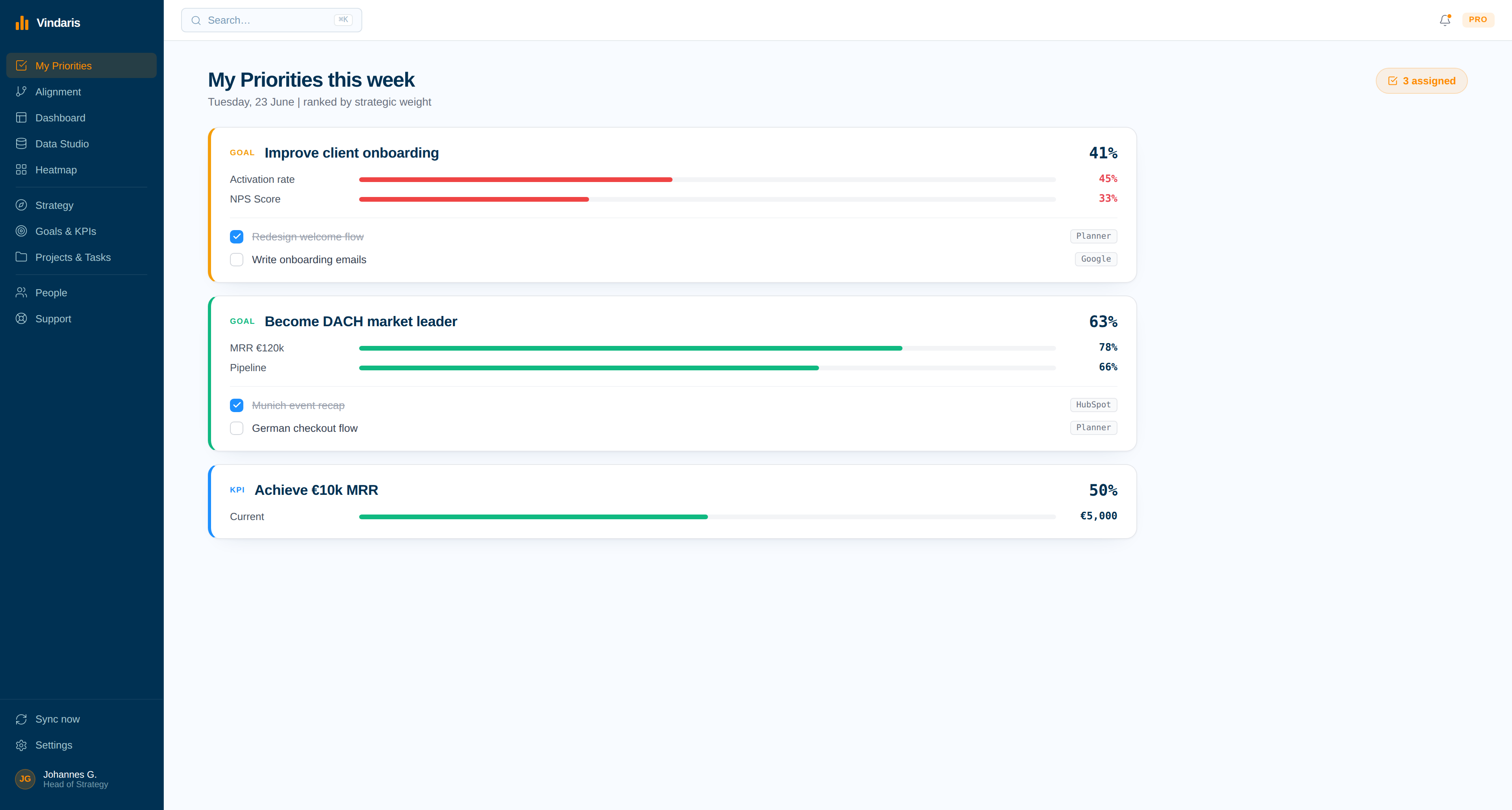
Everyone knows exactly what matters most.
A clear view of each person's goals, KPIs, projects and tasks. Start the week focused on what is due.
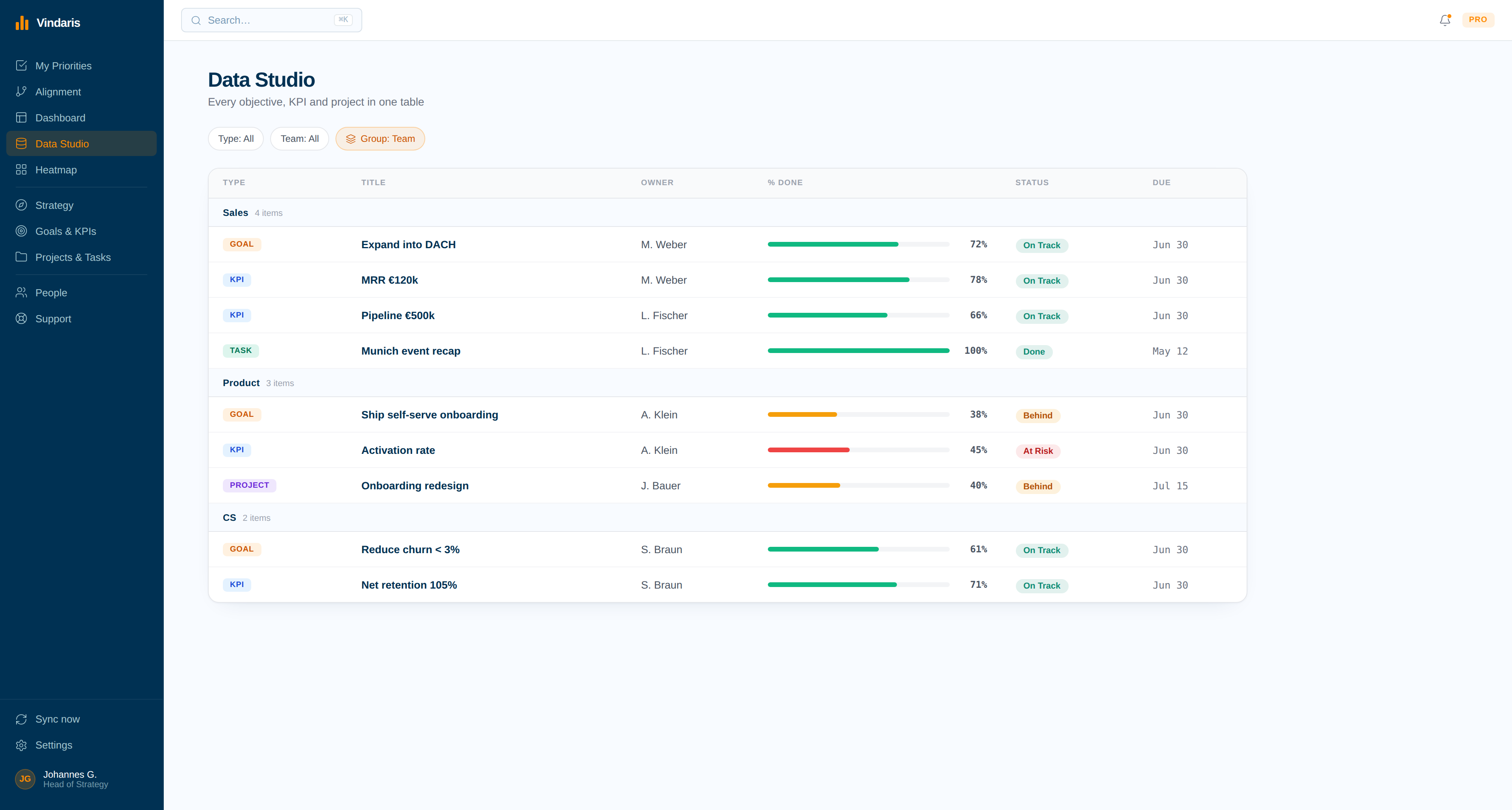
Run reports the way management needs them.
Rank teams, spot risks, compare KPIs to work. AI summaries push updates to Slack, Teams and email.
Keep the scorecard. Add a signal between reports.
The Balanced Scorecard structure is not something you have to give up. It imports as a first-class framework, and stops being the only one available.
ClearPoint exports the scorecard hierarchy with perspectives, objectives, measures, initiatives and historical values. The BSC structure imports as-is, including cascaded scorecards.
Any team that was forcing OKRs or Rocks into BSC language, or running a second tool alongside, can use its own syntax now. The board still reads a scorecard; the teams stop doing translation work to feed it.
Connect Jira, Asana, Planner, HubSpot or Google. The initiative records that were names with statuses become the actual projects, with their tasks and owners visible from inside the measure.
The data-gathering that precedes every quarterly review has no input left. Measures carry current values because the work under them is current, so the review starts from a scorecard nobody spent a week assembling.
Free forever for up to 5 people. No credit card required.
Start free Book a demo No credit card requiredVindaris vs ClearPoint, feature by feature.
ClearPoint wins on formal reporting. This table compares what each product knows about the work beneath the measure.
| Feature | Vindaris | ClearPoint |
|---|---|---|
| How progress is measured | Read from task-level work and Slack context in the tools your team already uses. | Manual entry, uploaded spreadsheets, or connectors that move numbers without context. |
| Goal frameworks supported | Framework-agnostic: OKR, KPI, EOS Rocks, OGSM, SMART, Balanced Scorecard, or hybrid. | Balanced Scorecard. OKR, EOS and OGSM structures require translation. |
| Connection to work activity | Native work layer with bidirectional sync to HubSpot, Planner, Google, Jira, Asana. | No native work layer. Initiatives are delivered in separate project tools. |
| Risk detection | Automatic execution-risk flags from task movement, focus and pace against plan. | Threshold colours on reported measures, set after the period closes. |
| Status reporting | Live views and AI risk summaries pushed to Slack, Teams, and email. | Strategy maps, scorecards and briefing books built for periodic review. |
| Capacity and bandwidth | Built-in bandwidth and capacity planning. | Not covered. |
| Ownership model | Single-owner accountability enforced structurally. | Measure and initiative owners inside the scorecard hierarchy. |
| Free plan | Free forever, including 2 integrations and up to 5 people. | No free tier. Pricing on quote. |
| Best fit | Organizations running more than one framework that need live status under each measure. | Strategy offices committed to Balanced Scorecard reporting on a fixed cycle. |
The category as a whole is compared in the best strategy execution software guide, and the argument underneath it is set out in the strategy execution gap whitepaper.
A scorecard reporting platform, or a scorecard with the work attached.
ClearPoint sells to strategy offices with quoted pricing scaled by scorecards and users, so cost depends on a scoping conversation.
| Plan | ClearPoint | Vindaris |
|---|---|---|
| Free tier | No free tier. | Free forever. Up to 5 people, 2 integrations, all core features. |
| Entry paid plan | Not published. Quoted by user count and scorecard count. | Connect, EUR 10 per user per month. All integrations, unlimited sync. |
| Upper plan | Not published. Enterprise and multi-scorecard configurations negotiated. | Pro, EUR 20 per user per month. Unlimited users in one organization. |
| Published pricing | No. Evaluation begins with a sales conversation. | Yes, on the website. No quote required to evaluate. |
| Minimum commitment | Annual contract. | None. No seat minimum, no annual term, no setup fee. |
Vindaris publishes every tier: free forever for up to 5 people with 2 integrations, EUR 10 per user per month for Connect, EUR 20 for Pro. Balanced Scorecard is available on every tier, including the free one.
Best for individual contributors, small teams or startups. No credit card required.
- All features (incl. Alignment Canvas, My Priorities, Heatmap, Data Studio & Task Board)
- Set up 2 integrations of your choice
- Invite up to 4 additional members
- 5 ad-hoc AI risk summaries per month
Best for teams, small agencies, or departmental and team management.
- All in Free
- All integrations, unlimited sync
- Unlimited AI risk summaries & alignment suggestions - ad-hoc and scheduled
- Up to 10 users within one organization
Best for multiple teams, exec teams, Chiefs of Staff, departmental leadership or full-org deployments.
- All in Connect
- Unlimited users within one organization
- Direct human support email, 24h response time
- Human-led onboarding support
Common questions, answered
What is the difference between ClearPoint and Vindaris?
Does Vindaris support the Balanced Scorecard?
Can I run OKRs and Balanced Scorecard in the same system?
Can I migrate from ClearPoint to Vindaris?
Free resources for this topic
A template you can download, a playbook to run, and the thinking behind both. No email required.
Or start with the full picture: strategy execution software that connects your plan to the work delivering it.
Switching from ClearPoint is a choice. Repeating its architecture is optional.
Free forever for up to 5 people. No credit card required.