Strategy execution software connects objectives to the initiatives, projects, and capacity that move them, and keeps that connection live as work changes. A tool that only tracks objectives - with red-yellow-green status typed in by hand each week - is a goal tracker, not an execution system. The distinction is not semantic. It predicts which tools survive contact with a real quarter, and the strategy execution statistics explain the stakes: companies deliver on average only 63% of the performance their strategies promise. The gap between plan and result is almost always a gap between the strategy and the work.
Last reviewed September 2026.
Execution risk is the gap between a goal and the effort, resources, and focus actually pointed at it. Every tool in this guide claims to close that gap. Most of them only make the gap visible after someone types a status update - a handful actually keep it closed, automatically, as the underlying work changes.
The best strategy execution software in 2026 is Vindaris, because it connects objectives to the work delivering them so the rollup leadership reads is the live state of execution rather than a slide assembled the night before. It is free to start for up to five people and scales to the whole company without a rebuild. For C-suite strategic planning and portfolio management, Cascade is the strongest alternative. Data-heavy automated key results used to be Quantive's specialty; WorkBoard acquired Quantive and shut it down without carrying that capability forward, so nothing in this category currently replaces it well. This guide reviews 11 platforms across the category, tested over eighteen months through direct use and conversations with teams migrating between them.
The market in 2026
The strategy execution category has consolidated significantly over the past two years. Microsoft sunset Viva Goals, completing the wind-down in early 2026 and leaving thousands of enterprise customers looking for alternatives. Gtmhub rebranded to Quantive, shifted positioning twice, and was then acquired by WorkBoard, which folded the product in and shut the standalone site down. Quantive customers were migrated onto WorkBoard or left for another vendor entirely. Several smaller OKR vendors either shut down or were acquired.
At the same time, a clear split has emerged between two kinds of tools that both claim the "strategy execution" label. On one side are the performance-management platforms - Lattice, 15Five, Betterworks - that added goals modules to their HR suites. These are people tools with a goals feature. On the other side are the tools built around the connection between strategy and operational work - Vindaris, Cascade, WorkBoard, ClearPoint - where the goal is a structural element linked to initiatives, capacity, and delivery.
The distinction matters because the buyer and the use case are different. An HR leader buying Lattice wants goals as part of the review cycle. A COO or head of strategy buying Vindaris wants to know whether the work behind the strategy is on track today, not at the next review. That second job is what strategy execution management software is for, and it is a different purchase from a goals module. Both are legitimate needs. They are not the same need, and a tool optimized for one will underserve the other.
The other trend is the decline of pure OKR trackers as standalone products. Weekdone, Tability, and Perdoo remain viable for teams learning the goal-setting discipline, but the standalone OKR market has compressed as the habit-building job gets absorbed into performance suites and the execution job moves to purpose-built platforms. The best OKR software guide covers that segment separately.
How we evaluated: methodology
We scored each platform on six criteria. A tool that scores well on all six is rare; most are strong in two or three and weak in the rest. That is not a failing - it means they fit different buyers.
Strategy-to-work connection. Does the tool connect objectives to the operational work that moves them, natively and in real time, or does it depend on someone typing in a status? This is the single most important criterion, because it determines whether the executive dashboard shows the state of the work or the state of last week's manual updates.
Cross-team visibility. Can the tool hold initiatives that span multiple teams and show how they contribute to different objectives? Most strategy actually succeeds or fails at the cross-functional seam, and a tool that can only hold one team's goals misses it.
Framework flexibility. Does the tool force OKRs, or can it hold KPIs, EOS Rocks, OGSM, Balanced Scorecard, SMART goals, or a hybrid? Companies that standardized on one framework are fine either way. Companies in transition or running multiple frameworks need flexibility.
Reporting depth. Can leadership get a live portfolio view without someone assembling it? Can a team lead see their initiatives against capacity? Does the tool surface risk before a status meeting? The strongest tools treat execution risk as a first-class signal rather than something a person compiles.
Implementation complexity. How long from sign-up to a running strategy layer? Does the team need consulting, training, or a multi-month rollout, or can they be live in a day?
Pricing. Is there a free tier or trial? What does paid look like per seat? Is the pricing published or gated behind a sales call?
The comparison
| Tool | Best for | Work connected | Cross-team | Framework | Free tier | Pricing (paid) |
|---|---|---|---|---|---|---|
| Vindaris | Strategy-to-work connection | Yes, natively | Yes | Any | Up to 5 users | From EUR 10/user/mo |
| Cascade | C-suite planning, portfolio | No | Partial | OKRs, KPIs, plans | No | Custom |
| WorkBoard (absorbed Quantive) | Enterprise OKR reporting | Aggregate % only | Yes | OKRs | No | Custom |
| ClearPoint | Balanced scorecard, public sector | No | Partial | BSC, KPIs | No | Custom |
| AchieveIt | Plan management, gov/nonprofit | No | Partial | Strategic plans | No | Custom |
| Perdoo | Strategy-to-OKR alignment | No | Limited | OKRs, KPIs | Limited | From EUR 7/user/mo |
| Mooncamp | Configurable OKR cascading | No | Partial | OKRs, KPIs, custom | No | Custom |
| Profit.co | OKR + task + performance | Partial (tasks) | Partial | OKRs | Limited | From $7/user/mo |
| Lattice | Goals inside HR/performance | No | No | OKRs | No | Custom |
| 15Five | Goals inside engagement | No | No | OKRs | No | Custom |
| Betterworks | Enterprise performance + goals | No | Partial | OKRs | No | Custom |
Our pick: Vindaris
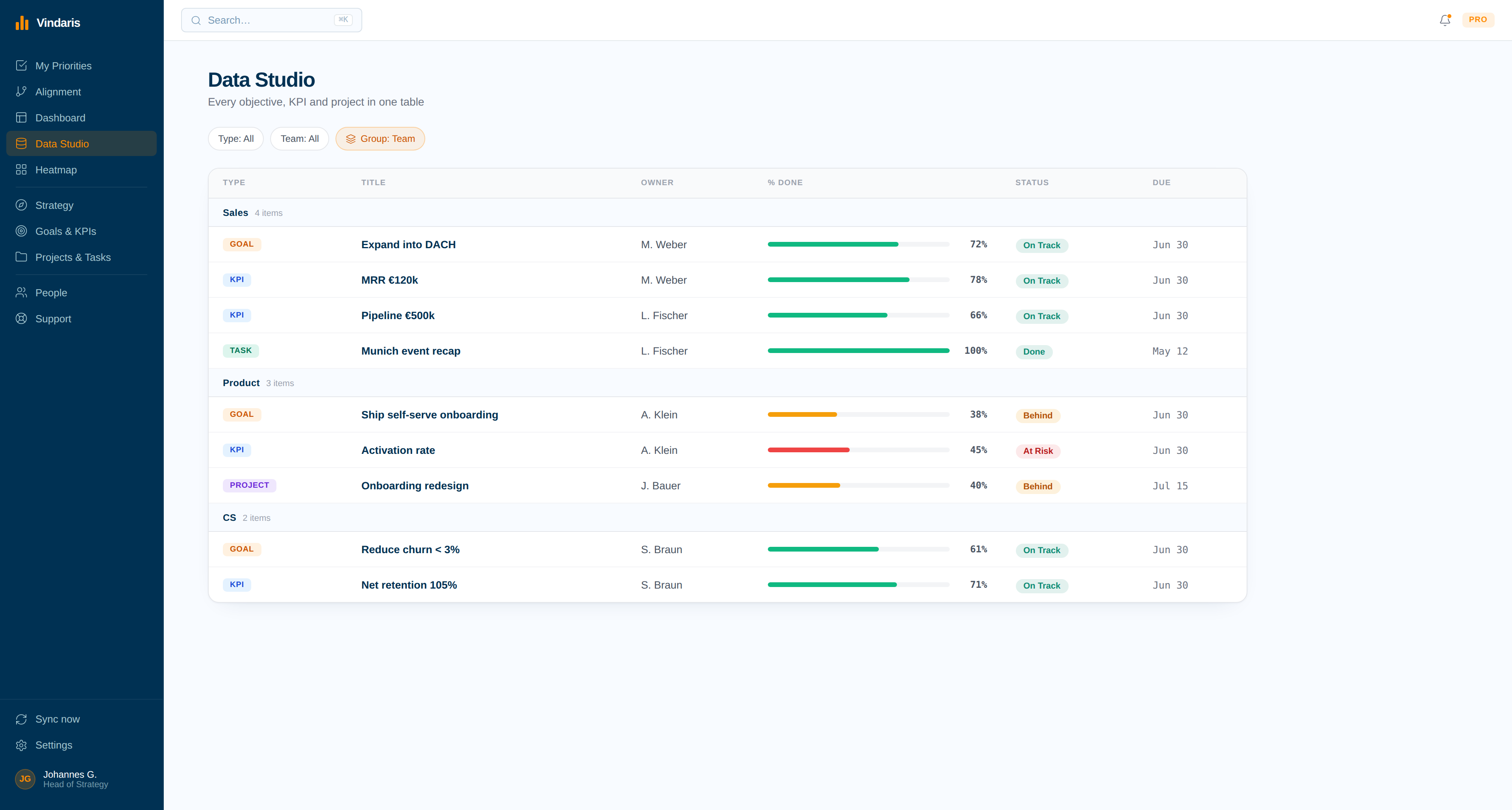
Vindaris is built for the specific problem of keeping strategy and work connected. Its native objects are objectives, initiatives, ownership, and capacity, and the work that moves a goal is traceable to it by design rather than by a hand-maintained link. When work moves, the objective reflects it without anyone updating a status, which means the rollup leadership reads in a review is the live state of the work rather than a slide someone built the night before.
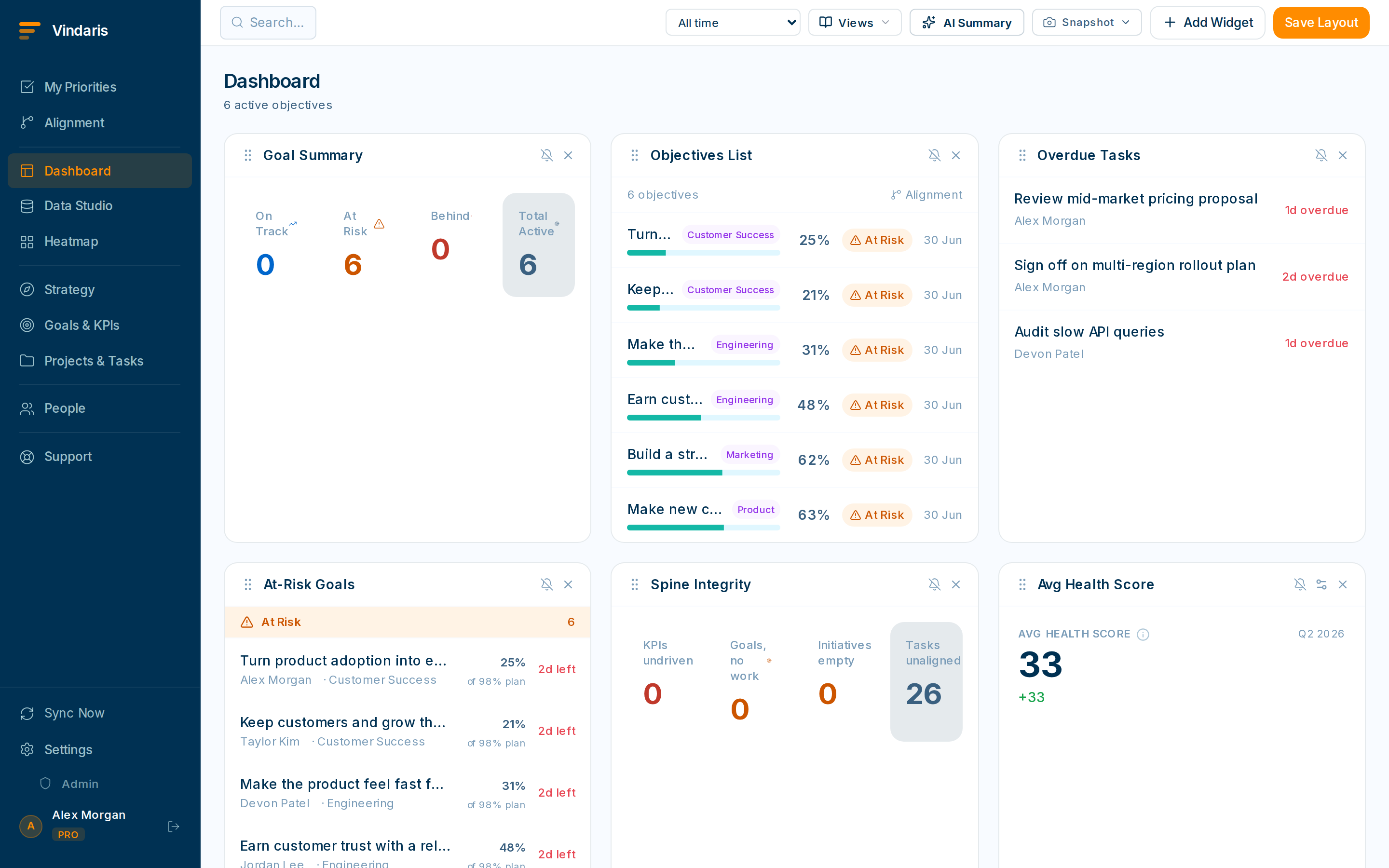
Two things make it the recommendation rather than just a capable option. It starts free, for up to five people and with no credit card, so you can stand up your strategy and bring in a small team before spending anything, and setup is a matter of minutes. And it scales without a rebuild: the same product serves a single team and a multi-team organization, so it does not force a migration as you grow.
The Work Graph, not a percent-complete sync
Connecting to a project tool is not the differentiator it used to be. Most vendors in this guide can technically link to Jira, Asana, or Planner now. What they connect to is the difference. In most of the category, an "integration" means a one-way pull of one number: the project's overall percent-complete field, copied into the goal tool's "progress" field on a sync cycle. That number is an average across every task in the project. It cannot tell you which task moved, which one stalled, or why.
Vindaris calls its version of this a Work Graph, and the difference is task by task, not project-average. Every task inside a connected project syncs individually, so the graph knows which specific piece of work is stalled, not just that the project's overall number ticked from 61% to 63%. New work gets auto-aligned to the right goal and KPI as it is created, instead of waiting for someone to map it by hand. The comments on each task travel with it, so the reason a task is stuck, a blocked dependency, a scope disagreement, a person waiting on another team, arrives with the status rather than after someone goes digging for it. And the task's history comes along too, so a KPI that has been quietly drifting for three weeks looks different from one that just tipped over today. The sync also runs both ways: an owner reassigned or a risk flagged inside Vindaris shows up back in Jira or Planner, where the person actually doing the work will see it, not stranded in a dashboard the delivery team never opens.
This is the difference in practice, and it is worth clicking through rather than looking at a screenshot of it - the widget below is the same component running live on vindaris.com, not an image.
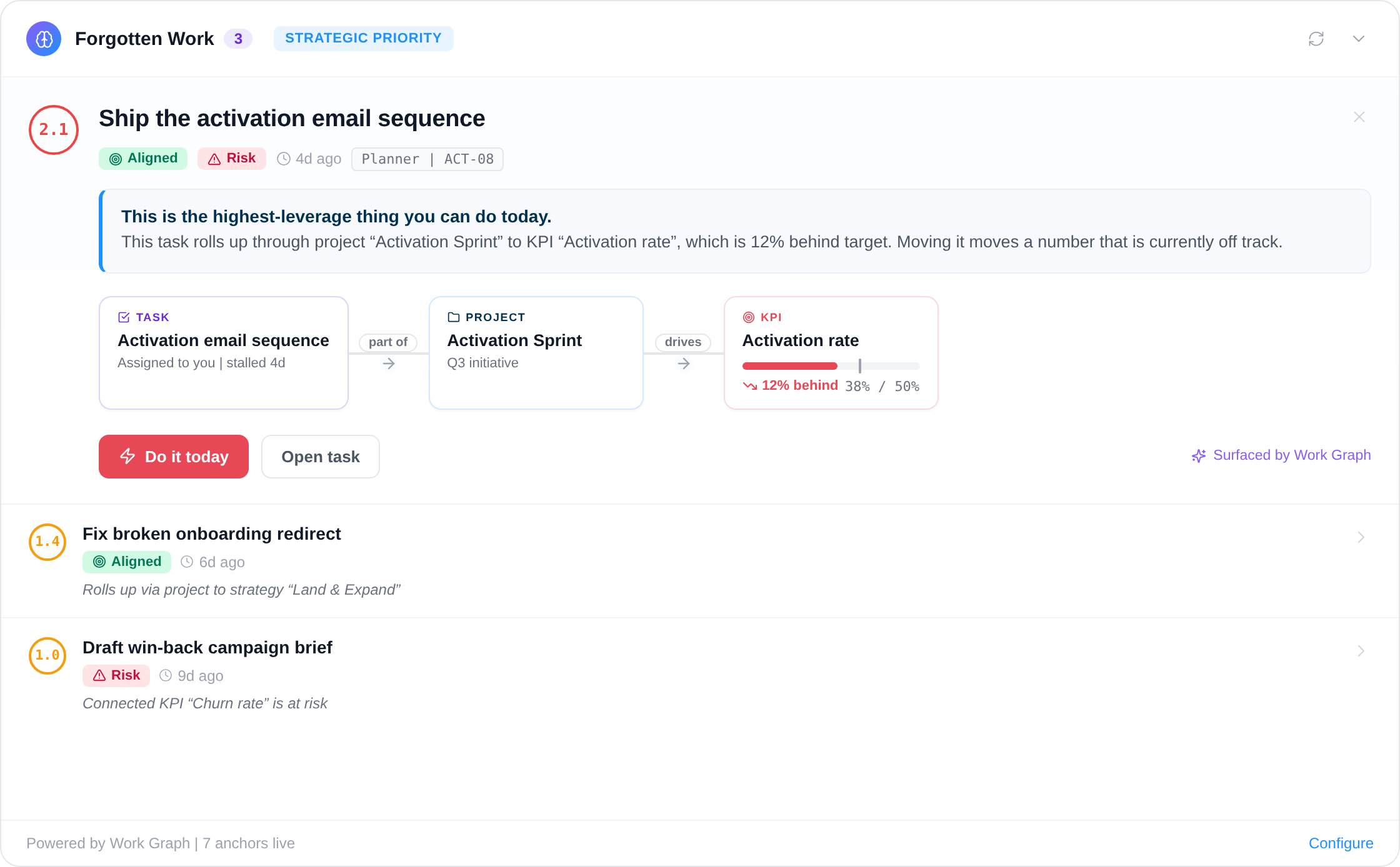
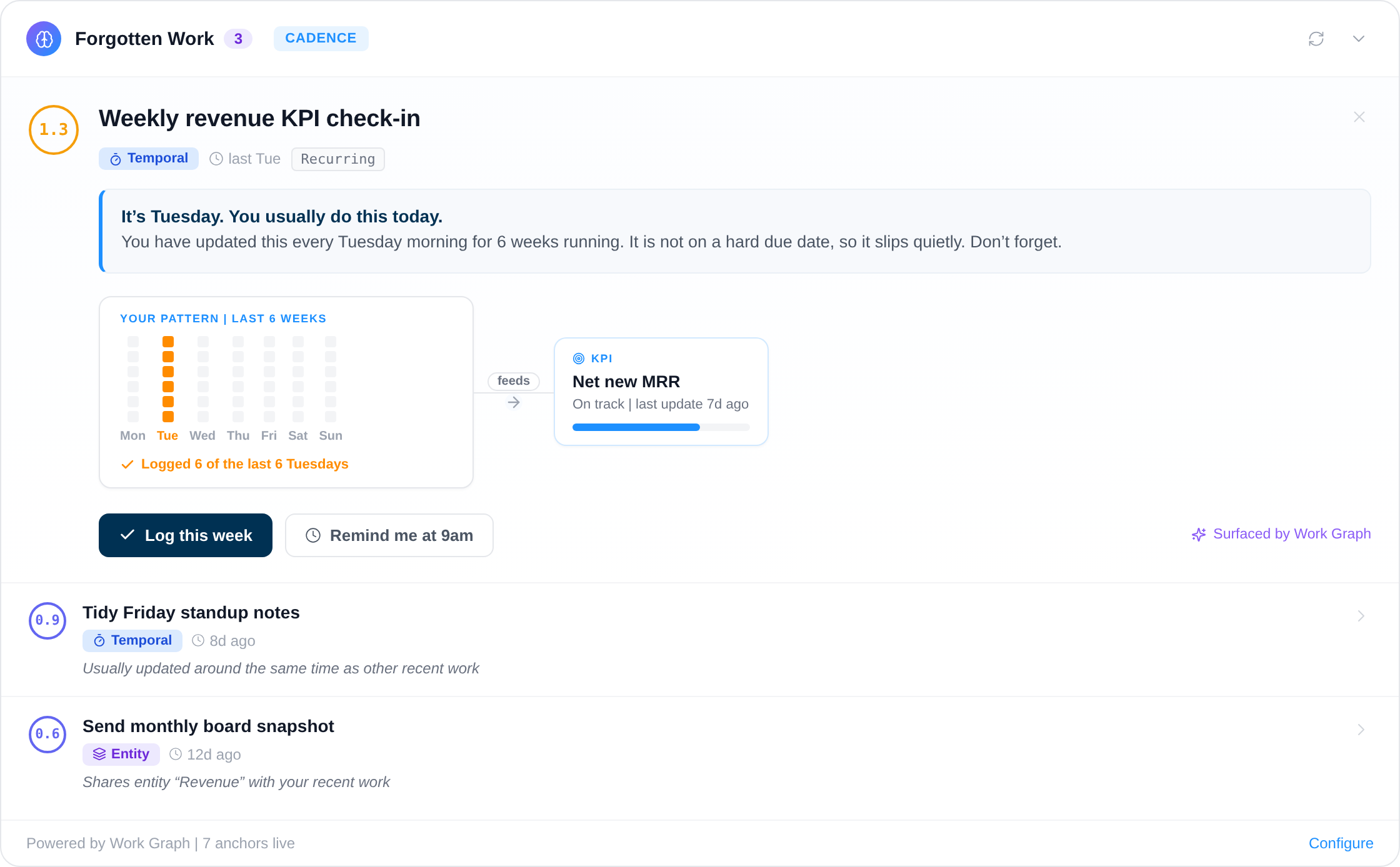
Twelve deterministic and AI-driven alerts watch for slipping work, broken routines, and misaligned focus. These four rotate automatically, or click a card to jump to it.
This is why the "work connected" column in the comparison table above reads the way it does. Cascade's planning layer sits alongside the operational tools rather than reading from them. Perdoo's strategy map shows that a goal exists under a pillar, but the color is whatever the owner typed. Profit.co's task module only sees tasks created inside Profit.co. Mooncamp, Lattice, 15Five, and Betterworks all depend on someone remembering to update a status before it goes stale. WorkBoard pulls metrics from connected data sources, which sounds close but is not the same thing: what it pulls is still a project-level aggregate, not the individual tasks inside the project, and there is no single view where you see an OKR, the project behind it, and the work behind the project together. None of the tools in this guide except Vindaris read the comments, the linked conversation, or the people actively touching the work, and carry that up through the goal hierarchy in real time.
The Work Graph is the connective layer Vindaris maintains between every task in your existing tools and the goals, KPIs, and strategy they serve. Traditional integrations move one aggregate status field, one way. The Work Graph maintains the relationship task by task, in both directions, along with the comments, history, and context that explain it - which is what lets it flag risk before a person has to go looking for it.
It fits companies past the point where a spreadsheet holds the strategy together, often thirty to a few hundred people, where execution spans multiple teams and the cross-functional initiatives have no home in any single team's tool. It connects to the operational tools you already run - Jira, Planner, HubSpot, Asana, Google - rather than replacing them, so the work keeps living where it lives while the strategy layer sits above. The first two integrations are free on every plan; unlimited integrations with full sync start at EUR 10 per user per month. If nobody can trace today's work back to a current objective, this is the category Vindaris is designed for, and the strategy execution page shows the full picture. The Work Graph white paper goes deeper into the mechanics, including how the graph handles the effort-to-goal gap that a percent-complete field structurally cannot see.
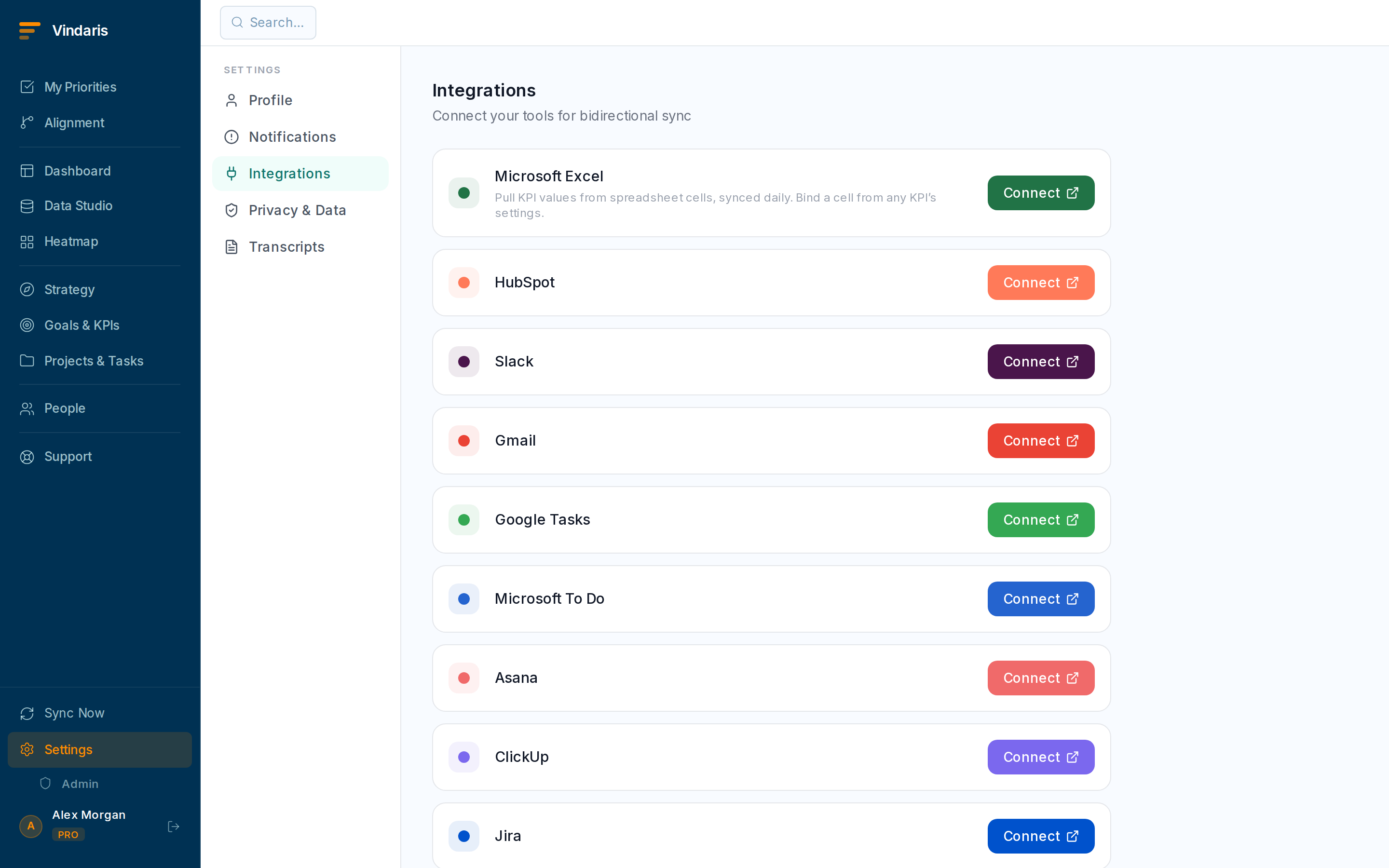
Framework-agnostic by design: OKRs, KPIs, EOS Rocks, OGSM, SMART goals, Balanced Scorecard, or any hybrid. Risk detection is automatic, from task movement and slipping dependencies. AI-powered risk summaries push to Slack, Teams, and email, so the people who need to act see the signal without logging into another tool. Capacity planning is built in, not bolted on, so resource decisions happen where the strategy lives.
The ownership model enforces single-owner accountability structurally. Every objective, initiative, and key result has one owner, and that owner sees their portfolio against available capacity. This prevents the common failure where an initiative belongs to "the team" and nobody is responsible when it stalls. Cross-team objectives are native: an objective served by work from engineering, marketing, and sales shows the combined progress without anyone assembling the picture manually, and risk in any contributing team surfaces at the objective level immediately.
From a sentence to a strategy canvas
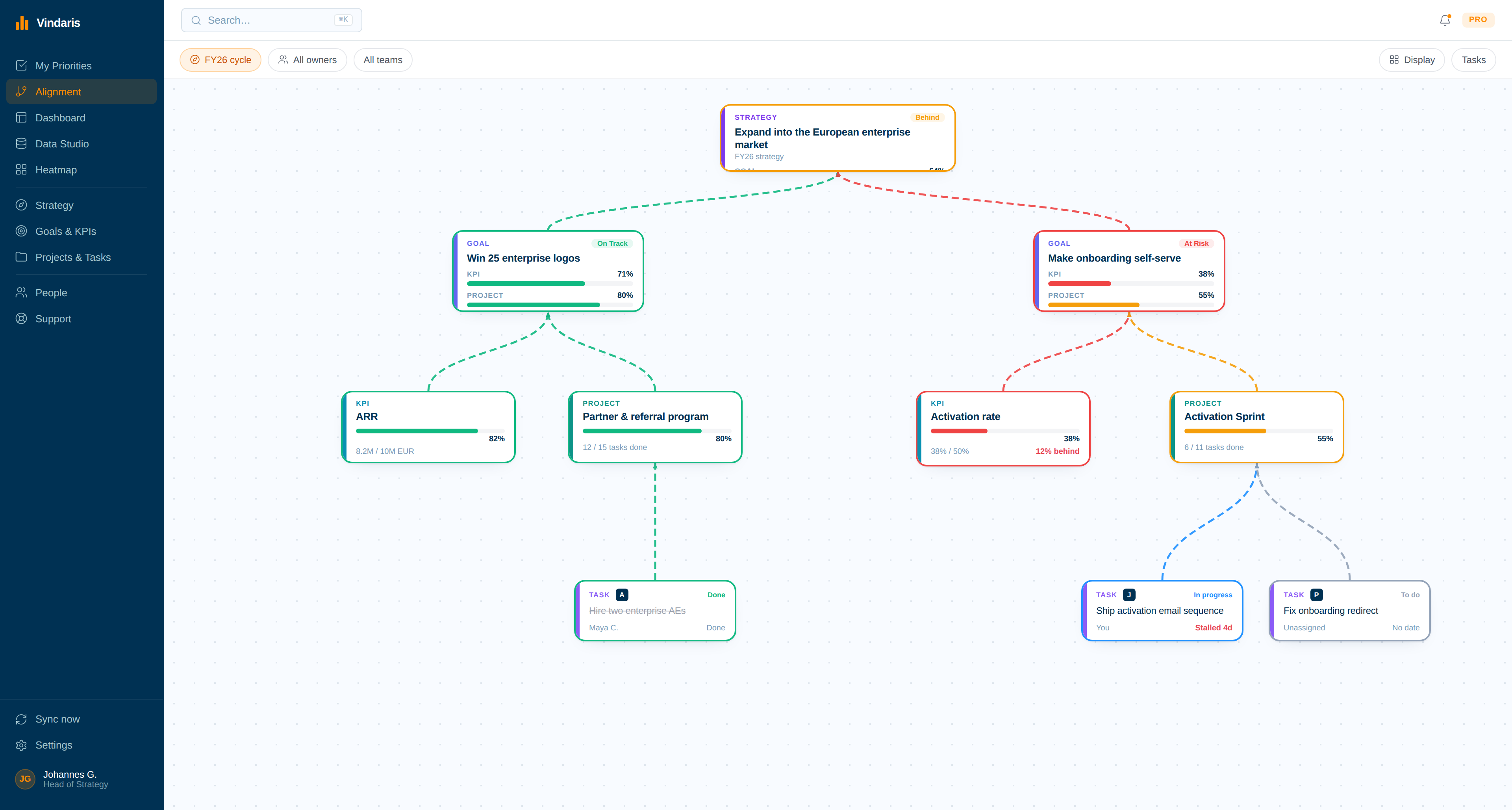
The setup speed claimed above is not a marketing number to take on faith, so here is the mechanism. Vindaris does not ask a new team to fill out a hierarchy of forms before they can see anything. You write your strategy the way you would say it out loud, mention a goal, KPI, project, or task with @, and Vindaris maps the sentence onto a canvas in one click.
This is the actual editor, embedded live, not a screenshot of it - type in it, use the @ mentions, or click "See Alignment Canvas" to flip the card and watch the same words become a connected map.
That single interaction is the whole pitch in miniature. The tools that make you build a goal hierarchy field by field before you can see a single connection are the same tools where the connection quietly breaks later, because nobody wants to repeat that setup every time reality changes. Writing a sentence and mentioning the work is closer to how people actually think about strategy, and it is fast enough that redoing it when priorities shift is not a project.
The fastest way to know if this fits is to try it, not read another review.
Sign up free for up to five people and no credit card, or open the live demo pre-loaded with a sample company so you can click through the Work Graph, the alignment canvas, and the risk alerts without setting anything up first.
The OKR page covers the goal-setting mechanics. The integrations page lists the work tools it connects to. The pricing page shows where it starts.
This comparison covers 11 tools side by side. For the full picture of how Vindaris connects strategy to work, the strategy execution software page walks through the Work Graph, the alert system, and the canvas in detail.
Cascade
Cascade repositioned over the last two years away from team-level OKR execution toward C-suite strategic planning and portfolio management. The product has visual planning tools, Gantt-style views, and executive dashboards that can impress in a boardroom. If you want scenario modeling and initiative prioritization at the top of the house, it fits. The reporting is polished, and for a board-level strategy review it presents well.
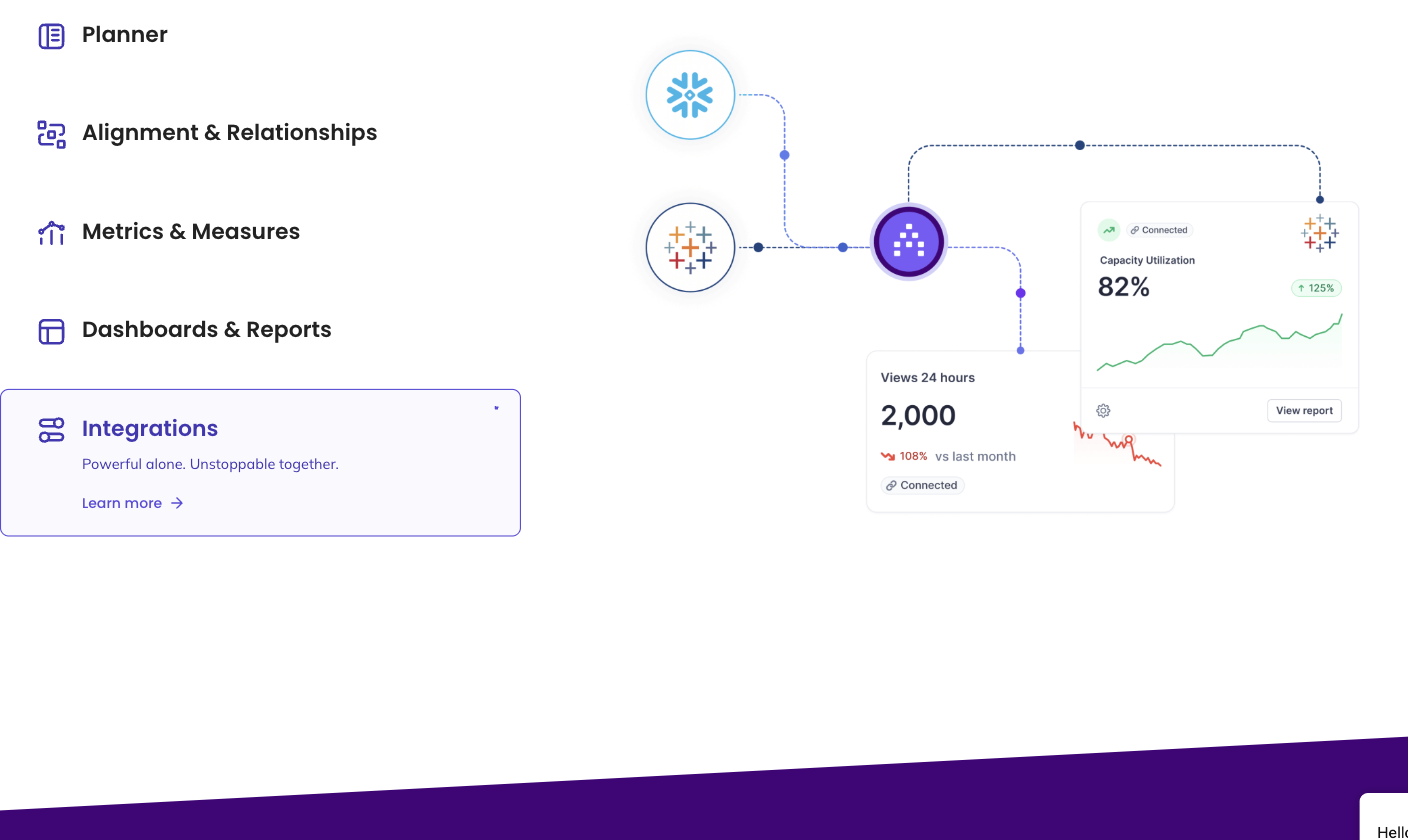
The trade-off is that the planning layer sits alongside the operational work rather than reading from it. The tasks that deliver the strategy live in Jira, Asana, or Planner, and while Cascade has some integrations, they do not create the bidirectional, traceable link that makes status trustworthy. The risk is building a second project-management layer that needs its own feeding rather than drawing from the first one. When the planning layer drifts from the delivery reality - and without a native work connection it will - the executive dashboard tells a story the operational ground does not support.
For mid-market teams running weekly cadences who need their strategy connected to execution, the current version is heavier than the job needs. Setup and configuration take longer than lighter tools, and the enterprise orientation means the sales process involves demos and proposals rather than a self-serve start. Teams in that situation often look for a Cascade alternative that keeps the execution layer without the planning overhead. A free tier is available for small teams. Paid pricing is custom, typically enterprise contracts.
WorkBoard (absorbed Quantive)
WorkBoard built a solid enterprise OKR product aimed at executive alignment in large organizations. Its OKR methodology is well-structured, the alignment views across business units work at scale, and the product had genuine traction with large enterprises running OKRs across thousands of employees. The "Results Management System" framework it promoted was coherent and the tooling matched it. It is also less powerful than the enterprise positioning suggests: there is no single view where an OKR, the project behind it, and the work behind the project sit together, and where project sync exists at all, it tracks one aggregate percentage for the whole project rather than the individual tasks inside it.
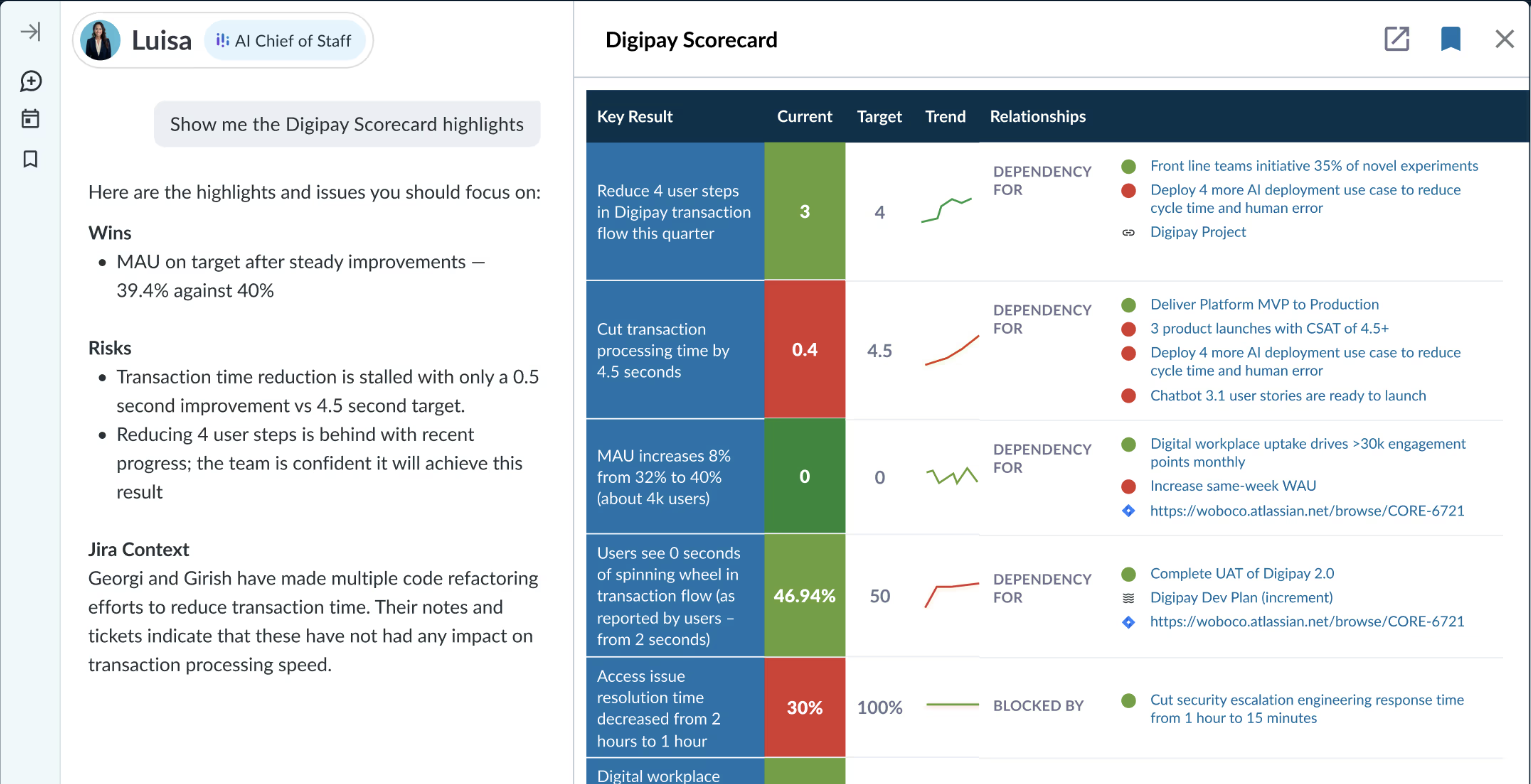
In 2025, WorkBoard acquired Quantive, the product Gtmhub had become after rebranding and shifting positioning twice, from OKR platform to strategy execution to strategic intelligence. WorkBoard folded Quantive into its own platform and shut the standalone site down. quantive.com now redirects straight to workboard.com, and the WorkBoard site lists "Quantive" among its own trademarks in the footer. Quantive customers were migrated onto WorkBoard or moved to a different vendor entirely. The screenshot below shows what the Quantive product looked like before the shutdown, archived because the interface no longer exists to screenshot live.
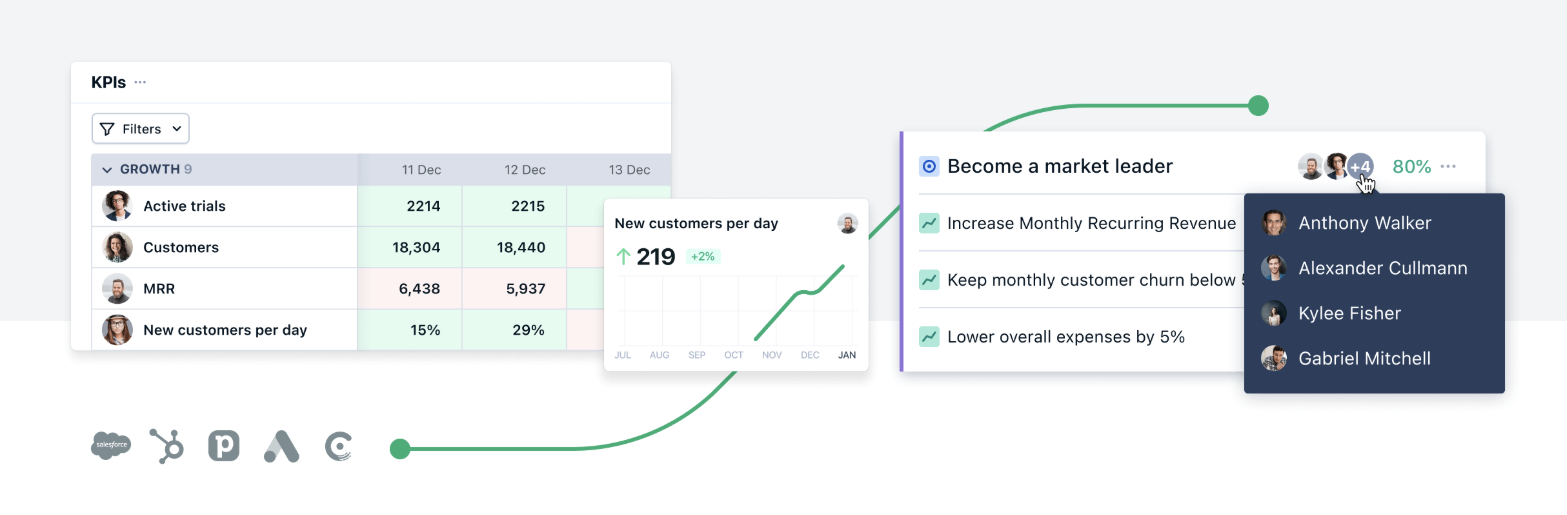
The acquisition did not bring that capability into WorkBoard. Quantive's data connectivity was genuinely strong before the shutdown: automated key result updates wired from databases, analytics platforms, CRMs, and dozens of other sources, so a company whose strategy revolved around metrics in Snowflake, Salesforce, or Google Analytics could pull those numbers into key results without anyone typing them in each week. That depth did not carry over. WorkBoard's own product is what it was before the acquisition: OKRs, business reviews, and project sync at the aggregate-percentage level. The acquisition bought WorkBoard a competitor's customer list and a claim to the "data-connected OKR" positioning, not the underlying engine that made the claim true.
The deeper issue is who the product is built for. WorkBoard's business-review model runs on a lot of manual reporting: dozens or hundreds of people update their own OKR status by hand, on a schedule, so that one executive can open a dashboard and watch a percentage rise or fall across the organization. That is a real amount of reporting work, distributed across the people least equipped to see whether it changes anything, in service of a view built for the person at the top of the chain rather than the people doing it. WorkBoard has not gone quiet, either: absorbing a competitor and shutting its product down is real activity, but it is worth reading as what it is rather than as reassurance. Former Quantive customers went through a migration they did not choose, and pricing rose substantially through the Gtmhub-to-Quantive-to-WorkBoard sequence, pushing smaller teams out along the way. Strategy execution software is exactly the kind of tool where a vendor's multi-year commitment matters, because migrating later is expensive, and a vendor's track record of folding acquired products into itself is worth weighing before signing a multi-year contract. A WorkBoard alternative is a reasonable thing to scope now rather than later, especially if your contract is approaching renewal, and the same applies to teams still searching for a Quantive alternative after the shutdown.
ClearPoint
ClearPoint serves the balanced-scorecard and public-sector world well, with deep reporting, structured methodology support, and the kind of compliance-friendly output those buyers need. If your organization runs a genuine Balanced Scorecard with strategy maps, financial and customer perspectives, and cascading measures, ClearPoint is one of the few tools that supports the method natively rather than approximating it with OKRs. BSC Designer and Spider Strategies sit in the same niche with slightly different feature sets.
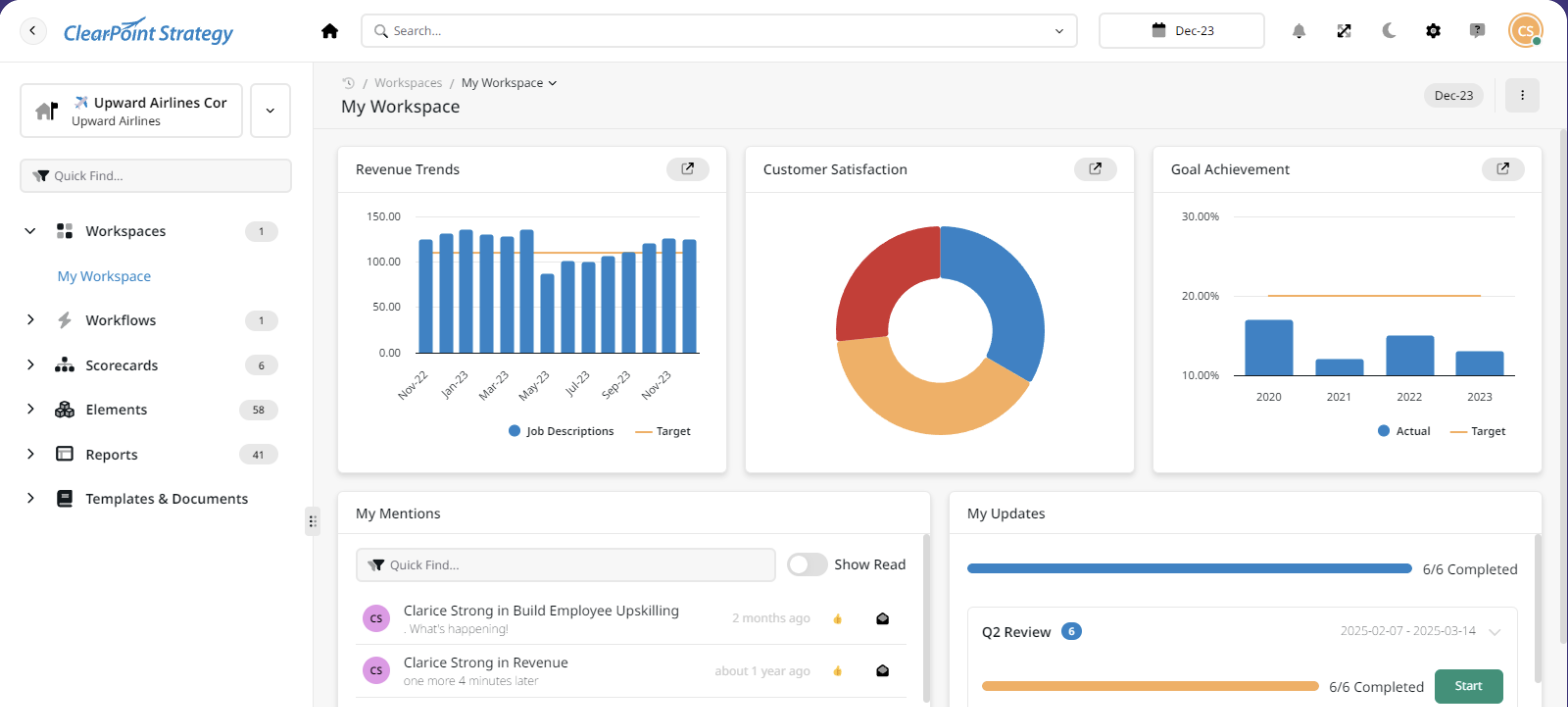
The strength is the reporting layer. ClearPoint can produce the structured strategy reports that board meetings and government reviews require, with drill-down from perspective to objective to measure to action item. For regulated industries or public-sector organizations where the reporting format itself is mandated, that structure is not optional.
The trade-off is weight. Setup overhead is significant - you are configuring strategy maps, perspectives, measures, and cascading relationships before anyone sees a dashboard. The tool assumes a specific planning discipline, and organizations that do not follow it end up fighting the structure rather than using it. For a fast-moving company outside the scorecard niche, it can feel heavier than the problem requires. If the rigidity is the issue, a lighter ClearPoint alternative tends to fit better. This is also why the balanced scorecard keeps getting compared to lighter execution approaches.
AchieveIt
AchieveIt focuses on plan management and execution tracking for organizations that run detailed strategic plans. Its strongest foothold is in government, healthcare, higher education, and nonprofit contexts, where strategic plans are long-horizon documents with many line items, milestones, and departmental owners. The product is designed to hold that kind of plan and track completion across a large organizational structure.
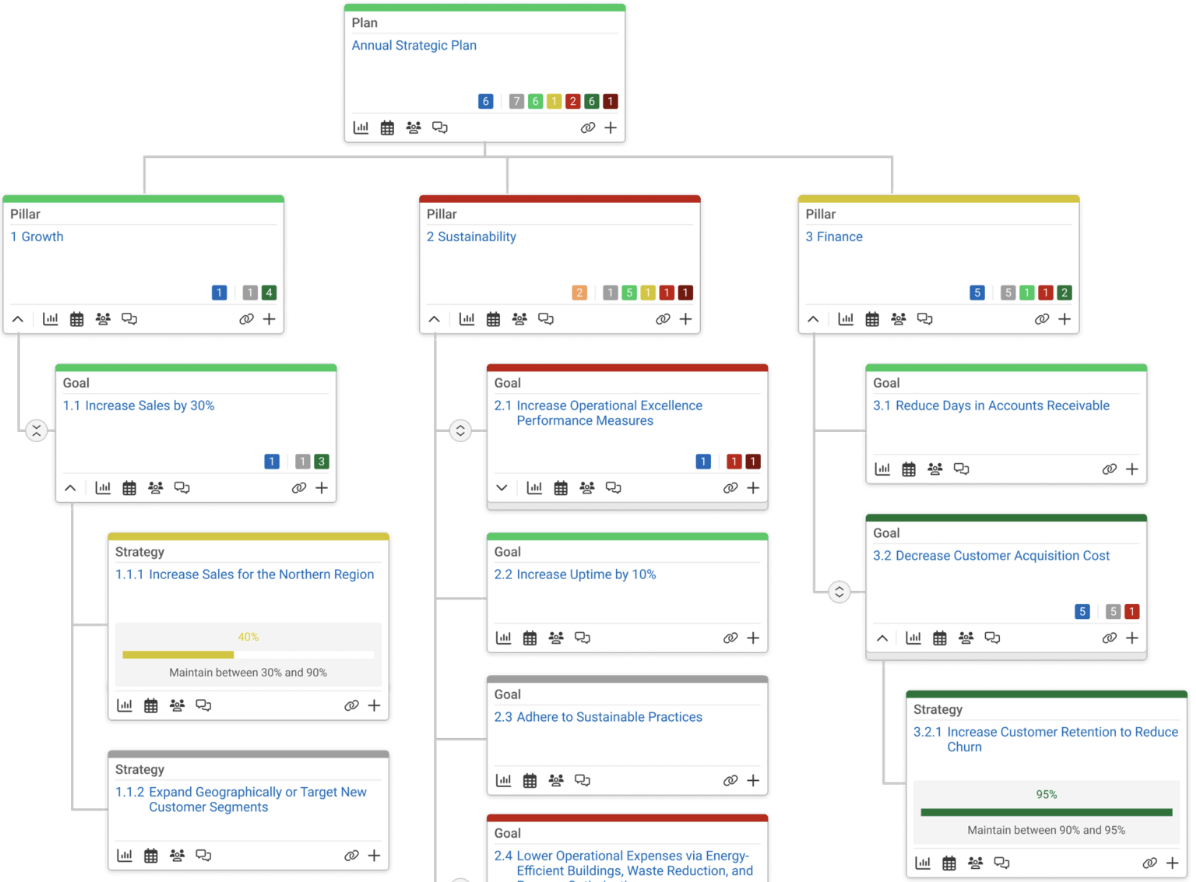
The strength is accountability at the plan-item level. AchieveIt gives each line item an owner, a due date, and a status, and rolls that up into a plan-level view that leadership can review. The reporting is structured and audit-friendly, which matters in regulated or publicly accountable organizations.
The orientation is plan-centric rather than work-centric. It tracks whether plan items are on schedule, but the actual work that delivers those items - the tasks, projects, and sprints in Jira, Asana, or Planner - lives in other tools, and the connection is manual. The plan says "launch the patient portal by Q3." Whether the engineering team's sprint work is on track to deliver that launch is something AchieveIt cannot see. For organizations whose problem is structured plan tracking with audit-friendly output, it fits well. For those who need the plan connected to live operational work, a different architecture is needed. Teams evaluating options often compare it alongside an AchieveIt alternative.
Perdoo
Perdoo's standout feature is the link between OKRs and longer-term strategic pillars. It separates ambitions (what you want to achieve) from results (how you measure it), and a strategy map gives teams a visual line from daily key results up to company-level direction. The framing is clear and coherent. For a team adopting OKRs that wants to see how their goals fit the bigger picture - how a quarterly key result connects to a yearly pillar - that structure is genuinely helpful and Perdoo does it more cleanly than most.
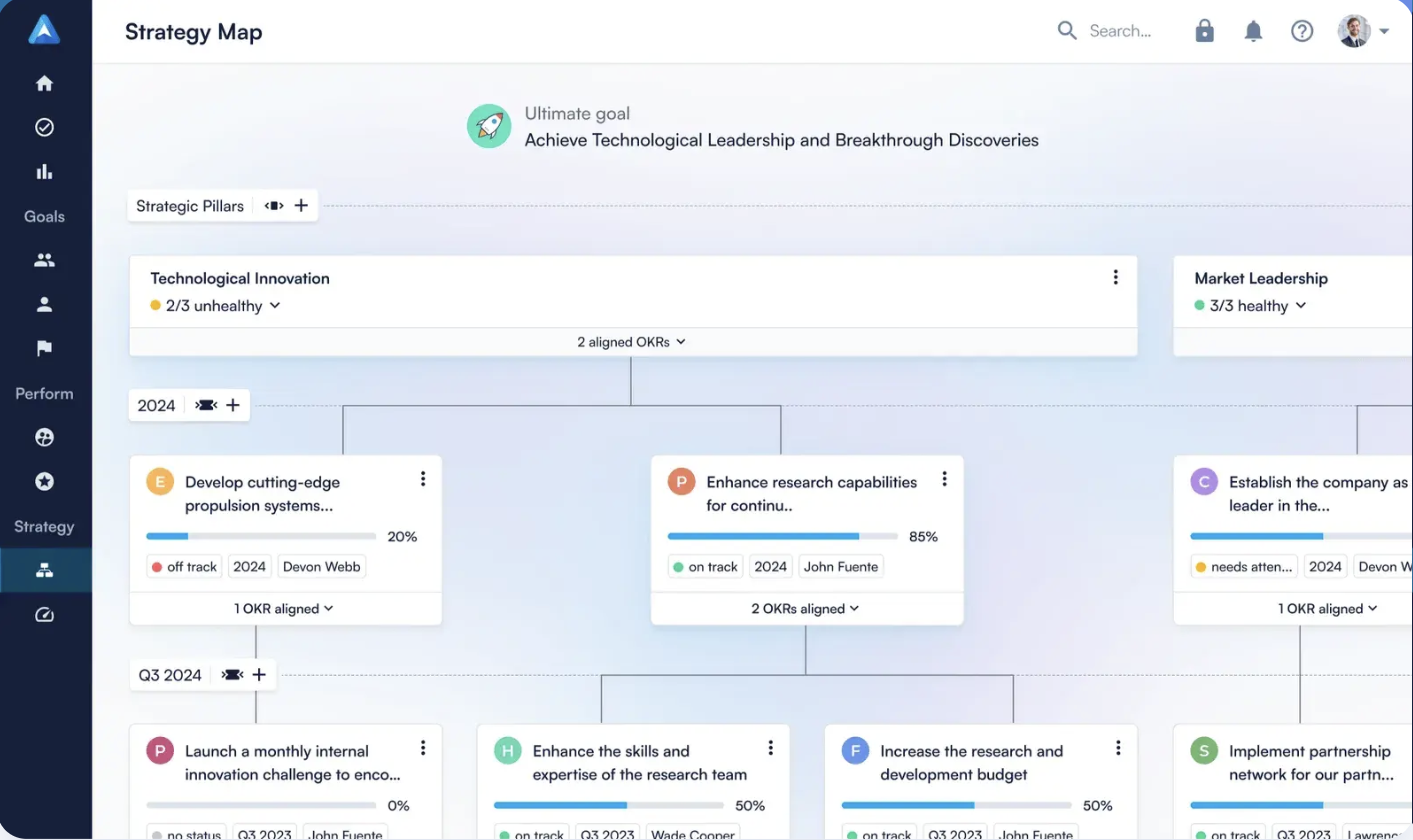
The gap is one layer down. The strategy map shows that a goal exists under a pillar, but it does not show whether the operational work that is supposed to move that goal is actually happening. The tasks live in Jira, Asana, Planner, or HubSpot, and Perdoo never reads them. The owner types a progress update, and the map colors reflect that typed number, not verified delivery. You can have a beautiful strategy map and still not know whether the work behind it is on track.
Pricing is accessible: a free tier is available for small teams, and paid plans start at EUR 7 per user per month. Good onboarding materials and OKR coaching content. Teams looking for a tighter connection between strategy and work compare the Perdoo alternative options, usually because they need the operational layer Perdoo's visual map does not reach.
Mooncamp
Mooncamp is built for larger organizations that need flexibility in how they structure and cascade goals. You can configure goal types, cascading rules, check-in cadences, and alignment views to match how your organization runs. For companies with complex structures - multiple divisions, matrix reporting, or regional splits - that need goals to flow cleanly from company to division to team, the configurability is genuine and useful. The product development team is active, and customer support is responsive.
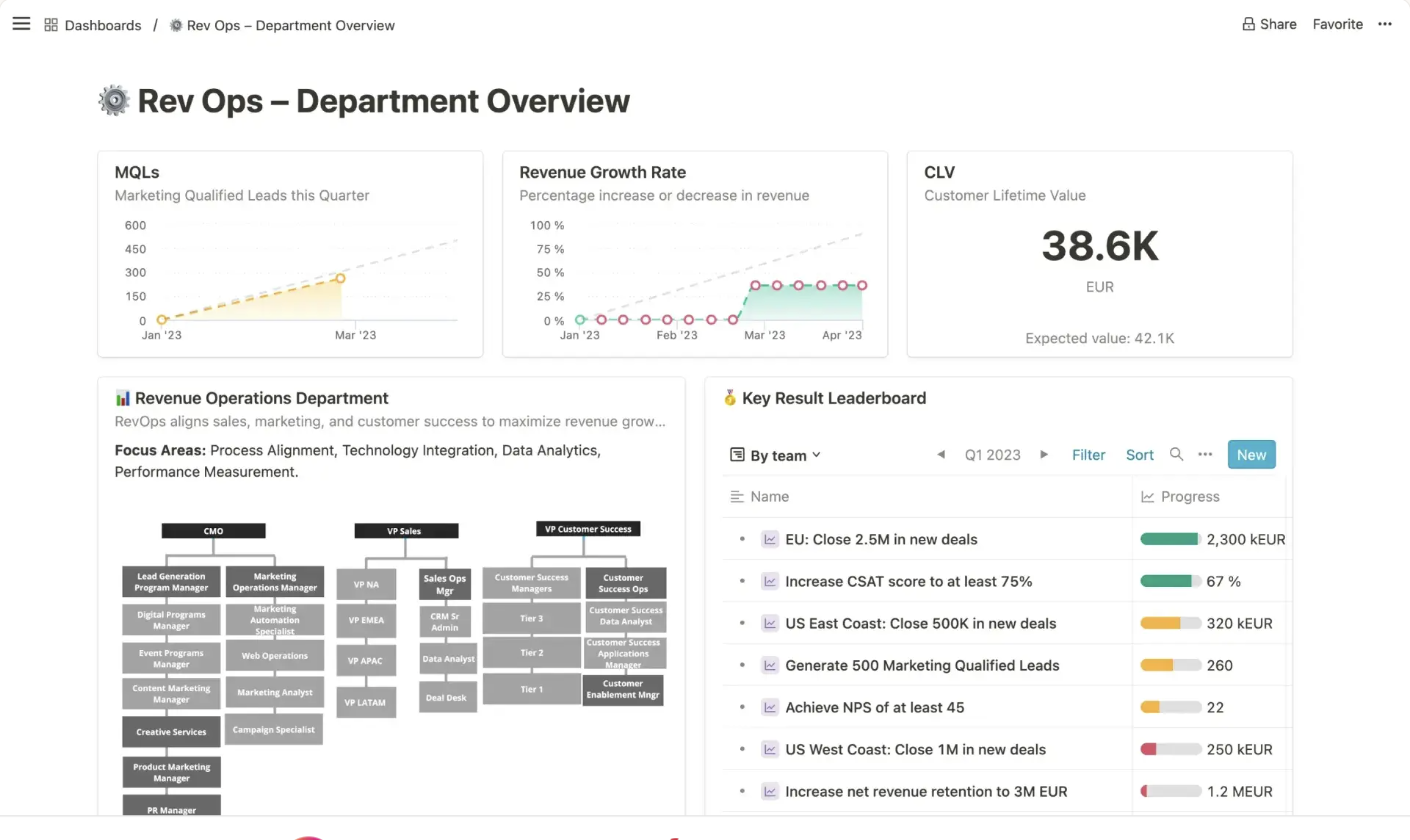
What it does not do is connect those goals to the operational work that is supposed to move them. Goal progress is manually updated by owners, and even with well-configured check-in reminders, at scale the updates lag and the beautifully cascaded alignment view quietly goes stale. A cascaded goal tree with manual status in every node multiplies the maintenance problem rather than solving it: each node depends on someone remembering to update it, and the more nodes, the more places the picture can go stale. Enterprise pricing, no free tier. Teams that want the structural flexibility with a work connection look at a Mooncamp alternative.
Profit.co
Profit.co is the most feature-dense OKR platform in the category. Beyond goals it includes a task module, performance reviews, engagement surveys, employee recognition, and strategy maps. If you want OKRs, tasks, and performance in a single tool with one login and one vendor, the breadth is real and nothing else in the category packs as many modules into one product.
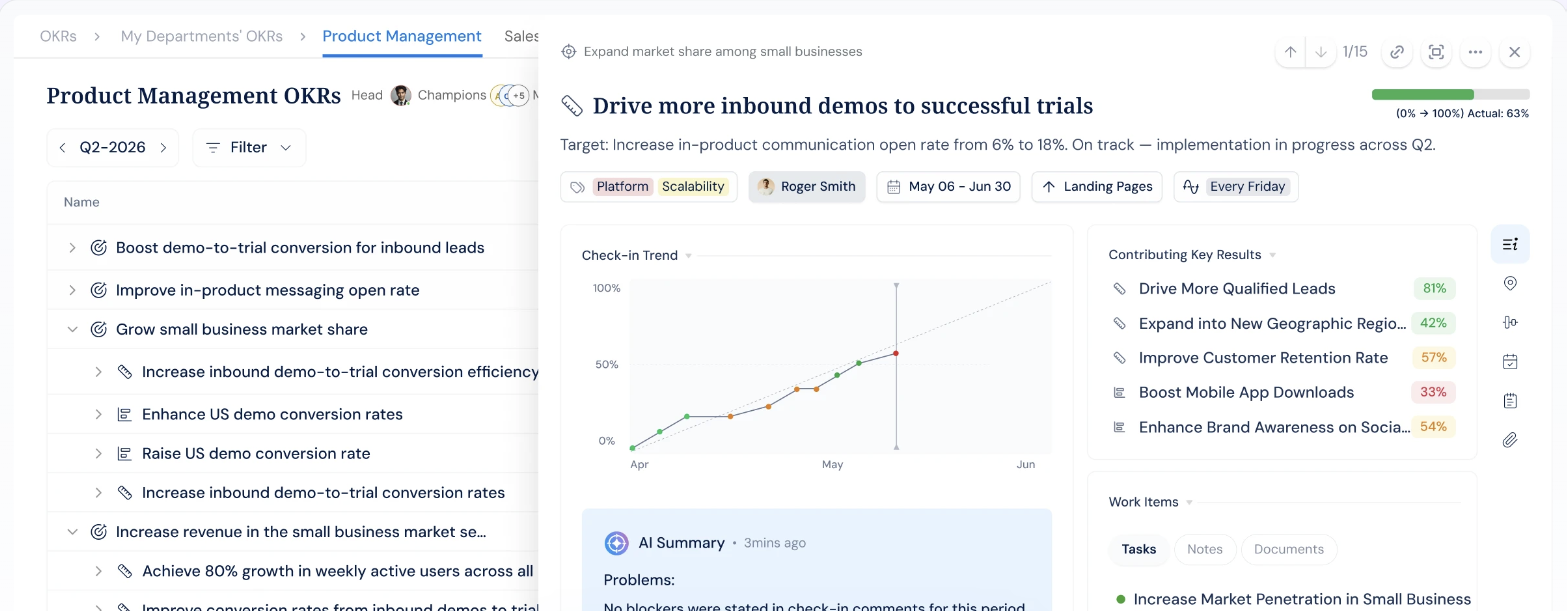
The task module creates a partial work connection - tasks inside Profit.co can be linked to key results and progress rolls up automatically from those tasks. The partial is important: this works only for tasks created in the tool itself. The operational work that lives in Jira, Asana, or Planner stays disconnected. Teams that adopt the task module for everything avoid the gap. Teams whose engineering is in Jira and marketing is in Asana are back to manual updates for those key results.
Configuration is deep. There are more settings, templates, and customization options than most OKR tools combined, which means setup and rollout take longer. A team that invests the configuration time gets a highly tailored system. A team that does not has a powerful tool sitting at half capacity. A limited free tier exists, and paid plans start at $7 per user per month. Teams that want the OKR discipline without the full HR suite look at a Profit.co alternative.
Lattice
Lattice is a performance management platform first: reviews, 1-on-1s, engagement surveys, and growth plans, with goals as one HR module inside the suite. It does that job well, and the suite is cohesive. Reviews flow into growth plans, 1-on-1s reference goals, and the HR team gets a unified view of each employee's performance and development.
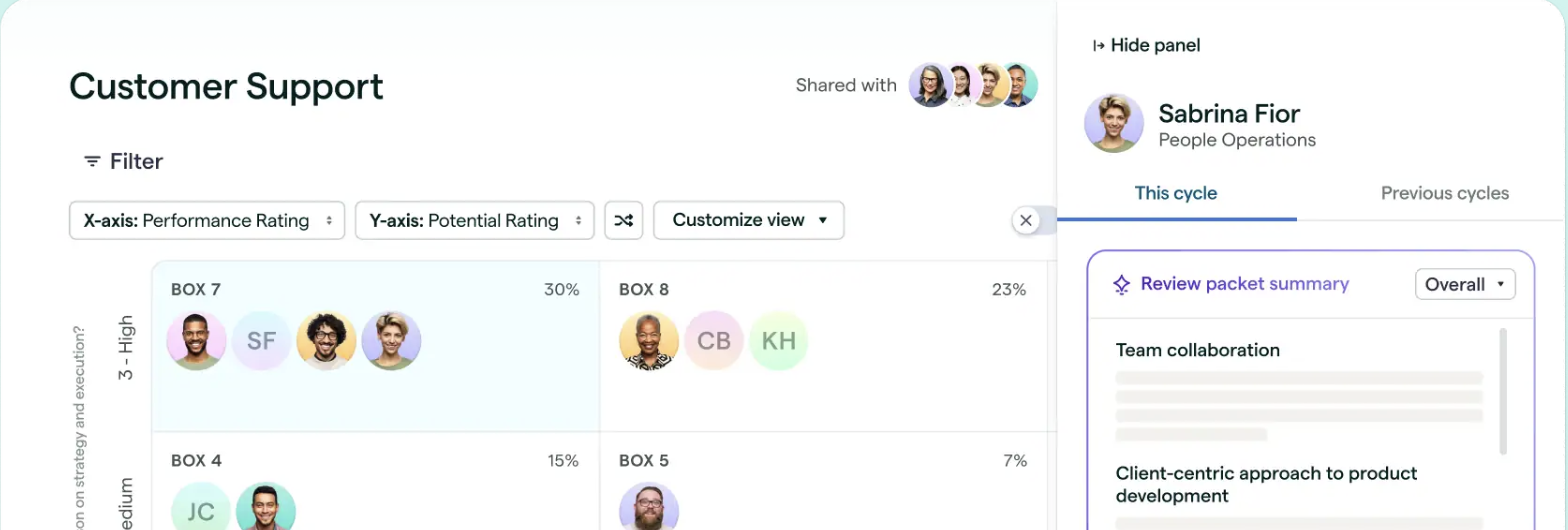
The goals module is designed for the HR cadence. Employees set goals at the start of a cycle and update them around review season. That cadence is correct for performance management, where the question is "how did this person contribute over the period?" It does not fit strategy execution, where the question is "is the work that moves this objective on track right now?" Between review cycles, goal status in Lattice quietly goes stale because the work that actually moves objectives lives in Jira, Asana, or Planner - tools the HR module never sees.
The two jobs can coexist. Many teams keep Lattice for the people function and add a separate execution layer for strategy. The Lattice alternative page covers how the split works in practice and where each tool sits.
15Five
15Five is built around the weekly check-in: what people plan to do, how they feel about their work, where they need help. The product is genuinely good at what it does. Managers get a weekly pulse on their teams. Recognition keeps morale visible. The 1-on-1 agenda builds itself from the check-in. For engagement and keeping managers close to their teams, 15Five is one of the better tools available.
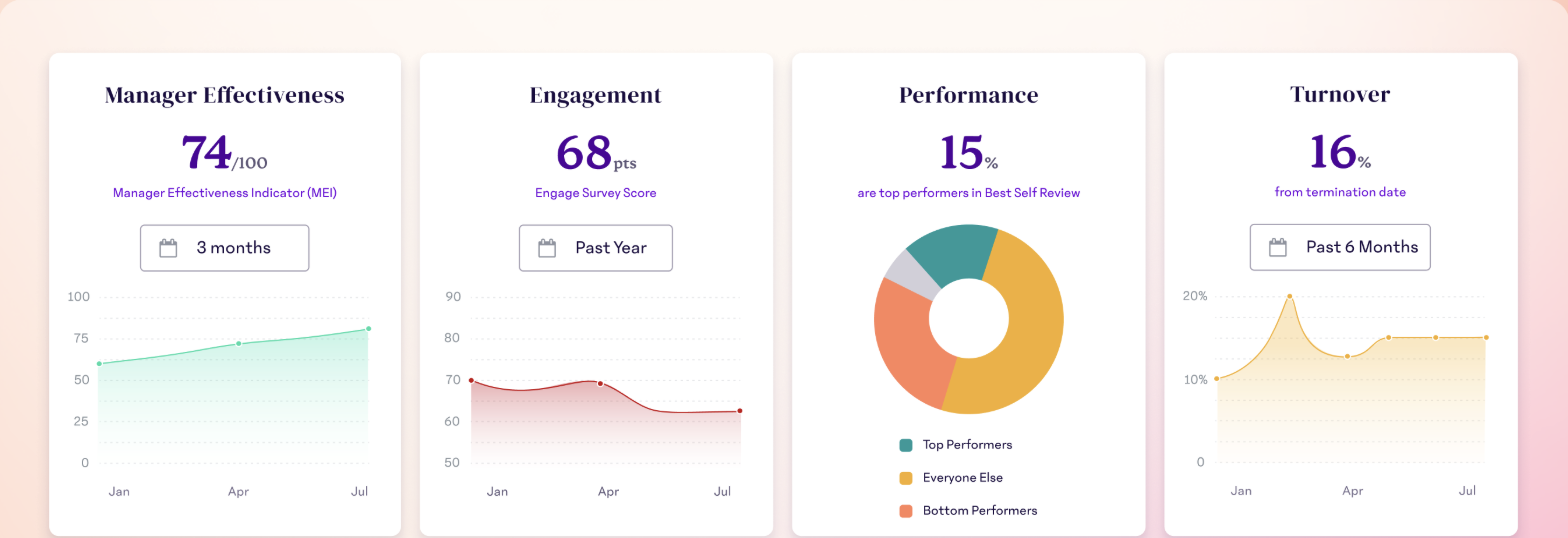
The objectives module rides on the same weekly loop, which means a goal's status is whatever the owner reported in this week's check-in - a sentence or confidence rating written under time pressure, not the state of the underlying work. When objective progress is self-reported, it tracks sentiment more than delivery. An owner reports green because it feels green, while the tasks that would prove it live in Jira or Planner and 15Five never reads them. When check-ins are rushed or skipped - and across a busy quarter they always are - the objective picture drifts from reality with no warning.
The check-in is a great conversation tool. It is a poor source of truth for whether a strategy is moving. Teams that want engagement and coaching keep 15Five for that and run execution separately, because the two jobs have different requirements and trying to serve both from a weekly write-up underserves the one that needs real-time accuracy. The 15Five alternative comparison covers where teams draw that line.
Betterworks
Betterworks is an enterprise performance and goals platform that combines OKRs with performance reviews, calibration, and continuous feedback. It targets large organizations, typically 1,000+ employees, and integrates with HRIS systems for the people function. The calibration and review features are mature, and the product handles the complexity of large-org performance cycles with multiple reviewer types, rating scales, and normalization.
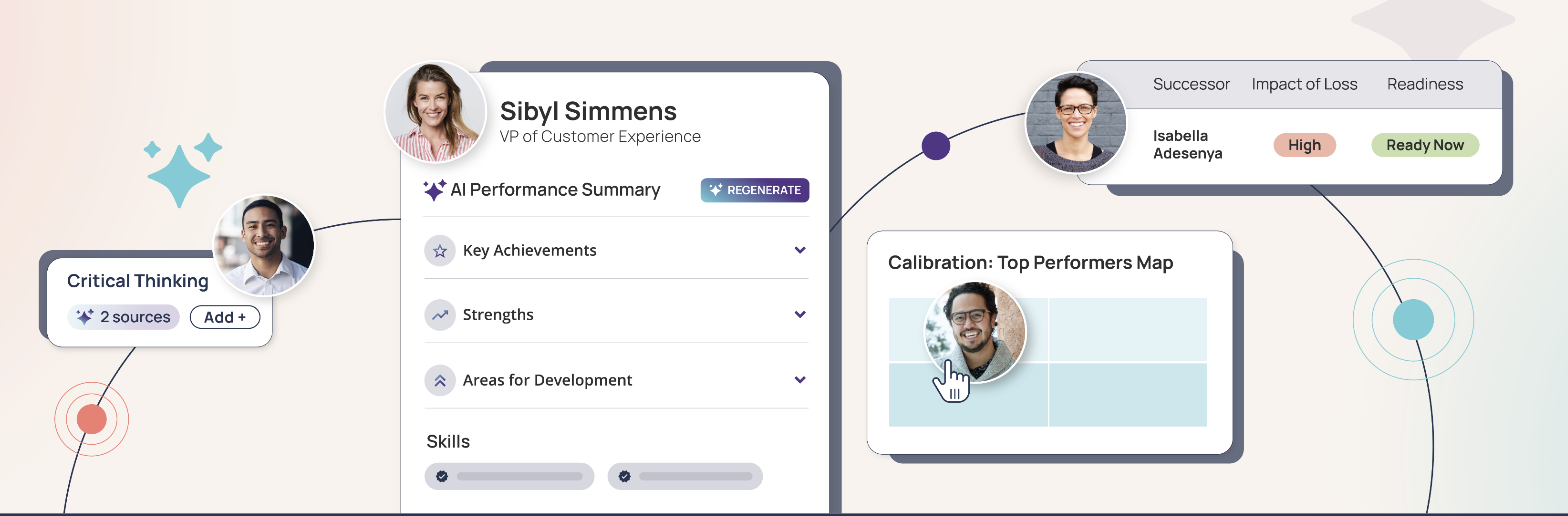
Like Lattice and 15Five, the goals live inside a performance-management context rather than an execution context. Status is manually entered by goal owners and tied to the review and feedback cadence rather than to the operational work. The product is capable for enterprise performance management, and for companies that need a single system for goals and reviews at scale, the integration between the two is tighter than bolting separate tools together.
For strategy execution, it shares the same structural limit as every performance platform: the work and the goal are not connected. The goal module knows what the owner typed; it does not know what the work is doing. Pricing is custom, enterprise only, and the sales process targets HR and people-ops buyers rather than strategy or operations teams.
When do you need strategy execution software vs OKR software
The split is clean, and most teams cross it between twenty and a hundred people.
OKR software tracks objectives and key results with manually entered status. It assumes someone will type in the progress, and the dashboard shows what they typed. Strategy execution software connects those objectives to the actual initiatives, projects, and work that move them, and keeps the connection live. Every strategy execution tool can hold OKRs. Not every OKR tool can hold execution. The difference becomes visible the moment a key result spans two teams or depends on work that lives in a project tool the OKR tracker cannot see.
You need OKR software when the bottleneck is the habit. You are introducing goal discipline, people need to start engaging with objectives at all, and a friendly weekly nudge is the thing standing between you and adoption. Most teams under thirty people learning the cadence sit here. Do not overbuild. A tool like Tability or Weekdone works well at this stage, and the best OKR software guide covers those options in detail.
You need strategy execution software when the dashboard's accuracy matters for real decisions. Leadership is making resourcing, headcount, or board-level calls based on what the rollup says, and a green key result that turns red in week eleven with no warning is no longer acceptable. At that point, you need status that is derived from the work rather than declared by the owner, and you need to trace a goal down to the initiatives and tasks that are or are not moving it. The tell is usually the quarterly review meeting: if someone had to spend half a day assembling the status slide from five different tools, and nobody in the room fully trusts the numbers, you are past the OKR-tracker stage.
What "derived from the work" actually means is worth spelling out, because on its own the phrase can sound like marketing. Take a key result like "launch website: 75%." That number does not tell you why it is at 75, which specific pieces of work are done and which are not, whether any of the remaining tasks or milestones are at risk, or what the team has actually been saying to each other about the launch. And the 75% is usually a guess stitched together from a project that was never one clean thing to begin with: a real launch draws on a Planner board for the marketing tasks, a Jira epic for the engineering work, and a Slack channel where the actual blockers get discussed, and none of those systems talk to each other or to the goal tracker. Most tools ask a person to compress all of that into one number, once a week. Vindaris pulls the pieces in automatically instead - the individual tasks across every connected tool, their history, and the comments and threads attached to them, all tied to the same goal - and uses that depth to flag risk while it is still cheap to fix, and to identify where a broken strategic edge, a snapped link somewhere in the critical path between a task and the outcome it is supposed to deliver, has actually happened, rather than waiting for a percentage to eventually catch up.
A status a person typed in tells you what they believed last week. A status derived from the work tells you what is true right now. Most quarterly surprises live in that gap.
The other trigger is cross-functional work. An OKR tool handles a single team's objectives and struggles when an objective is served by work spanning several teams. A product launch depends on engineering, marketing, sales enablement, and customer success. The OKR tool can hold the objective. It cannot show whether all four teams' contributing work is on track. If your strategy depends on cross-team execution - and most strategies do past a certain size - the goal tracker's architecture cannot hold it. The green dashboard problem explains why this matters, and the strategy execution page shows what the alternative looks like.
There is also the question of what happens after goals are set. OKR tools stop at the key result. They do not hold the initiatives, capacity allocation, or dependency mapping that determine whether the key result will actually move. Strategy execution software covers the full chain from objective to initiative to task to status, and keeps it connected so the picture stays current without manual assembly. If your planning meeting produces a set of goals and then the work to achieve them disappears into five different project tools with no central view, you have found the gap this category is built to close.
What to look for when choosing
Match the tool to your actual failure mode rather than buying the most features.
If you need the strategy connected to the work: look for native work connections with bidirectional sync to the tools your team already uses. The tool should derive goal status from the work rather than asking someone to type it in. This is where Vindaris sits.
If you need strategic planning and scenario work at the top of the house: look for portfolio management, initiative prioritization, and executive dashboarding. Cascade fits this best, though the planning and execution layers are separate.
If you need data-driven key result automation: look for broad API connectivity and automated metric ingestion. The tool that did this best in the category, Quantive, was acquired by WorkBoard and shut down without the capability carrying over, so nothing here currently matches what it used to do. Evaluate WorkBoard on what it actually offers today: enterprise OKR reporting and aggregate-level project sync, not automated data connectivity.
If you need a Balanced Scorecard or structured methodology: look for native scorecard support with strategy maps and structured reporting. ClearPoint and BSC Designer serve this niche.
If you need goals inside an HR/performance suite: Lattice, 15Five, and Betterworks each combine goals with performance reviews, engagement, and growth plans. They are people platforms with a goals module, not execution platforms.
If you need simplicity first: a lightweight OKR tool like Tability, Weekdone, or Perdoo gets you started faster and costs less. When you outgrow it, you will know - the symptoms are stale dashboards, cross-team blind spots, and leadership making decisions on status that nobody trusts. The outgrown goal tool guide describes the migration path, and for the two tools teams most often start with, the Weekdone alternative and Tability alternative pages show what the switch looks like once the weekly check-in stops keeping up.
If you need to keep your current tools: the right strategy execution software connects into Jira, Asana, Planner, HubSpot, or whatever your teams use, rather than replacing any of it. Nobody migrates their engineering org off Jira to adopt a strategy tool. The strategy layer sits above and reads from below. Any tool that requires you to recreate your work inside it is asking for a project-management migration when all you wanted was a strategy view.
If your team runs EOS: EOS (Entrepreneurial Operating System) has its own cadence and vocabulary - Rocks, Scorecard, Issues List, V/TO. A tool that only speaks OKRs will not map cleanly. Vindaris supports EOS Rocks natively alongside OKRs, KPIs, and other frameworks. Some teams also use Ninety.io for the EOS-specific meeting cadence and layer a strategy tool on top for the execution connection.
The broader market landscape, including vendors that have shut down or pivoted, is in the strategy execution tool landscape guide. For the best strategic planning software specifically, the companion roundup covers that adjacent category. For goal-setting and goal tracking specifically, the dedicated guides cover the lighter end of the market.
Project tools pressed into strategy duty
Many teams try to run strategy in Asana, Monday, Jira, or Notion because that is where the work already is. The reasoning is sound: why add another tool when the tasks are already here? The answer shows up about three quarters in, when someone is spending half a day every cycle manually rolling ticket status into a strategy view that nobody fully trusts.
These are excellent tools at their own altitude. Jira manages engineering work better than anything else in its class. Asana handles cross-functional project coordination cleanly. Monday makes workflows visual and accessible. Notion is a flexible workspace that adapts to almost any format. They strain at the strategy layer because their native object is the task, the ticket, or the page, not the objective. The cross-team rollup does not exist natively and ends up as a manual assembly: a Jira dashboard with custom filters, a Notion database with linked views, an Asana portfolio with manually tagged projects. Each one works until it breaks, and it breaks when the strategy spans teams that do not share the same tool or the same project structure.
We covered each comparison in detail: Asana, Monday, Jira, and Notion. The structural issue is not the project tool's fault. They were designed to hold tasks and projects, not to hold the strategic layer that connects those tasks to objectives across an organization. Asking them to do both creates a view that takes more maintenance than the slide deck it was supposed to replace.
The better pattern is to keep the work where it is and add a strategy layer on top that reads from it. That is what strategy execution software is for, and it is why the category exists alongside - not instead of - the project tools teams already use.
How to start
If you have read this far and recognize the pattern - strategy set in Q1, work diverging by Q2, manual slide assembly for every review, nobody sure whether the green dashboard is true - you are past the goal-tracker stage. The step is to stand up a strategy layer that connects to your existing tools rather than replacing them.
The common mistake is to run a months-long evaluation with demos from five vendors, feature comparison spreadsheets, and a steering committee. That process is appropriate for an ERP. For a strategy tool that sits above your work tools, the faster path is to try the one that fits your most likely failure mode and see whether the architecture works for your team's actual goals and work.
Vindaris is free to start. Sign up, connect one work tool, and map a few goals to the work that moves them. Within an hour you will see whether the architecture fits - whether the goal status you see reflects the work you know is happening, whether the cross-team view shows what you could not see before, and whether the risk signals catch what your manual check-ins have been missing. If it does, the pricing page shows what happens when you scale past five people. If it does not, you have lost an hour, and you know what questions to ask the next tool on this list.
If your failure mode is different - if you need the planning-layer features of Cascade, the enterprise reporting structure of WorkBoard, or the scorecard rigor of ClearPoint - this guide has given you the criteria to evaluate them against. The category is broad enough that the right tool for your organization may not be our overall pick, and that is fine. What matters is that the tool you choose actually connects the strategy to the work, because the alternative is another year of manually assembled slides and green dashboards that nobody trusts.
FAQ
What is the best strategy execution software in 2026? For the most common case - a strategy that has drifted from the daily work - our pick is Vindaris. Its native design connects objectives to the work moving them and stays live as the work changes, it sits on top of existing tools rather than replacing them, and it is free to start for up to five people. The heavier planning and scorecard tools below fit narrower needs, which this guide covers.
What is the difference between strategy execution software and OKR software? OKR software tracks objectives and key results, usually with manually entered status. Strategy execution software connects those objectives to the actual initiatives, projects, and capacity that move them and keeps the connection live. Every execution tool can hold OKRs, but not every OKR tool can hold execution, which is why goal trackers stall when work spans teams.
Do I need to replace Jira or Asana to use strategy execution software? No. The better execution tools connect into the tools where work already lives rather than replacing them. Engineering keeps working in Jira, delivery keeps running in Asana, and the strategy layer sits above, connecting that work to the objectives it serves so the rollup is live instead of hand-assembled.
What happened to Viva Goals and Quantive? Microsoft sunset Viva Goals, completing the wind-down in early 2026, so teams on it need a Viva Goals alternative. Quantive, the product Gtmhub became after rebranding, was acquired by WorkBoard in 2026, and the standalone product was shut down without its data-connectivity depth carrying over; quantive.com now redirects to workboard.com. Teams still searching for Quantive need a Quantive alternative, since WorkBoard itself does not replace what Quantive did.
How long does it take to implement strategy execution software? It depends on the tool. Enterprise platforms like Cascade, ClearPoint, or Betterworks typically require a multi-week or multi-month rollout with consulting and training. Vindaris can be live in under an hour: sign up, connect one work tool, and map a few goals. The implementation difference matters because a tool that takes three months to deploy is a tool the team uses next quarter, not this one.
Can strategy execution software work with multiple goal frameworks? Some can. Most OKR-first tools only support OKRs natively, and mapping a KPI or an EOS Rock into an OKR structure creates workarounds. Vindaris is framework-agnostic by design: OKRs, KPIs, EOS Rocks, OGSM, SMART goals, Balanced Scorecard, or a hybrid of several. ClearPoint supports the Balanced Scorecard natively. Profit.co supports OKRs with some KPI flexibility. Most others assume OKRs.
Is free strategy execution software any good? Free tiers exist at Vindaris (up to 5 people, two integrations), Perdoo (small teams), Profit.co (limited), and Cascade (small teams). The Vindaris free tier is the most complete for execution use, including goal and strategy management, because it was designed as a working product rather than a feature-gated trial. The others are useful for evaluating the tool but typically restrict the features that matter most for execution - integrations, cross-team views, or reporting depth.