OKR Template for Excel and Google Sheets
Updated Aug 2026
This free OKR template is a ready-to-use .xlsx file with sections for Objective, Key Results (metric, baseline, target, owner, confidence), supporting initiatives, and explicit trade-offs. Download it, open it in Excel or upload it to Google Sheets unchanged. No signup, no email wall, no macros.
The fastest way to write a weak OKR is to start typing. This template forces the three decisions that make an OKR work: a qualitative Objective that names the outcome, Key Results stated as a metric with a baseline and a target, and a single owner for each. Fill one block per Objective, and keep the count to two or three Objectives per team so focus survives contact with the quarter.
| Quarter | Year | Team | Objective Owner |
|---|---|---|---|
| Q1 | 2026 | Customer Success | A. Lee |
| - | - | - | - |
| Objective |
|---|
| Make onboarding effortless for new admins |
| - |
| - |
| KR | Metric | Baseline | Target | Owner | Confidence |
|---|---|---|---|---|---|
| KR1 | Median time to first value (days) | 9 | 3 | A. Lee | Amber |
| KR2 | - | - | - | - | - |
| KR3 | - | - | - | - | - |
| KR4 | - | - | - | - | - |
| KR5 | - | - | - | - | - |
| Initiative | Moves KR |
|---|---|
| Rebuild the admin setup wizard | KR1 |
| - | - |
| - | - |
| Explicit trade-off |
|---|
| No new integrations until onboarding is fixed |
| - |
| - |
Free and ungated. Opens in Excel, Google Sheets, or Numbers. No signup, no email wall.
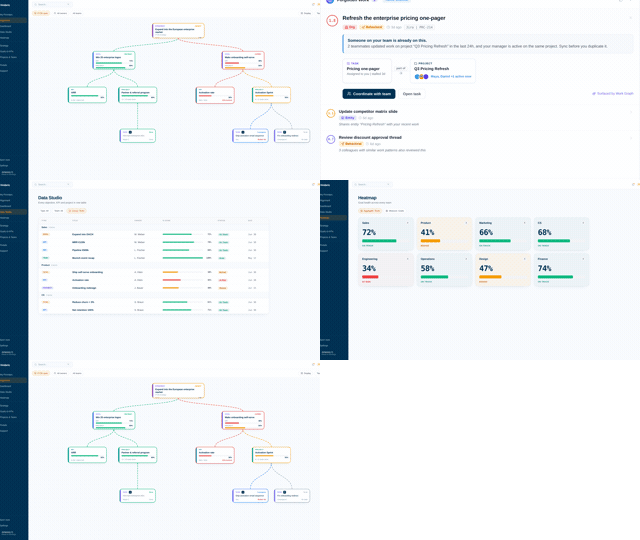
A spreadsheet shows the plan on the day you fill it in. To see which goals have no project or task behind them a month later, open the Vindaris demo. No signup needed.
How to use this template
- Write the Objective first, with no numbers in it. If it contains a metric, that metric is really a Key Result.
- For each Key Result, fill the baseline and target. A Key Result with no baseline cannot be scored honestly.
- Give every Key Result one owner. Shared ownership is the most common reason a Key Result quietly stalls.
- List the supporting work and connect each item to the Key Result it moves, so progress can be traced to delivery.
What this OKR template includes
The spreadsheet has five sections, each matching a decision that separates a working OKR from a vague goal:
- Header row — quarter, year, team name, and Objective owner, so every OKR is anchored to a time box and a person.
- Objective block — one short, qualitative statement with no numbers. If a metric creeps in, move it to a Key Result.
- Key Results grid — up to five rows, each with a metric name, baseline, target, single owner, and RAG confidence. Baselines are required because a target without one cannot be scored honestly at the end of the quarter.
- Supporting work — initiatives and projects mapped to the Key Result they move, so progress traces back to delivery.
- Not-doing list — explicit trade-offs the team agreed to drop this quarter, the single most common missing piece in OKR templates.
Frequently asked questions
How many OKRs should a team have?
Two to three Objectives per team per quarter, each with three to five Key Results. More than that is a sign the team has not prioritized, and focus collapses.
What is the difference between a Key Result and a task?
A Key Result is a measurable outcome (grew signups from 200 to 500); a task is an activity (published 10 posts). If finishing the work guarantees the number, it is a task, not a Key Result.
Can I use this OKR template in Google Sheets?
Yes. Download the .xlsx file and upload it to Google Drive; Sheets opens and edits the format natively, including the section layout. Nothing in the template depends on Excel-only features.
Is there a free OKR template for Excel?
This one. The download is a plain .xlsx with no macros and no sign-up gate, structured as one block per Objective with rows for each Key Result's metric, baseline, target, owner, and confidence.
Run this template live, connected to real work
A template is a starting point. In Vindaris, the same structure becomes a living plan where every goal links to the work moving it, so progress updates without a manual check-in. Start free.
Sign Up for Free