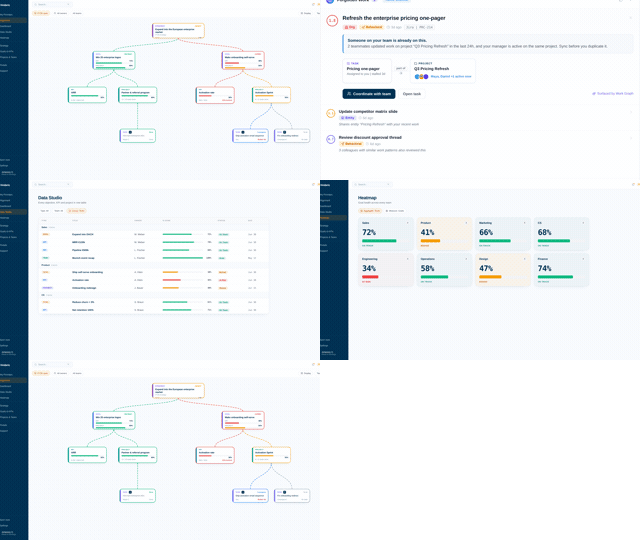
Mooncamp configures the goal tree. It never measures whether the work is moving.
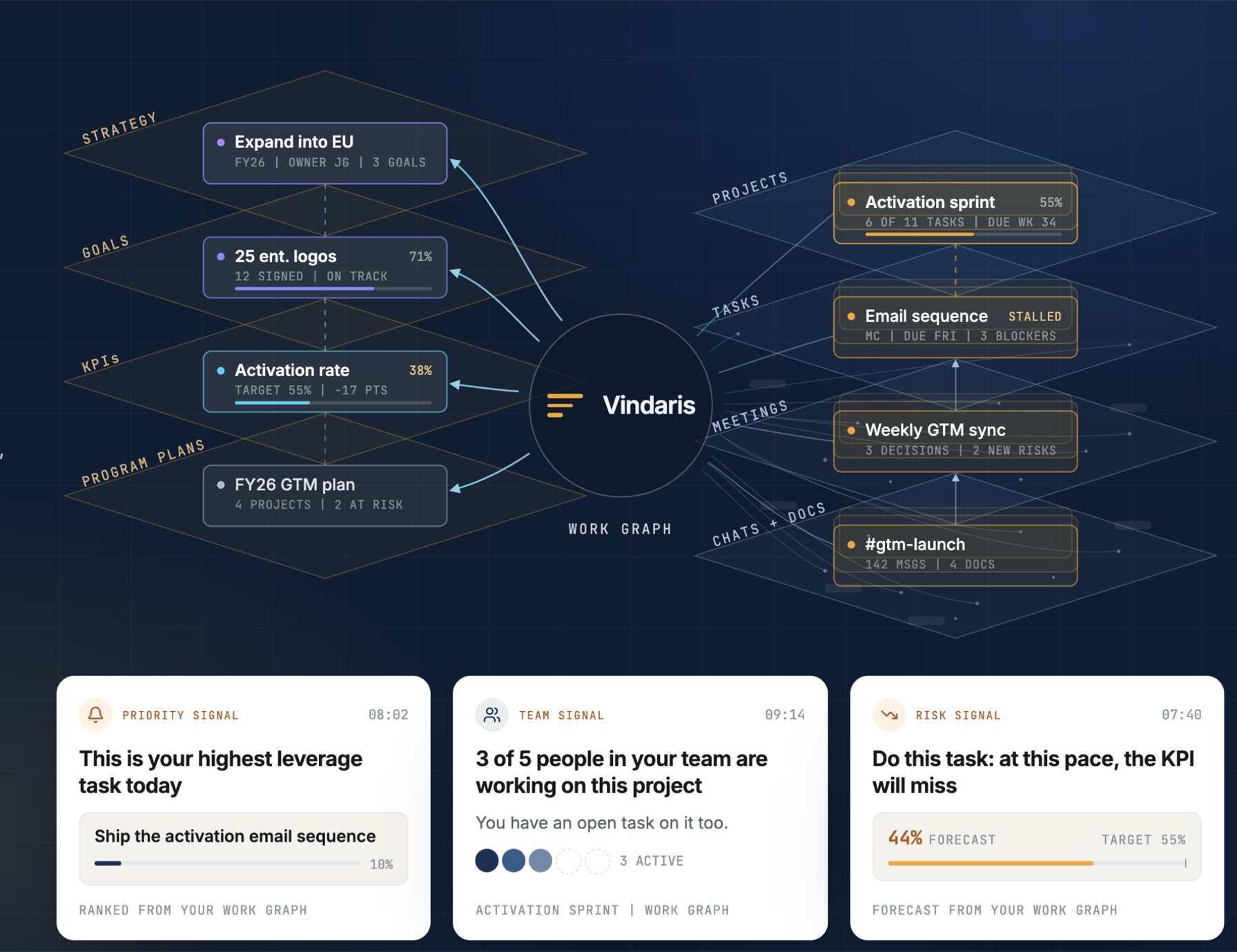
Vindaris keeps your alignment true without anyone maintaining it. It analyzes the work activity behind every goal, the tasks, conversations and threads your teams already generate, derives alignment from what they actually do, and flags the goal that has stalled before the next check-in. Mooncamp only shows the status someone last entered into a configured cascade.





Last reviewed August 2026
Mooncamp is a configurable OKR platform for larger organizations that want flexible cascading, goal types, and alignment views. Vindaris is strategy execution software: strategy, goals and KPIs mapped down to every project and task, with the Work Graph flagging execution risks before they show up in an update. Mooncamp gives you structure; Vindaris derives each goal's status from the work activity that moves it.
Mooncamp shows how goals are configured. Vindaris shows whether the work behind them is moving.
Mooncamp is one of the most flexible OKR workspaces in the category: custom hierarchies, custom fields, custom views, a clean interface and a fair EU stance on data.
Mooncamp's strength is configurability. You can set up goal types, cascading rules, check-in cadences, and alignment views to match how your organization runs. For companies with complex structures that need goals to flow cleanly from company level to team level, that flexibility is genuine and useful. What it does not do is connect any of those goals to the operational work that is supposed to move them.
When goal progress in Mooncamp is manually updated, it carries the same weakness as every other manual-entry tool: status reflects what someone reported, not what the work is doing. The tasks that move a key result live in Jira, Planner, Asana, or HubSpot, and Mooncamp never sees them. A beautifully cascaded goal tree with stale status is still stale.
In Mooncamp, a goal's status is a manual entry. The cascade is well-built, but every number in it depends on someone remembering to update it. When updates lag - and at scale they always do - the alignment view stops reflecting reality, and nobody can tell when the picture went stale.
What teams consistently praised
- Highly configurable hierarchies, fields and views.
- Clean, modern interface teams enjoy using.
- EU-friendly hosting and data posture.
- Fast to set up without consultants.
Where teams hit the limit
- No engine measuring pace or focus against the plan.
- Progress arrives when a person enters it.
- Flexibility shifts effort to configuration.
- Risk stays invisible between updates.
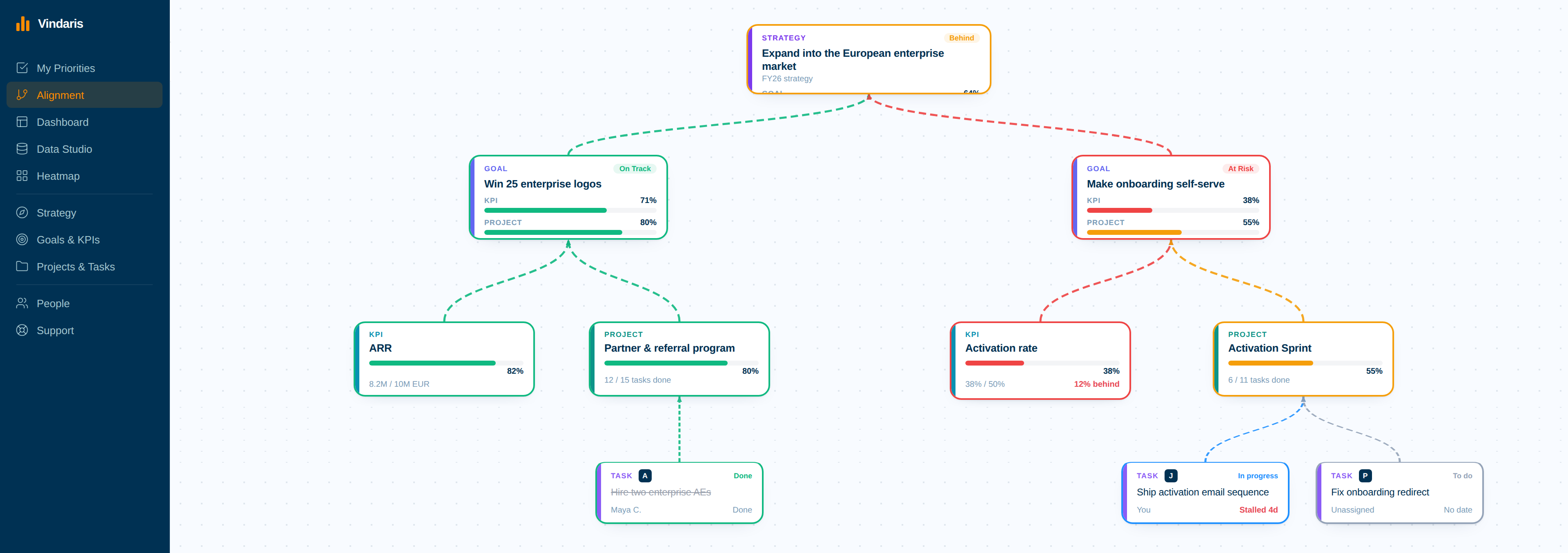
Vindaris is built for strategy execution. Mooncamp is a goal layer that only holds the goals you configured.
and most of the category
- Goals live in one system. Work lives in another.
- Teams update goals as a reporting exercise.
- Integrations move a percentage, not traceable links between effort and outcome.
- Dashboards show what teams reported, which is not what happened.
- Nothing observes pace against the plan.
- No cascade to configure, because the graph follows the work rather than the org chart.
- Progress is derived from tasks instead of collected through check-ins.
- Reorganizations do not require rebuilding the alignment structure.
- Risk comes from task movement, not from a check-in cycle.
- OKRs, KPIs, EOS Rocks and OGSM together, not OKRs with variations.
Vindaris derives alignment from the work itself, keeps status live, and flags a stalled goal before the next check-in.
Mooncamp's distinguishing feature is how flexibly it models alignment: teams, departments, matrix structures, custom hierarchies, all configurable. The model is genuinely good. It is also a model of the organization, which is a different thing from a model of the work.
| Object | Mooncamp | Vindaris |
|---|---|---|
| Central object | The configured alignment hierarchy | The work, with alignment emerging from it |
| Alignment source | How you set the cascade up | Which tasks actually feed which goals |
| After a reorg | Reconfigure the hierarchy | Nothing to do. The edges follow the work |
| Progress source | Check-ins against key results | Task state in the connected tools |
| Hidden cross-team dependencies | Only visible if someone modeled them | Surfaced from shared work |
A configured hierarchy tells you how work is supposed to flow. A derived one tells you how it does. The two agree at the start of a quarter and drift apart after that, as teams pick up work no one mapped and drop work the cascade still shows as on track. Vindaris derives the real flow from the work activity, because how work actually moves is what predicts a miss, not the chart you drew in January.
Five views that keep strategy and execution in sync.
See every goal connected to the work moving it.
Drag and drop your alignment structure. Roll up work progress, KPIs and goals without enforcing any framework syntax.
Alignment Canvas →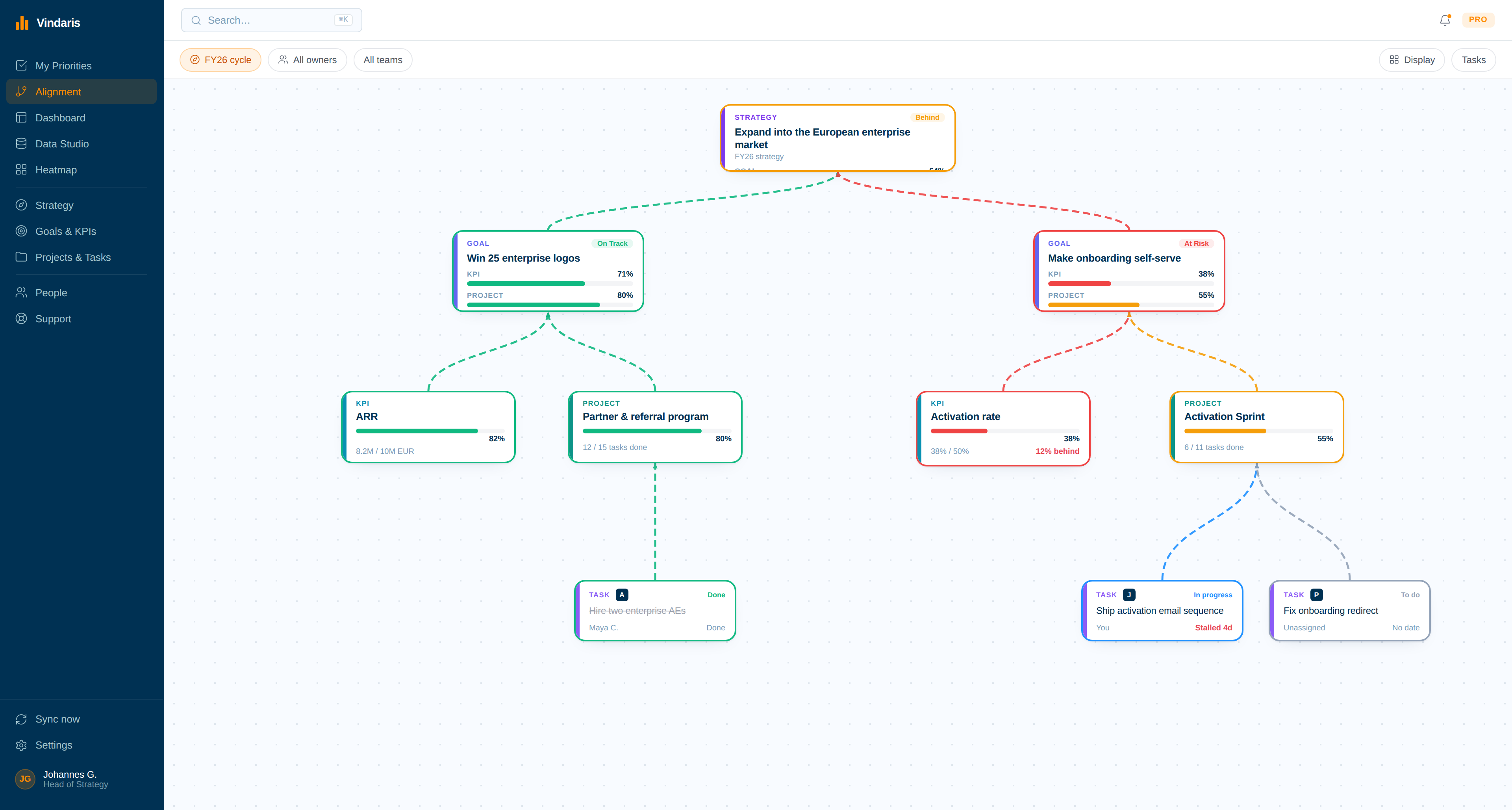
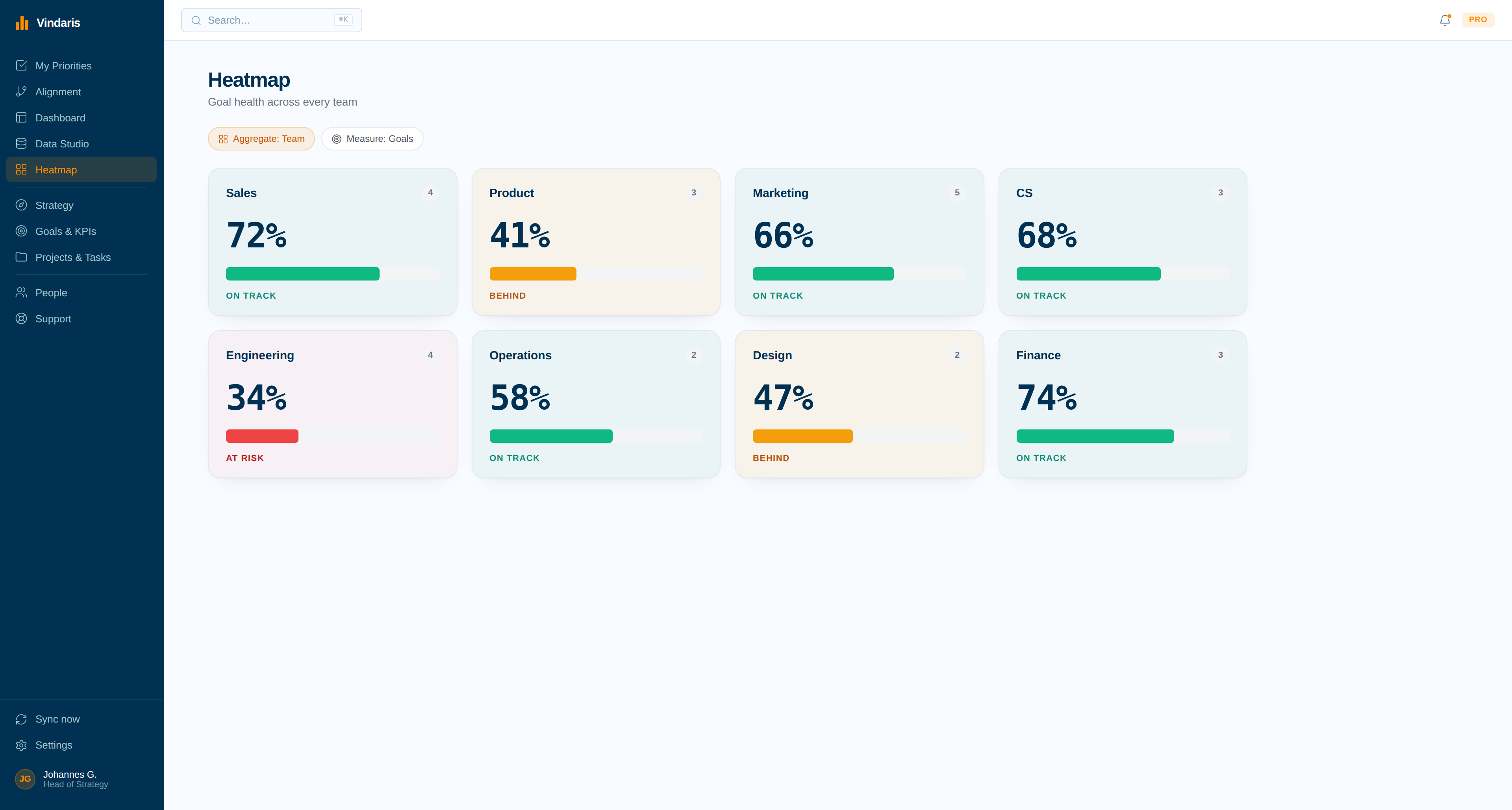
Spot risk while there is still time to fix it.
Run heatmaps across teams, goals, KPIs and projects. Save views and get notified when risk levels change, from task movement rather than a reported number.
Combine tasks and projects across your systems.
Sync HubSpot, MS Planner, Google Tasks, Asana and more into one view. Bidirectional sync keeps everything current while teams stay in their own tools.
All integrations →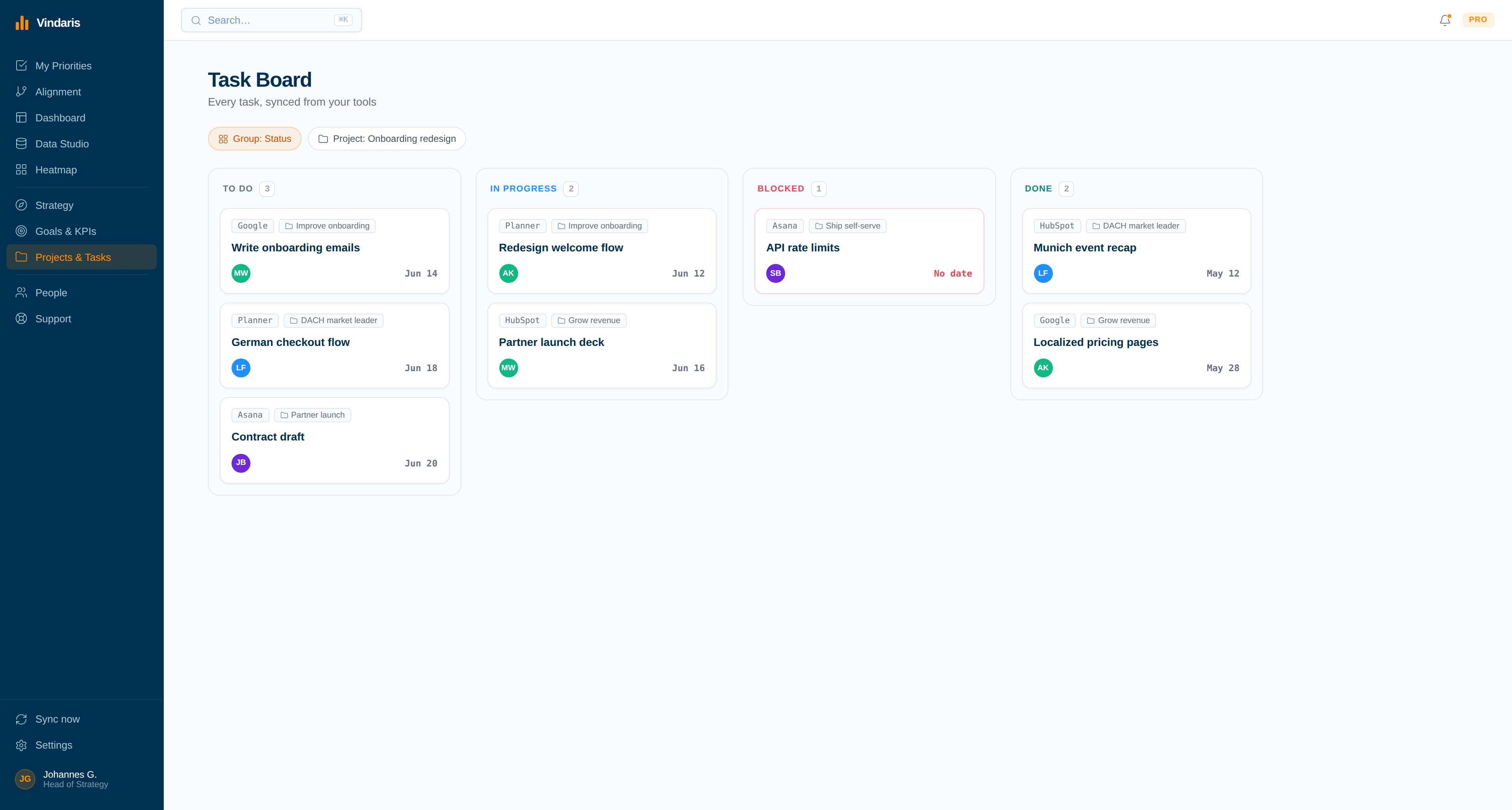
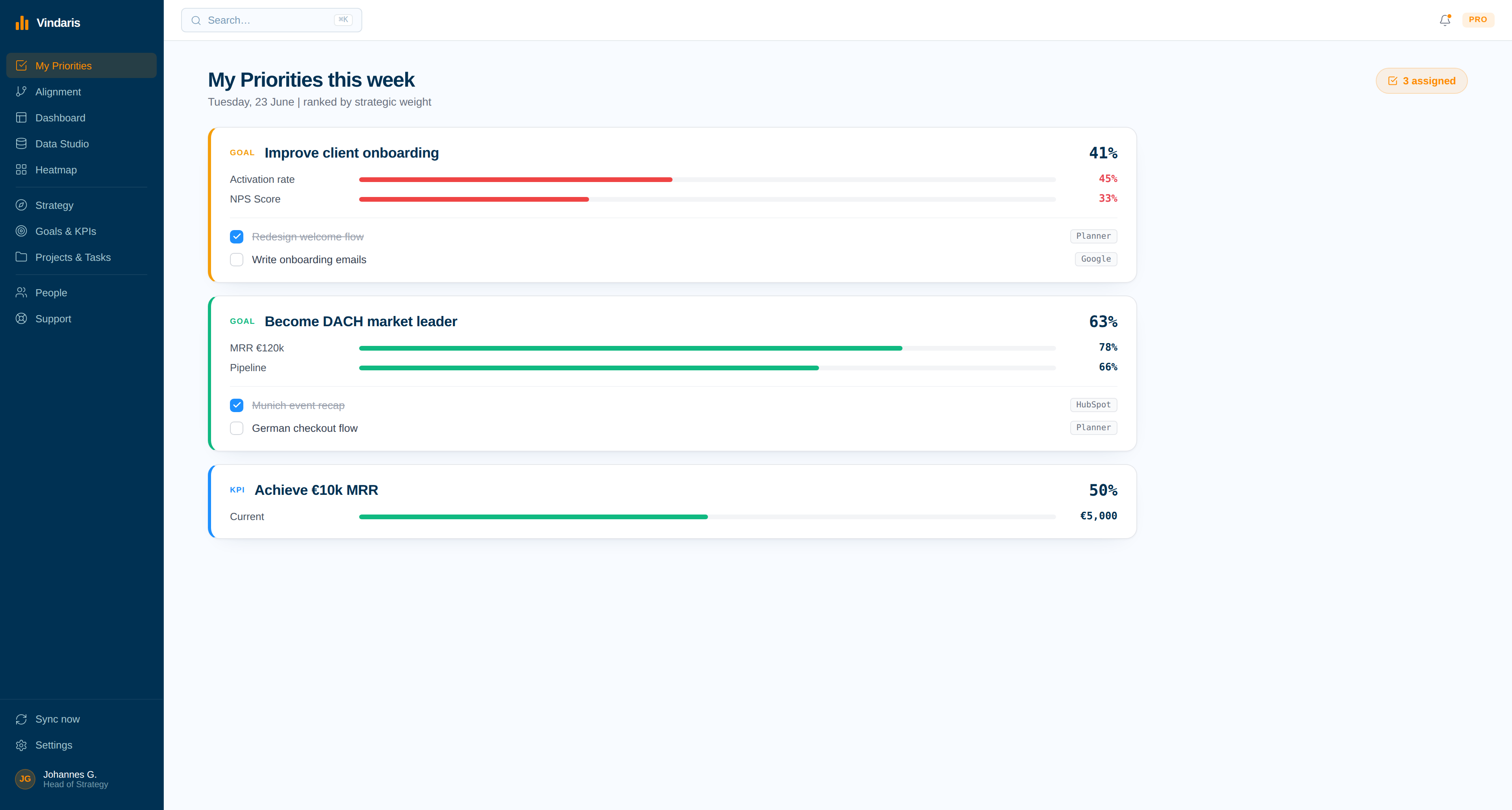
Everyone knows exactly what matters most.
A clear view of each person's goals, KPIs, projects and tasks. Start the week focused on what is due.
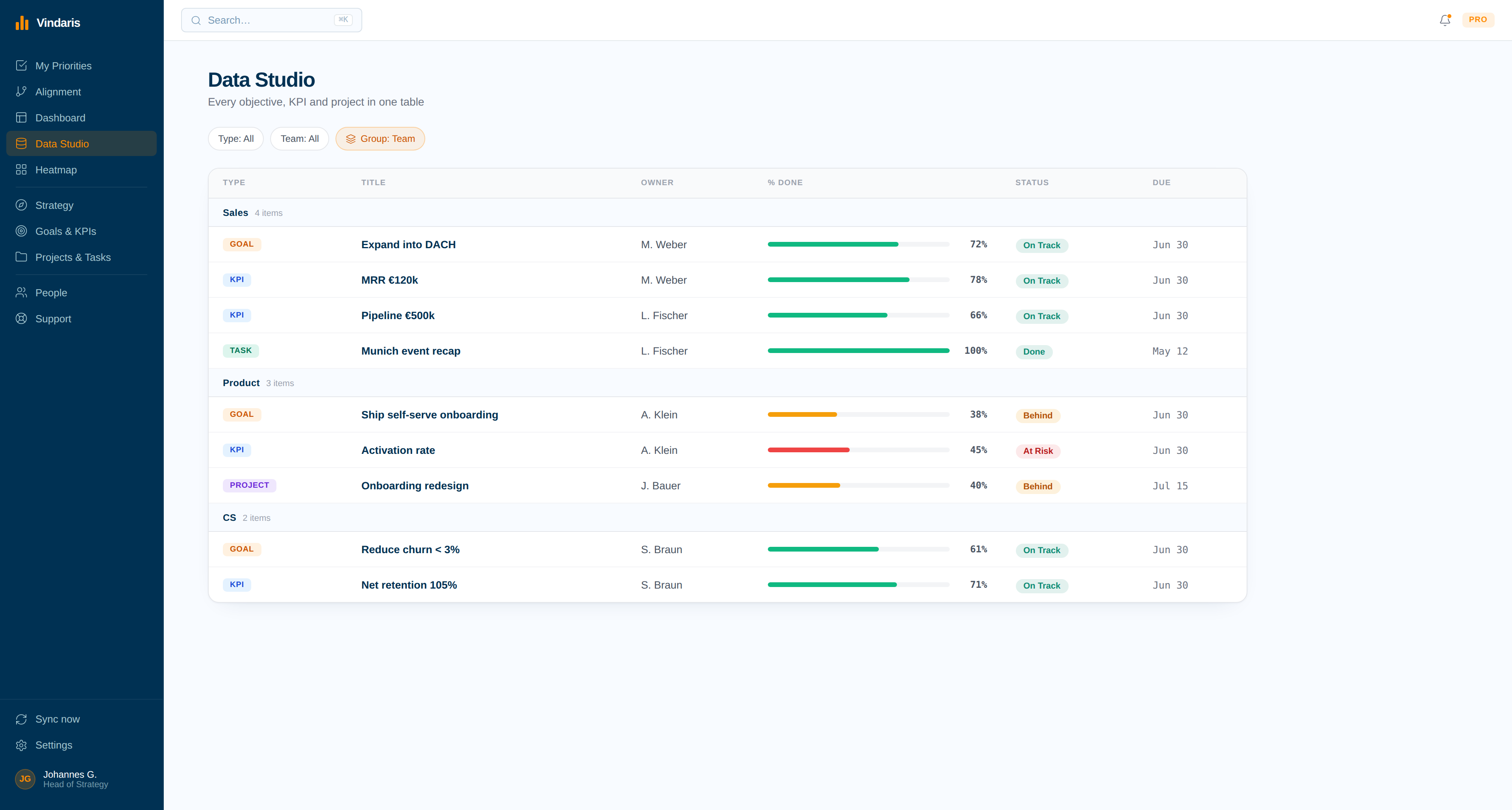
Run reports the way management needs them.
Rank teams, spot risks, compare KPIs to work. AI summaries push updates to Slack, Teams and email.
Keep your structure. Add the signal.
The good news for Mooncamp users is that the configuration work does not need repeating, because Vindaris does not need it.
Mooncamp exports the OKR set with owners, targets and current values, and its API covers the same. Import as-is; the objectives keep their targets and their owners.
The teams, departments and custom alignment structure do not need recreating. Vindaris derives alignment from which work feeds which goal, so the configuration effort that Mooncamp required has no equivalent step here.
Connect Jira, Asana, Planner, HubSpot or Google. The tasks arrive with their owners and projects, and the goal graph starts forming from real connections rather than declared ones.
Worth doing once. Put the alignment you configured in Mooncamp next to the alignment Vindaris derived. The differences are the work that drifted, and they are usually the most useful thing anyone learns in the first week.
Free forever for up to 5 people. No credit card required.
Start free Book a demo No credit card requiredVindaris vs Mooncamp, feature by feature.
Mooncamp wins on flexibility. This table compares what each product knows about the work behind each goal.
| Feature | Vindaris | Mooncamp |
|---|---|---|
| How progress is measured | Read from task-level work and Slack context in the tools your team already uses. | Manual updates by goal owners; configurable check-in reminders. |
| Goal frameworks supported | Framework-agnostic: OKR, KPI, EOS Rocks, OGSM, SMART, Balanced Scorecard, or hybrid. | OKRs, KPIs, and custom goal types with flexible cascading. |
| Connection to work activity | Native work layer with bidirectional sync to HubSpot, Planner, Google, Jira, Asana. | Limited; some integrations exist but no native bidirectional work layer. |
| Risk detection | Automatic execution-risk flags from task movement, focus and pace against plan. | No automatic risk detection from connected work. |
| Status reporting | Live views and AI risk summaries pushed to Slack, Teams, and email. | Configurable dashboards and progress views. |
| Capacity and bandwidth | Built-in bandwidth and capacity planning. | Not covered natively. |
| Ownership model | Single-owner accountability enforced structurally. | Flexible ownership model with cascading permissions. |
| Free plan | Free forever, including 2 integrations and up to 5 people. | No free tier; published per-user pricing (min 5 seats), enterprise on quote. |
| Best fit | Teams that need status derived from work activity and cross-tool visibility. | Larger organizations that want highly configurable OKR cascades. |
The category as a whole is compared in the best strategy execution software guide, and the argument underneath it is set out in the strategy execution gap whitepaper.
Per-seat configuration, or per-seat connection.
Mooncamp prices per user with published tiers, and positions itself for mid-market and larger OKR programmes with a configuration phase attached.
| Plan | Mooncamp | Vindaris |
|---|---|---|
| Free tier | Free trial rather than a free tier. | Free forever. Up to 5 people, 2 integrations, all core features. |
| Entry paid plan | Per-user monthly pricing, published, by feature tier. | Connect, EUR 10 per user per month. All integrations, unlimited sync. |
| Upper plan | Higher tiers add configuration depth, analytics and admin controls. | Pro, EUR 20 per user per month. Unlimited users in one organization. |
| Published pricing | Yes, published on the website. | Yes, on the website. No quote required to evaluate. |
| Minimum commitment | Annual on most tiers. | None. No seat minimum, no annual term, no setup fee. |
Vindaris is free forever for up to 5 people with 2 integrations, then EUR 10 per user per month with every integration included, and there is no configuration project to budget for.
Best for individual contributors, small teams or startups. No credit card required.
- All features (incl. Alignment Canvas, My Priorities, Heatmap, Data Studio & Task Board)
- Set up 2 integrations of your choice
- Invite up to 4 additional members
- 5 ad-hoc AI risk summaries per month
Best for teams, small agencies, or departmental and team management.
- All in Free
- All integrations, unlimited sync
- Unlimited AI risk summaries & alignment suggestions - ad-hoc and scheduled
- Up to 10 users within one organization
Best for multiple teams, exec teams, Chiefs of Staff, departmental leadership or full-org deployments.
- All in Connect
- Unlimited users within one organization
- Direct human support email, 24h response time
- Human-led onboarding support
Common questions, answered
What is the difference between Mooncamp and Vindaris?
Can Vindaris handle complex organizational structures like Mooncamp?
Why is Mooncamp's goal status unreliable for execution?
Can I migrate from Mooncamp to Vindaris?
Free resources for this topic
A template you can download, a playbook to run, and the thinking behind both. No email required.
Or start with the full picture: strategy execution software that connects your plan to the work delivering it.
Switching from Mooncamp is a choice. Repeating its architecture is optional.
Free forever for up to 5 people. No credit card required.