How to Run an OKR Cycle
Most teams treat OKRs as a setting exercise: a planning offsite, a list of goals, and then silence until the next offsite. That is why so many OKR programs quietly die in their second or third quarter. An OKR cycle is a loop, not an event, and the value is in the steps between setting and scoring. This playbook walks the full loop, with the specific failure mode that kills each step so you can avoid it.
The steps
Before any team plans, leadership sets two or three company Objectives with measurable Key Results. These are the anchor everything else aligns to. The trap: setting too many. A company with seven Objectives has none, because no team can tell which two actually matter this quarter.
Each team writes its own OKRs that support the company set, then meets leadership to confirm the link and push back on anything unrealistic. This back-and-forth, borrowed from Hoshin Kanri's catchball, is what creates ownership. The trap: pure top-down cascade, where teams receive goals they never agreed to and quietly stop believing in them.
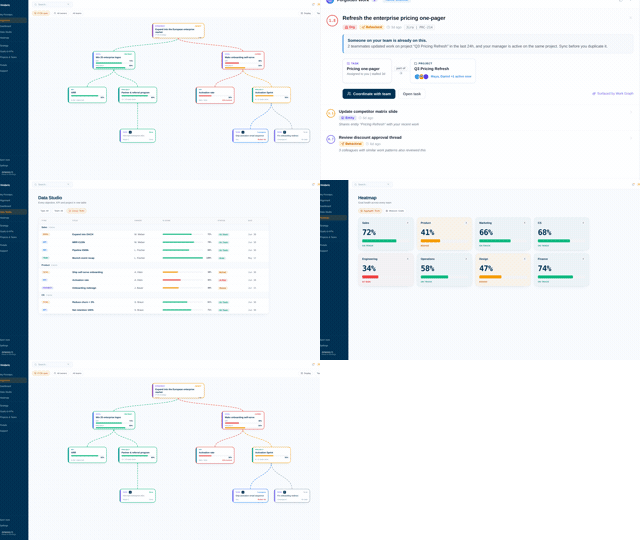
Before the quarter starts, map the initiatives and tasks expected to move each Key Result. A Key Result with no work mapped beneath it is a wish, and you want to discover that in week zero, not week ten. The trap: leaving the work in a separate tool, so the OKRs and the actual delivery drift apart from day one.
Each week, owners update progress and a confidence rating. The point is to surface a stall in week three, while there is time to act, not at quarter end. The trap: confidence theater, where everything stays green until the first honest red appears too late. Tie confidence to the observable work, not to how the owner feels.
Around the halfway mark, step back from weekly blockers and ask whether the trend will hit the target. This is where you make the one or two corrections that save a goal. The trap: skipping it, so problems that built over weeks only surface at the final review when nothing can be done.
At quarter end, score each Key Result 0.0 to 1.0. For aspirational goals, around 0.7 is success; for committed goals, expect 1.0. The trap: punishing a missed stretch goal like a missed commitment, which teaches everyone to set safe targets next quarter and quietly kills ambition.
Before setting next quarter, ask what the scores taught you: which goals were mis-sized, which work never materialized, which assumptions broke. The trap: starting the next planning session cold, repeating the same mistakes with higher confidence because last quarter's lessons were never written down.
Frequently asked questions
How long is an OKR cycle?
Most teams run quarterly OKRs with an annual layer above them. The quarter is short enough to stay relevant and long enough to deliver meaningful outcomes. Some fast-moving teams use six-week cycles, but quarterly is the default.
Who owns the OKR cycle?
Each Objective has a single owner accountable for it, and someone, often a chief of staff or ops lead, owns the cadence itself: making sure setting, check-ins, and scoring actually happen on schedule.
What is the most common reason OKR programs fail?
Treating OKRs as a setting exercise rather than a loop. Goals are set with energy at the offsite, then disconnected from weekly work, and by the time anyone looks again the quarter is over. The fix is connecting goals to traceable work and reviewing on a cadence.
Run this playbook on goals connected to real work
Vindaris connects every goal to the traceable work moving it, so the cadence in this playbook runs on real progress instead of hand-typed status. Start free, no credit card.
Sign Up for Free