Organizational Alignment
Organizational alignment is the degree to which a company's structure, incentives, decision rights and day-to-day work all reinforce the same strategy. It is broader than strategic alignment: it asks not only whether work maps to goals but whether the org chart, budgets and incentives make that mapping likely to hold.
Alignment operates on several layers at once. Structure decides who owns what, incentives decide what people optimize, decision rights decide where trade-offs get made, and the daily work decides what actually ships. An organization is aligned when those layers agree. The classic failures are a reorg that changes reporting lines but not the work, and an incentive plan that keeps paying for outputs the strategy no longer wants.
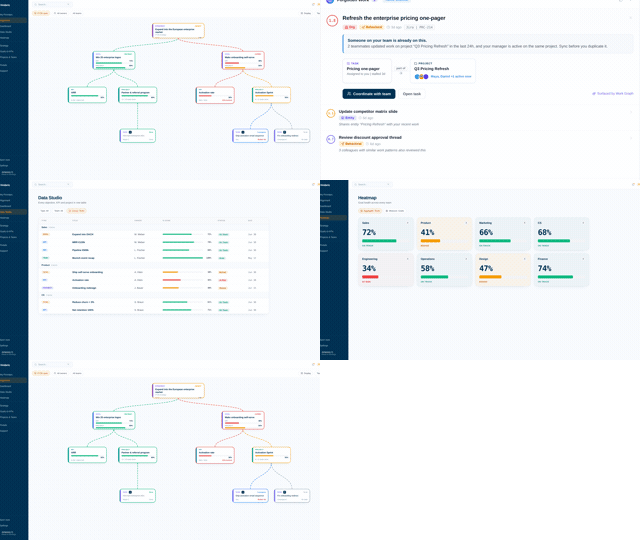
The work layer is the one place alignment can be checked empirically. When goals are traced to the teams and tasks beneath them, misalignment stops being a culture diagnosis and becomes a list: goals with no active owner, teams whose effort maps to no current priority, two units optimizing metrics that pull against each other. Fixing structure and incentives is leadership work, but seeing the drift early is an information problem, and it is solvable continuously rather than at the annual review.
A company shifts strategy from new-logo growth to retention. The sales incentive plan keeps paying on new logos. Six months later the strategy deck says retention while the pipeline says acquisition. The organization was never realigned; only the slides were.
See where effort has drifted from your goals
Vindaris runs OKRs, KPIs, EOS, OGSM, SMART goals, the Balanced Scorecard, and Hoshin Kanri in one place, with the Work Graph flagging execution risks across all of them. Start free, no credit card.
Sign Up for Free