 Otter.ai
Otter records the conversation. Vindaris tracks what was promised in it.
Vindaris pulls Otter conversations, reads them for commitments and decisions, and proposes tracked work under the goals they touch. Two delivery paths keep it working whether or not your plan includes API access.
Free forever | Two integrations included | Your team keeps working in Otter.ai
Built to keep working on either Otter plan.
API access is not available on every Otter tier, so the integration runs two ways. If polling is available it uses it. If not, transcripts can be pushed in and handled identically.
With an API key configured, Vindaris fetches the latest conversations on a schedule and queues them for extraction.
Where API access is not available, an inbound webhook accepts the transcript and follows exactly the same path, so nobody is locked out by their plan.
Extraction looks for who agreed to do what, which is different from the recap that meeting tools generate by default.
Each candidate item arrives with a suggested objective, so accepting it takes one click rather than a mapping exercise.
The transcript itself becomes context attached to the related work, which is what makes a later risk alert specific rather than generic.
Nothing from a transcript becomes tracked work without review. Discussion is full of conditional statements, and treating those as commitments would be worse than useless.
Connect, record, review, track.
Whichever mode you use, the review step and the resulting work behave the same, so teams on different Otter plans stay consistent.
Add your API key for polling, or configure the inbound webhook if your plan does not include API access.
Record as usual. Vindaris picks up the conversation on the next poll or as soon as it is pushed.
Review what was extracted, attach each item to the goal it serves, and drop the rest.
Accepted items roll up to their goals and are flagged when they stall, the same as work from any other source.
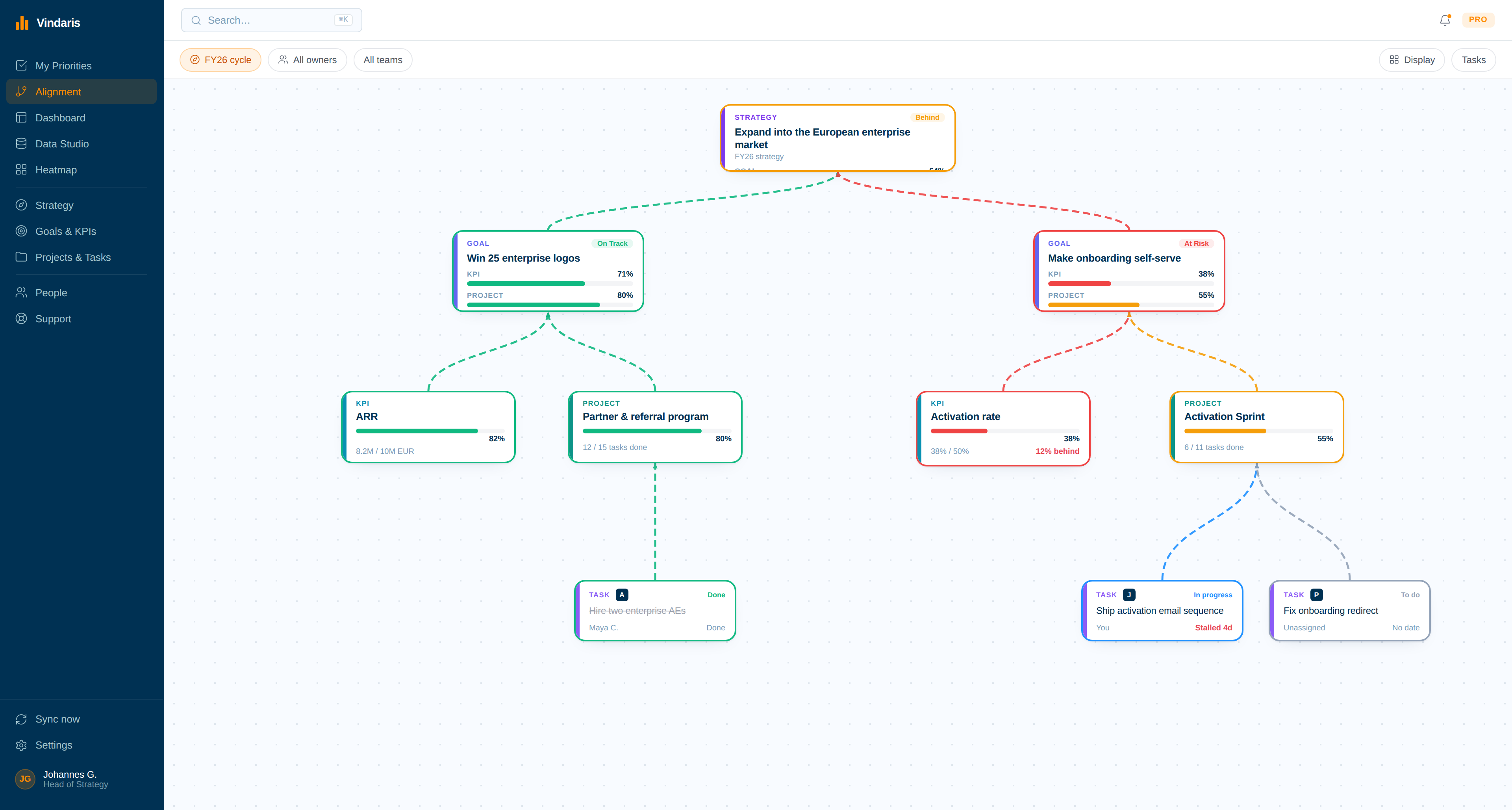
Meeting outcomes landing on the strategy.
A decision taken in a call attaches to the goal it changes, so the canvas reflects the conversation rather than the version of the plan written in January.
The promise nobody followed up.
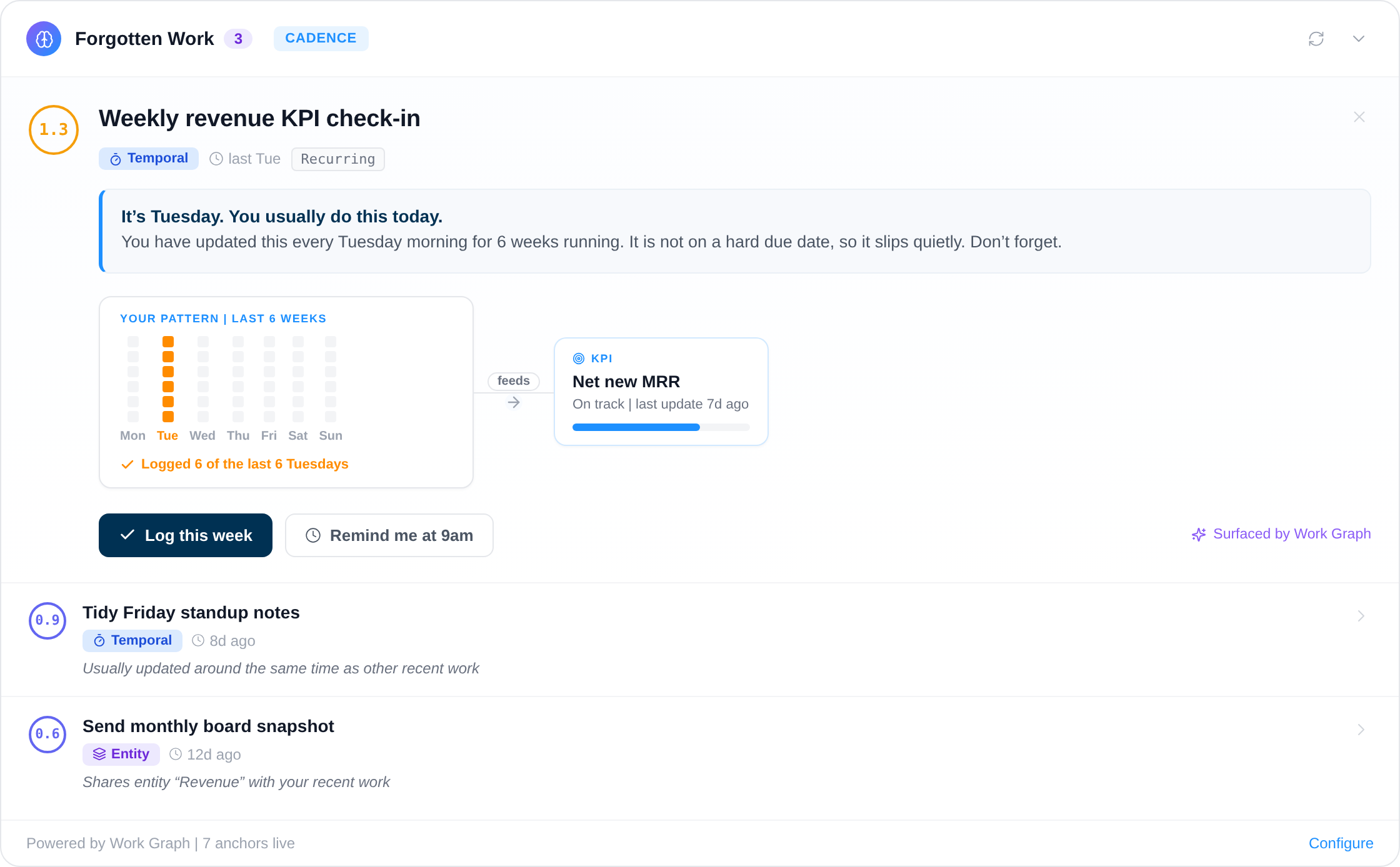
Commitments from meetings are the most forgettable work in a company. Once tracked, they are also the easiest to flag when nothing happens.
A searchable archive is not follow-through.
Otter makes it possible to find any sentence anyone said in a meeting. That is genuinely useful, and it is also the reason the follow-up problem hides so well. Because the record exists, everyone assumes the commitment is safe, and nobody notices that no task was ever created from it.
Vindaris takes the step after the archive. Commitments are lifted out, attached to the objective they affect, and measured against it. If the work never starts, the goal shows the gap. The transcript keeps proving what was said, and the Work Graph starts proving what was done about it.
Where to go next
Otter.ai and Vindaris, answered
Does this need an Otter plan with API access?
No. With an API key Vindaris polls for new conversations. Without one, transcripts can be delivered through the inbound webhook path and are handled exactly the same way afterwards.
What does Vindaris extract from a conversation?
Commitments and decisions: who agreed to do what, and what changed. That is deliberately different from a recap, because a summary of topics does not tell you what work now exists.
Is anything tracked without my confirmation?
No. Every extracted item is a proposal with a suggested goal, and you accept or discard it. Conversation is full of hypotheticals, and treating those as commitments would make the graph less trustworthy, not more.
Can transcripts inform risk alerts?
Yes. The transcript stays available as context on the related work, which is what allows a later risk finding to point at the discussion where a dependency or objection first appeared.
Turn the recording into work somebody owns.
Connect Otter.ai in a couple of minutes. Free forever for goal management, two integrations included.
Connect Otter freeNo credit card | No migration | Nobody leaves Otter.ai