OKR vs Balanced Scorecard: quarterly focus meets strategic breadth.
OKRs are fast to set up and outcome-focused. Balanced Scorecard is comprehensive and multi-perspective. Many organizations start with one and eventually need elements of both. The real question is what happens after you pick your framework.
Free forever | No credit card | Your team keeps their tools
OKR vs Balanced Scorecard is focus against breadth. OKRs set a few ambitious quarterly outcomes with measurable key results. The Balanced Scorecard maps performance across the financial, customer, process and learning perspectives over years. Many organizations keep the Scorecard as the annual strategy map and run OKRs as the quarterly priorities inside it.
Lightweight, outcome-driven, built for speed.
Objectives and Key Results gained popularity through Intel and Google and have become the default goal-setting framework in tech and fast-growing companies. The structure is simple: an Objective states where you want to go. Key Results define how you will measure whether you got there.
Quarterly cadence keeps teams focused on near-term outcomes. Ambitious targets (the "stretch" philosophy) encourage teams to aim beyond what feels comfortable. The format is deliberately lightweight - a team can have its OKRs written in 30 minutes. That simplicity is the framework's greatest strength and its limitation.
OKRs work well when teams need clear outcome targets and fast iteration. They are less effective for organizations that need to track a broad set of strategic dimensions simultaneously, or when financial, customer, and operational metrics all need equal attention in the same planning structure.
Four perspectives. Strategy as a system of linked objectives.
Kaplan and Norton's Balanced Scorecard was built to solve a specific problem: companies were managing strategy through financial metrics alone. The BSC adds three more lenses - Customer, Internal Process, Learning and Growth - and maps the cause-and-effect relationships between them.
The framework is heavier to implement than OKRs. It requires defining objectives, measures, targets, and initiatives across all four perspectives, plus building the strategy map that links them. That investment pays off in strategic completeness - you are forced to think about whether your internal processes actually support your customer goals, and whether your people development supports your process ambitions.
BSC is common in larger enterprises, healthcare, government, and organizations with complex stakeholder landscapes. Its comprehensiveness is valuable but also creates a reporting burden that can turn scorecard reviews into long presentations rather than decision-making sessions.
Different altitudes, not competing frameworks.
OKRs fit when you need fast goal-setting, your teams are outcome-oriented, and you want quarterly iteration. They work especially well in tech companies, startups, and product organizations where speed of learning matters more than comprehensive strategic mapping.
Balanced Scorecard fits when your organization is complex, multi-divisional, or needs to balance financial, customer, operational, and growth metrics explicitly. BSC is strong in environments where multiple stakeholder perspectives must be tracked simultaneously and where strategic cause-and-effect thinking is important.
Many organizations that mature past a certain size find they need both. BSC at the executive level to define the strategic landscape. OKRs at the team level to drive quarterly outcomes within it. The two frameworks are not competitors - they operate at different altitudes of the same strategy.
Why the framework choice matters less than the execution layer.
OKR check-ins and BSC reviews share the same structural weakness. Both depend on people reporting progress manually. And manual reporting always drifts from reality.
A team running OKRs updates their key result confidence in a weekly check-in. A team running BSC updates their scorecard measures in a quarterly review. In both cases, leadership sees what people chose to tell them. The tasks in Planner, the deals in HubSpot, the actual work happening every day - none of it is structurally connected to the goals. The connection exists only in someone's head or in a manually maintained spreadsheet.
Both frameworks structure how you think about goals. Neither structures how goals connect to work. Whether you run OKRs, BSC, or a hybrid - the gap between your strategic intent and your daily execution is where most organizations lose alignment. The framework does not close that gap. The execution layer does.
Vindaris is framework-agnostic. Model your goals as OKRs, BSC perspectives, or both at different levels. The platform connects whichever structure you choose to the real work in HubSpot, Planner, and Google - bidirectional, live, traceable. Your quarterly OKR review or your scorecard session gets grounded in what actually happened, not what someone remembered to report.
OKR vs Balanced Scorecard at a glance.
| Dimension | OKR | Balanced Scorecard |
|---|---|---|
| Origin | Intel (1970s), popularized by Google | Kaplan & Norton, 1992 |
| Core idea | Outcome-focused objectives with measurable key results | Strategy mapped across four balanced perspectives |
| Planning cycle | Quarterly | Annual with quarterly reviews |
| Setup effort | Low - a team can draft OKRs in 30 minutes | High - requires strategy mapping across four perspectives |
| Scope | Narrow, outcome-focused | Broad, multi-dimensional |
| Best fit | Tech, startups, product teams, fast iteration | Large enterprises, healthcare, government, complex orgs |
| Weakness | Can miss strategic dimensions outside the quarterly focus | Reporting burden can turn reviews into presentations |
| Execution link | Manual - weekly check-ins, confidence scoring | Manual - quarterly scorecard reviews |
| Vindaris support | Yes - OKRs natively supported | Yes - BSC perspectives natively supported |
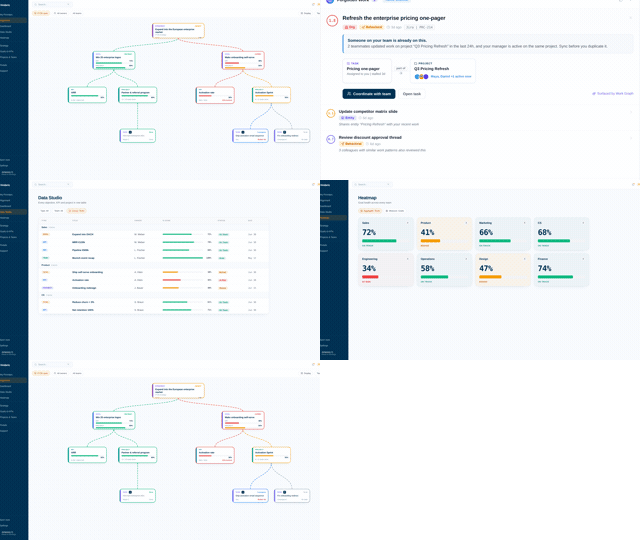
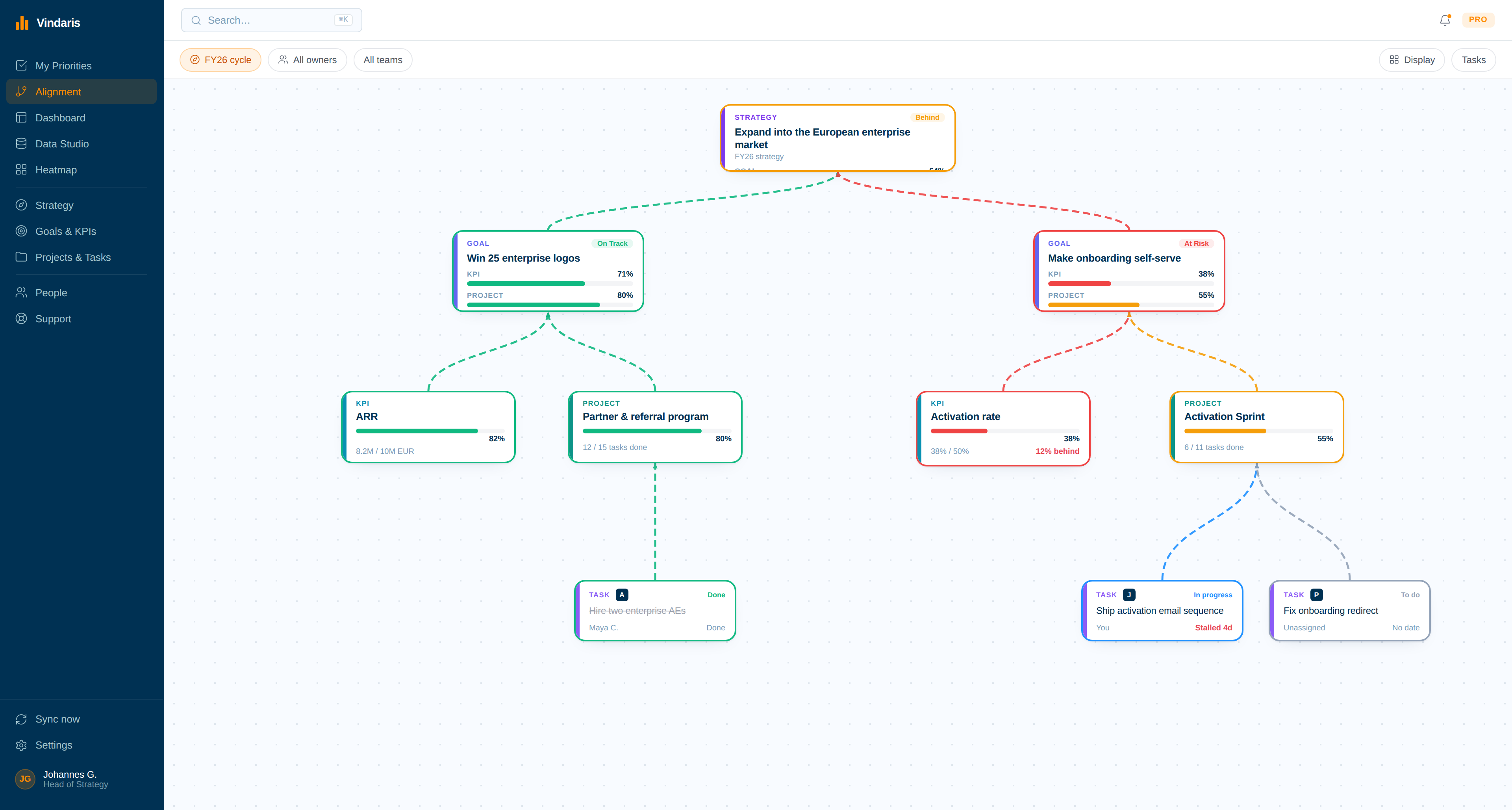
Goals, KPIs, tasks, and strategy in one place
See every goal connected to the work moving it.
Drag-and-drop your alignment structure. Roll up work progress, KPIs, and goals without enforcing any framework syntax.
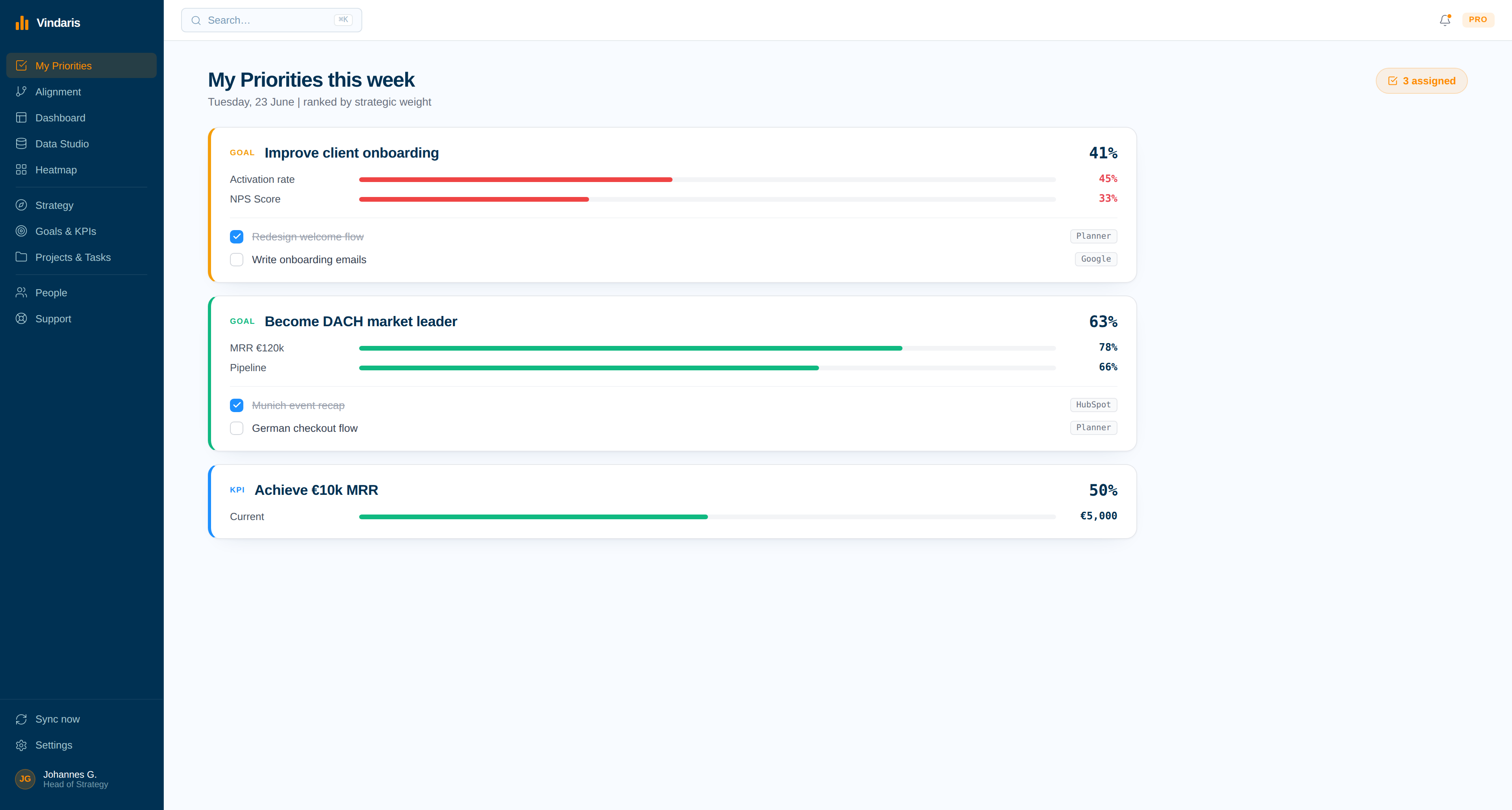
Everyone knows exactly what matters most.
A clear view of each person's goals, KPIs, projects, and tasks. Start every week focused on what's important and due.
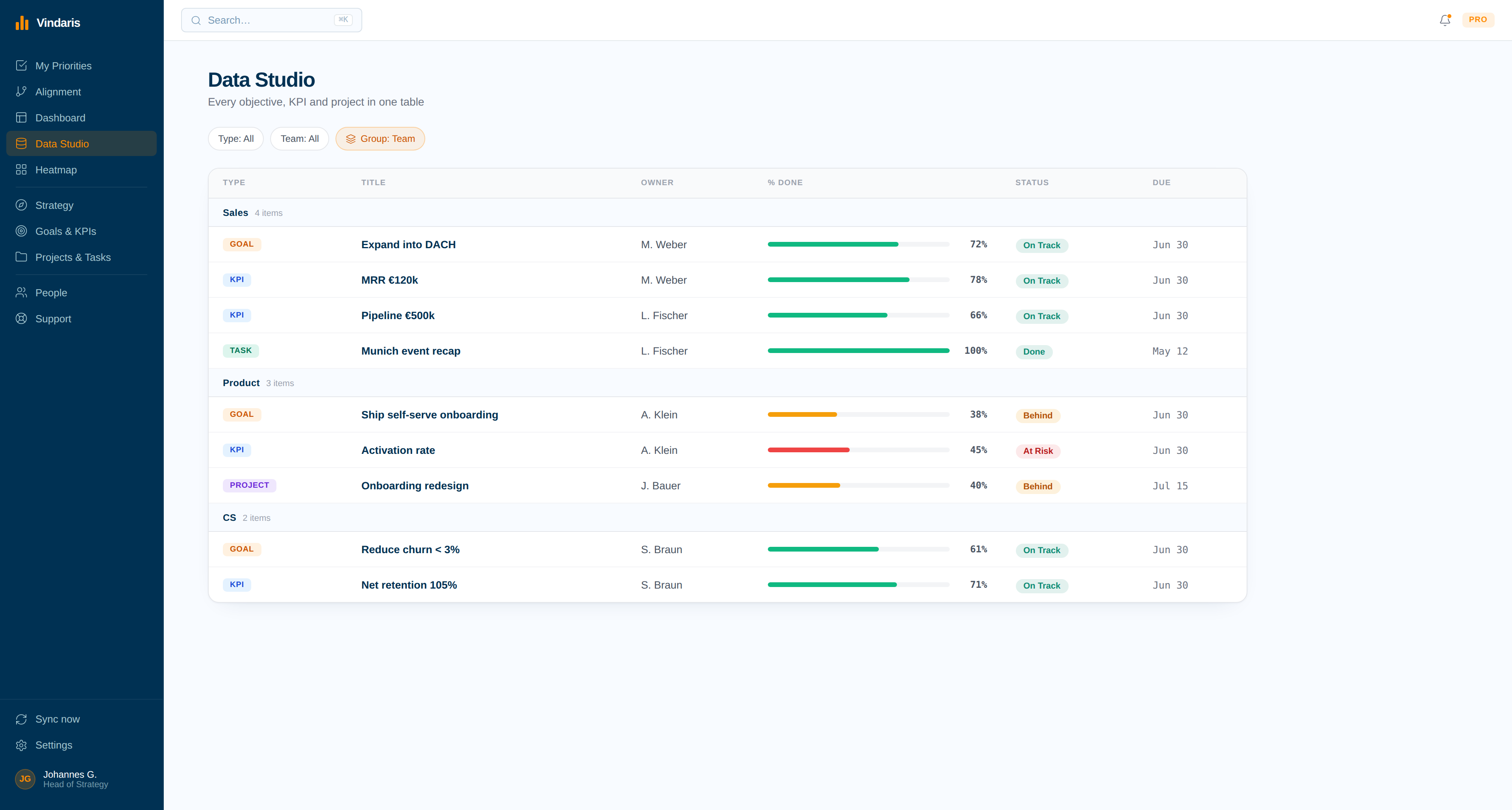
Run reports the way your management needs them.
Build custom views to rank teams, spot risks, compare KPIs to work. AI summaries push updates to Slack, Teams, and email.
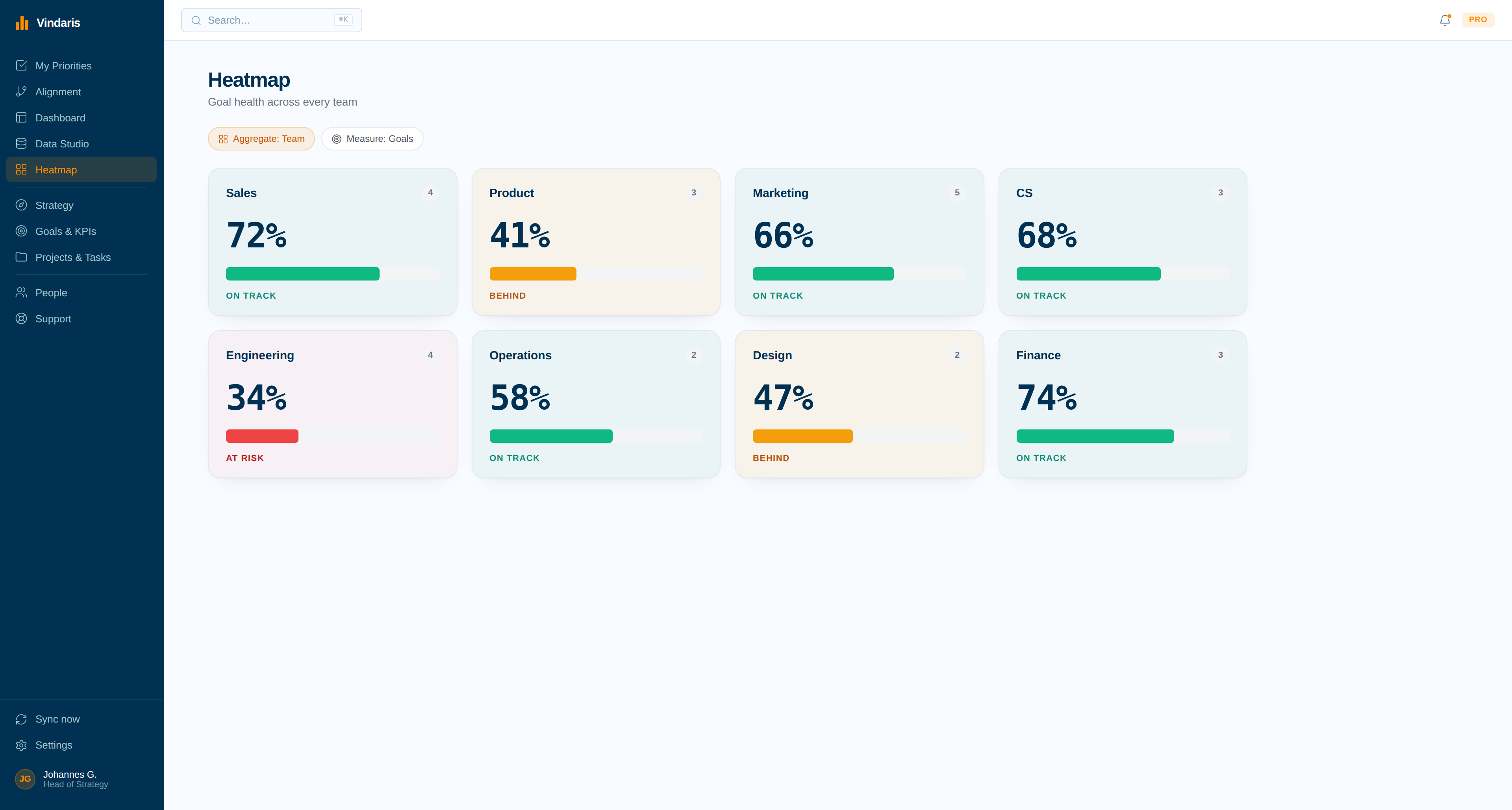
Spot risks while there's still time to fix them.
Run heatmaps across teams, goals, KPIs, and projects. Save views and get notified when risk levels change.
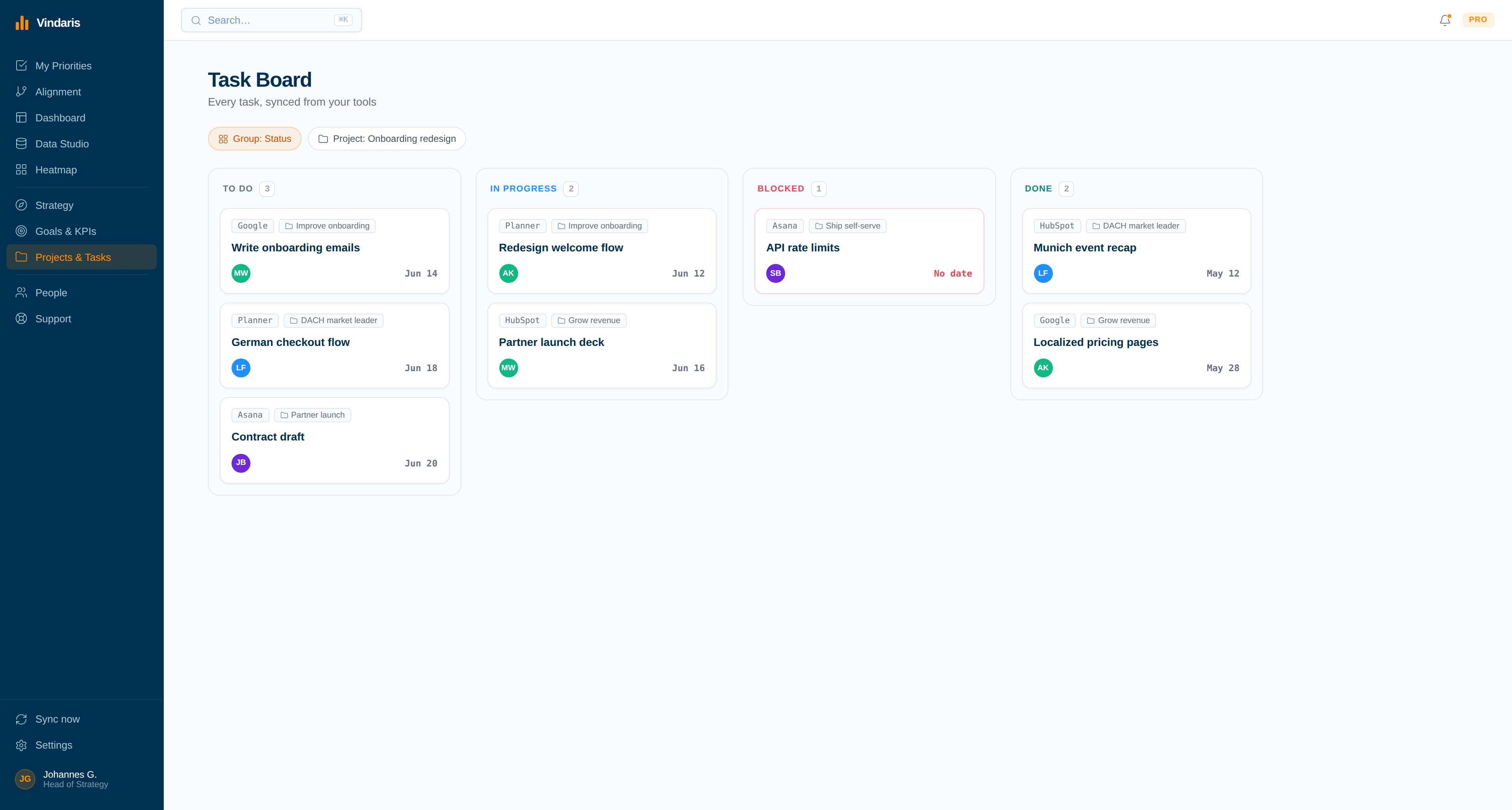
Combine tasks and projects across your systems.
Sync HubSpot, MS Planner, Google Tasks, Asana and more into one view. Bi-directional sync keeps everything current while teams stay in their own tools.
Common questions, answered
What is the difference between OKRs and Balanced Scorecard?
Can you use OKRs and Balanced Scorecard together?
Which is better for a tech company - OKRs or Balanced Scorecard?
Does Vindaris support both OKRs and Balanced Scorecard?
Why do both OKRs and Balanced Scorecard fail at execution?
Free forever, including two integrations
Start free with full strategy, goal, KPI, task, and project management. Pay only when you add more than 4 people, need more integrations, or more AI summaries.
Best for individual contributors, small teams or startups. No credit card required.
- All features (incl. Alignment Canvas, My Priorities, Heatmap, Data Studio & Task Board)
- Set up 2 integrations of your choice
- Invite up to 4 additional members
- 5 ad-hoc AI risk summaries per month
Best for teams, small agencies, or departmental and team management.
- All in Free
- All integrations, unlimited sync
- Unlimited AI risk summaries & alignment suggestions - ad-hoc and scheduled
- Up to 10 users within one organization
Best for multiple teams, exec teams, Chiefs of Staff, departmental leadership or full-org deployments.
- All in Connect
- Unlimited users within one organization
- Direct human support email, 24h response time
- Human-led onboarding support
Other framework comparisons
Pick the framework that fits. Then connect it to reality.
Vindaris supports OKRs, Balanced Scorecard, and any hybrid. Free forever for goal management.
Connect your first tool - freeNo credit card | No minimum contract | Your team keeps their tools