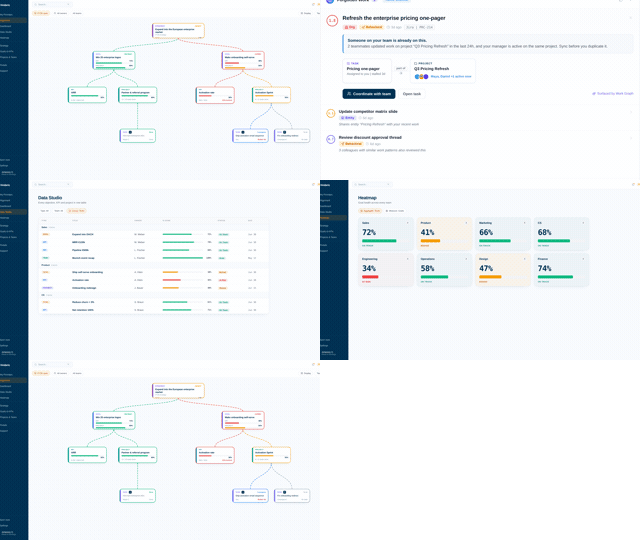
OGSM vs OKR: two ways to describe the goal. The same gap underneath.
OGSM maps Objectives, Goals, Strategies, and Measures on a single page. OKRs focus on quarterly Objectives and Key Results. Both work. Neither connects to the execution layer on its own.
Free forever for goal management | Supports OGSM, OKRs, and hybrids
OGSM vs OKR is a difference of cadence and direction. OGSM cascades a single annual page from the objective down to the measures, top down and stable. OKRs set quarterly targets that teams shape themselves. OGSM fits a strategy that holds for a year. OKRs fit one that changes inside it.
OGSM: the one-page strategy map from FMCG and manufacturing
OGSM stands for Objective, Goals, Strategies, Measures. Four layers on a single page. The format was popularized by Procter & Gamble and became the standard strategic planning tool across consumer goods, manufacturing, and large multinationals.
OGSM includes the strategy layer that most frameworks skip. The Objective defines the long-term direction. Goals quantify what success looks like. Strategies describe how you will get there. Measures track whether it is working. That four-layer structure forces teams to articulate the "how" alongside the "what" and the "how much."
Where OGSM struggles: cadence and agility. OGSM was designed for annual planning. The one-page format is powerful for alignment but difficult to update mid-cycle. In practice, OGSM pages are created in a strategy offsite, cascaded through PowerPoint, and rarely revisited until the next planning cycle. The strategy is clear. The execution is invisible.
OKRs: lightweight quarterly goals for fast-moving teams
OKRs strip goal-setting down to two layers: a qualitative Objective and two to five measurable Key Results. The quarterly cycle means you can adjust direction four times a year. The lightweight structure means a team can set OKRs in a single meeting.
OKRs are faster to set and easier to iterate on. There is no strategy layer to maintain, no formal one-page document to cascade. This makes OKRs the default choice for tech companies and startups where speed matters more than comprehensive strategic documentation. Set. Measure. Adjust. Repeat.
Where OKRs fall short: strategic context. An OKR tells you what the team wants to achieve this quarter but not why or how it connects to the broader strategy. Teams can set locally optimal OKRs that don't add up to anything coherent at the company level. And like OGSM, OKRs provide no built-in mechanism to connect the goal to the work that moves it.
When to use each
Annual or multi-year planning. Large organizations where multiple business units need to align on a shared strategy. Industries like FMCG, manufacturing, or pharma where the planning horizon is longer than a quarter. OGSM forces the strategic "how" onto the page.
Quarterly planning in tech and product organizations. Teams that need a lightweight goal format they can set, track, and adjust quickly. Organizations that already have strategy defined elsewhere and need a fast execution-level framework.
Use OGSM at the corporate level to define the annual strategic framework. Break it into quarterly OKRs at the team level. The OGSM provides context and direction. The OKRs provide the quarterly execution targets. The challenge is keeping both connected to the same work layer.
Why the framework choice matters less than you think
OGSM and OKR represent different philosophies, but they share the same blind spot. Both describe what you want to achieve. Neither connects structurally to the work that will achieve it.
OGSM pages live in PowerPoint or strategy documents. OKRs live in tracking tools. In both cases, the projects, tasks, and daily work that should move the goals happen in entirely different systems. The gap between the goal layer and the work layer is where execution visibility breaks down. Leadership sees the strategy. They cannot see whether the work is aligned to it.
Vindaris supports OGSM, OKRs, and hybrid models natively. You bring the framework that fits your organization. Vindaris provides the missing layer: a traceable connection between your goals and the work happening in Planner, HubSpot, Google, or wherever your teams operate. The framework is the label. The connection to real work is what makes it useful.
OGSM vs OKR at a glance
| Dimension | OGSM | OKR |
|---|---|---|
| Layers | Four (Objective, Goals, Strategies, Measures) | Two (Objective + Key Results) |
| Strategy layer | Built in (the S in OGSM) | Not included, left to the team |
| Cadence | Annual (sometimes multi-year) | Quarterly |
| Format | One-page strategy document | Goal + measurable results list |
| Common in | FMCG, manufacturing, large corporates | Tech, SaaS, startups |
| Strength | Comprehensive, includes the "how" | Lightweight, fast to set and adjust |
| Common failure | Created in offsite, never revisited | Set quarterly, disconnected from daily work |
Goals, KPIs, tasks, and strategy in one place
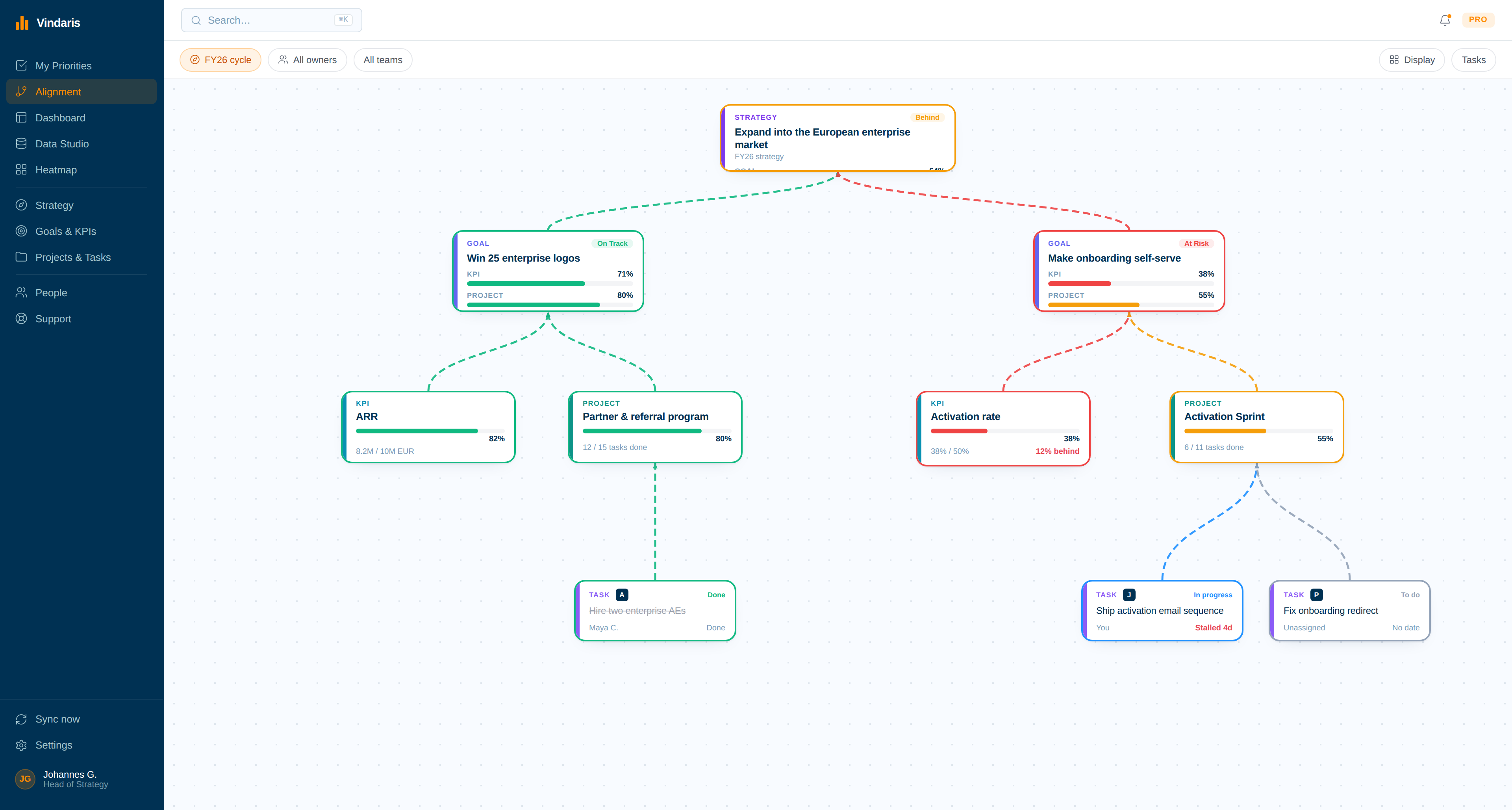
See every goal connected to the work moving it.
Drag-and-drop your alignment structure. Roll up work progress, KPIs, and goals without enforcing any framework syntax.
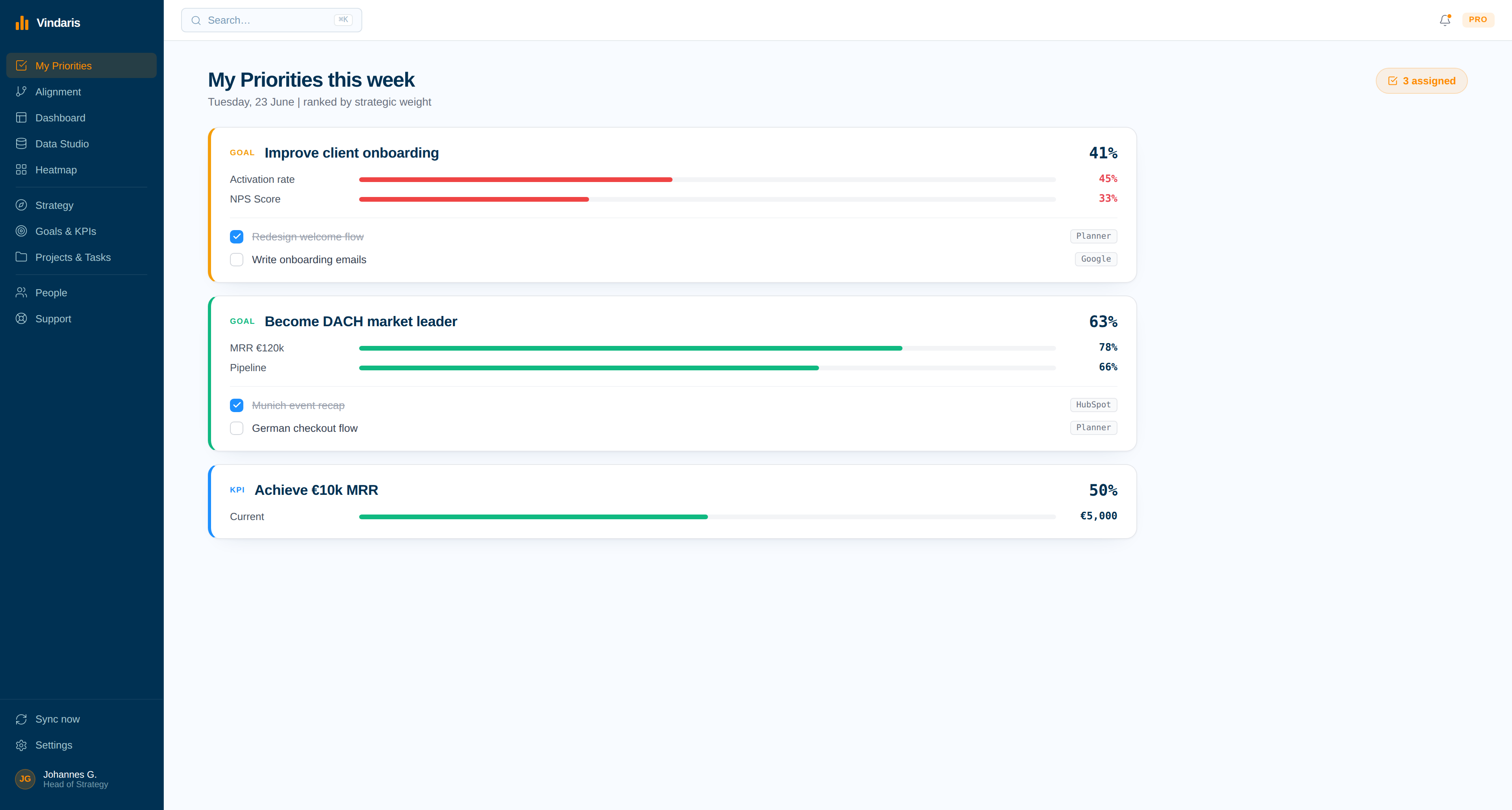
Everyone knows exactly what matters most.
A clear view of each person's goals, KPIs, projects, and tasks. Start every week focused on what's important and due.
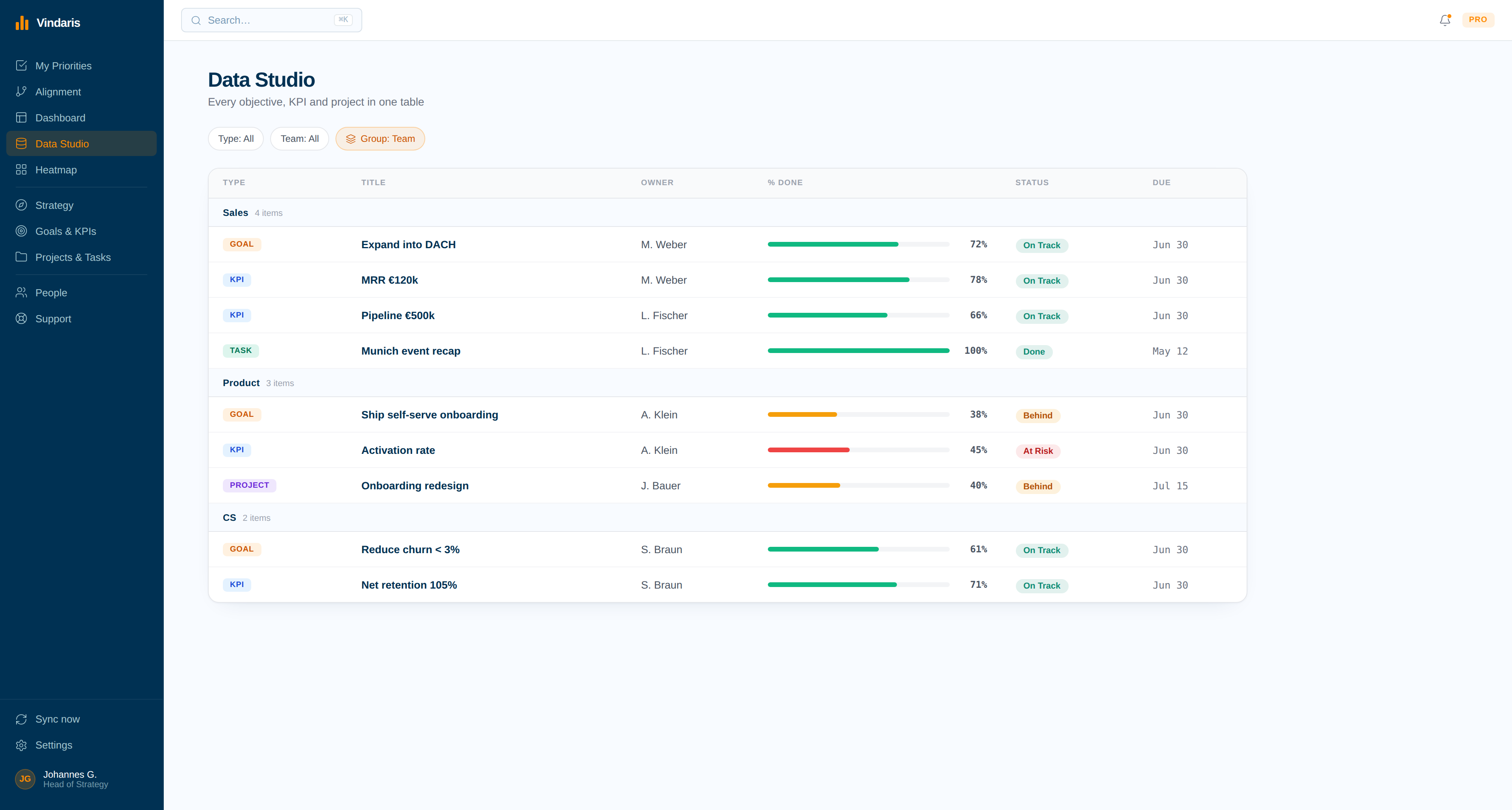
Run reports the way your management needs them.
Build custom views to rank teams, spot risks, compare KPIs to work. AI summaries push updates to Slack, Teams, and email.
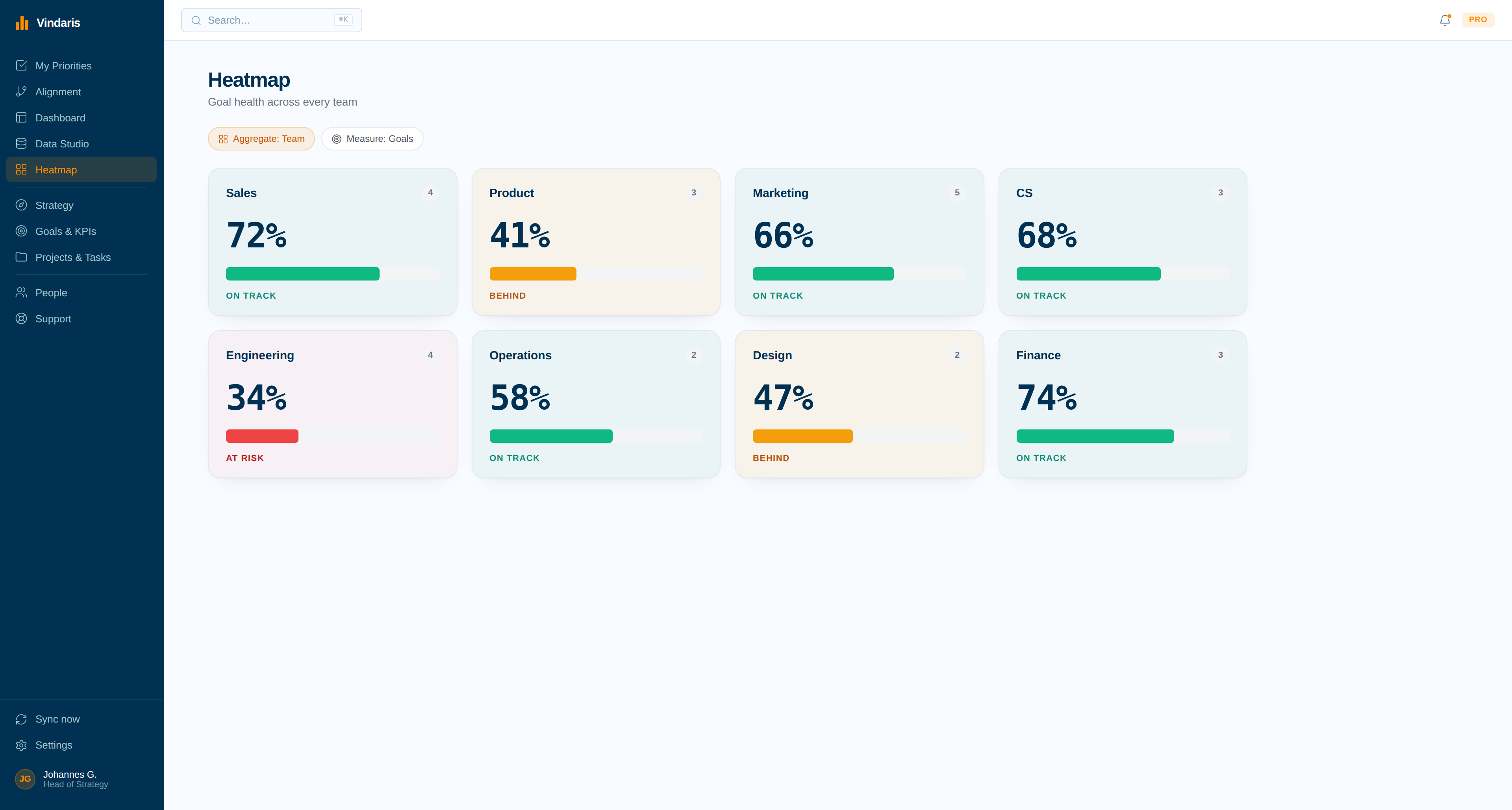
Spot risks while there's still time to fix them.
Run heatmaps across teams, goals, KPIs, and projects. Save views and get notified when risk levels change.
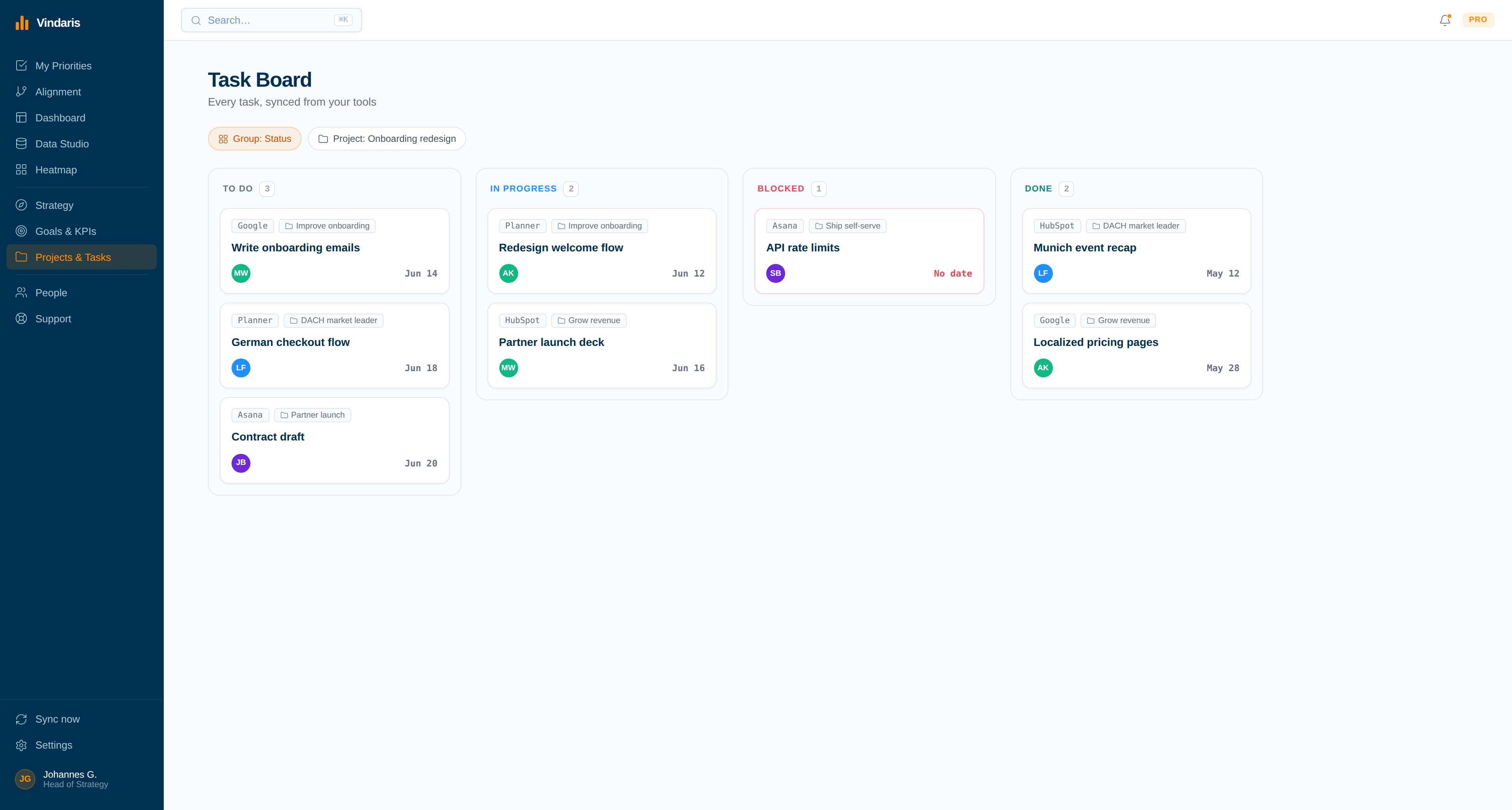
Combine tasks and projects across your systems.
Sync HubSpot, MS Planner, Google Tasks, Asana and more into one view. Bi-directional sync keeps everything current while teams stay in their own tools.
Common questions, answered
What is the difference between OGSM and OKR?
Is OGSM better than OKR?
Which industries use OGSM?
Can you combine OGSM and OKR?
Why do both OGSM and OKR fail in practice?
Free forever, including two integrations
Start free with full strategy, goal, KPI, task, and project management. Pay only when you add more than 4 people, need more integrations, or more AI summaries.
Best for individual contributors, small teams or startups. No credit card required.
- All features (incl. Alignment Canvas, My Priorities, Heatmap, Data Studio & Task Board)
- Set up 2 integrations of your choice
- Invite up to 4 additional members
- 5 ad-hoc AI risk summaries per month
Best for teams, small agencies, or departmental and team management.
- All in Free
- All integrations, unlimited sync
- Unlimited AI risk summaries & alignment suggestions - ad-hoc and scheduled
- Up to 10 users within one organization
Best for multiple teams, exec teams, Chiefs of Staff, departmental leadership or full-org deployments.
- All in Connect
- Unlimited users within one organization
- Direct human support email, 24h response time
- Human-led onboarding support
Other framework comparisons
OGSM, OKRs, or both.
Vindaris connects them to the work.
The framework describes the goal. Vindaris connects it to execution.
Try Vindaris freeNo credit card | Free forever for goal management