SMART goals vs OKR: individual clarity meets team outcomes.
SMART goals are clear and individually actionable. OKRs drive team-level outcomes. Most organizations need both at different altitudes. What matters is connecting them to execution.
Free forever for goal management | Supports SMART goals, OKRs, and hybrids
SMART goals vs OKRs compares a checklist with a framework. SMART tests whether a single goal is Specific, Measurable, Achievable, Relevant and Time-bound. OKRs pair one qualitative objective with a few measurable key results for the quarter, owned by a team. A key result can be written to pass the SMART test, which is why most teams use both.
SMART goals: precise commitments with built-in guardrails
SMART stands for Specific, Measurable, Achievable, Relevant, and Time-bound. The framework was designed to turn vague intentions into concrete commitments. Each criterion acts as a filter: if a goal passes all five, it is clear enough to act on.
SMART goals work well at the individual level. Performance reviews. Personal development plans. Project milestones with clear deliverables. The format forces specificity, which eliminates the ambiguity that kills follow-through. "Improve customer satisfaction" becomes "Increase NPS from 32 to 40 by September 30." The person responsible knows exactly what to deliver and by when.
Where SMART goals fall short: they describe what to do, not what to achieve at a broader level. A team of ten people each holding five SMART goals does not automatically have alignment. The goals may be individually clear yet collectively incoherent. And because SMART goals tend to live in HR systems or spreadsheets, they often get written during a review cycle and reopened six months later for grading.
OKRs: team-level ambition with measurable outcomes
Objectives and Key Results pair a qualitative direction (the Objective) with two to five measurable outcomes (the Key Results). The framework is designed for teams, not individuals. It creates shared focus on what to achieve rather than what to do.
OKRs work well when a team needs to rally around a shared outcome. The quarterly cadence creates natural checkpoints. The stretch-target convention (70% completion = success) encourages ambition over sandbagging. And because OKRs are outcome-focused, they leave room for teams to figure out the best path to the result rather than being told exactly what steps to take.
Where OKRs struggle: they don't tell anyone what to do on Monday morning. "Reduce churn to 3%" is a clear outcome but not an action plan. The gap between the key result and the daily work is where most OKR programs quietly fail. Teams set strong objectives, then the work drifts because nothing connects the tasks back to the result.
They operate at different levels, not in competition
The "SMART vs OKR" debate frames these as competing frameworks. They are not. They operate at different altitudes. OKRs sit at the outcome level: what does the team want to achieve? SMART goals sit at the action level: what will each person do to contribute?
OKRs define direction and measurable outcomes for a team or organization. They answer the question of where to go and how you will know you arrived. They are deliberately ambiguous about how to get there.
SMART goals define concrete, bounded commitments for an individual. They answer the question of what gets done, by whom, and by when. They are deliberately specific about scope and success criteria.
Many organizations use OKRs to set team-level outcomes each quarter, then ask individuals to define SMART goals that contribute to those outcomes. This gives you ambitious direction where it matters and clear accountability where the work happens.
Both frameworks share the same execution gap
Whether you pick SMART goals, OKRs, or run them together, the failure mode is the same. Goals get defined in one place. Work happens in another. The connection between them relies on manual updates, status meetings, and good intentions.
SMART goals typically live in HR tools or documents. They get written at the start of a review period and revisited months later for scoring. In between, the person works on tasks in Jira, Asana, or Linear, and nobody connects those tasks back to the goal. The goal is technically clear but practically invisible during the work that should move it.
OKRs suffer from the same disconnect. They get set at the start of a quarter, tracked in a spreadsheet or a dedicated OKR tool, and reviewed in weekly check-ins that become a reporting burden. Progress is estimated, not measured. By mid-quarter, the OKR tool is stale and the real work is happening somewhere else entirely.
The framework is never the bottleneck. SMART goals and OKRs both provide sound structure for defining what matters. They fail when the goal layer is disconnected from the work underneath. The fix is not a better framework. The fix is a traceable link between the goal and the tasks, projects, and tools where execution actually happens.
Vindaris supports both and connects them to traceable work
Vindaris does not force you into one framework. Define OKRs at the team level. Define SMART goals at the individual level. Link them together. The structure is yours to decide. What Vindaris adds is the execution layer underneath.
Goals connect to the work that moves them. Tasks, projects, and integrations with tools like Jira, Asana, or Linear feed progress back to the goal automatically. A SMART goal does not sit idle in a document. An OKR does not rely on someone remembering to update a percentage. The work itself becomes the progress signal.
One place for both frameworks. No separate OKR tool and HR system. No spreadsheet for SMART goals that nobody opens between reviews. Both live in the same environment, linked to the same execution layer, visible to the same people. That is how you run two frameworks without doubling the overhead.
SMART goals vs OKR at a glance
| Dimension | SMART | OKR |
|---|---|---|
| Purpose | Define clear, bounded individual commitments | Drive ambitious team-level outcomes |
| Altitude | Action level (what to do) | Outcome level (what to achieve) |
| Typical scope | Individual or small project | Team, department, or organization |
| Cadence | Review cycle (monthly, quarterly, annual) | Quarterly (set, track, grade, reset) |
| Success criteria | 100% = goal met (binary pass/fail) | 70% = healthy stretch target |
| Ambition model | Achievable by design (the A in SMART) | Stretch by convention (aim high, accept 70%) |
| Common failure | Written once, filed away, revisited at review | Set and forgotten, no link to daily work |
Goals, KPIs, tasks, and strategy in one place
See every goal connected to the work moving it.
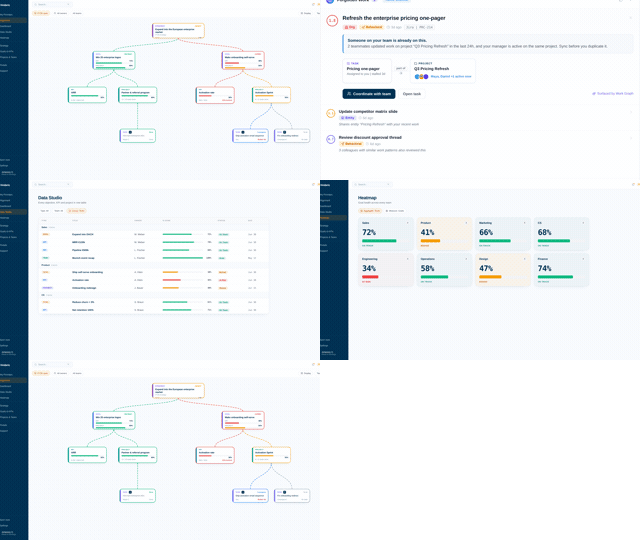
Drag-and-drop your alignment structure. Roll up work progress, KPIs, and goals without enforcing any framework syntax.
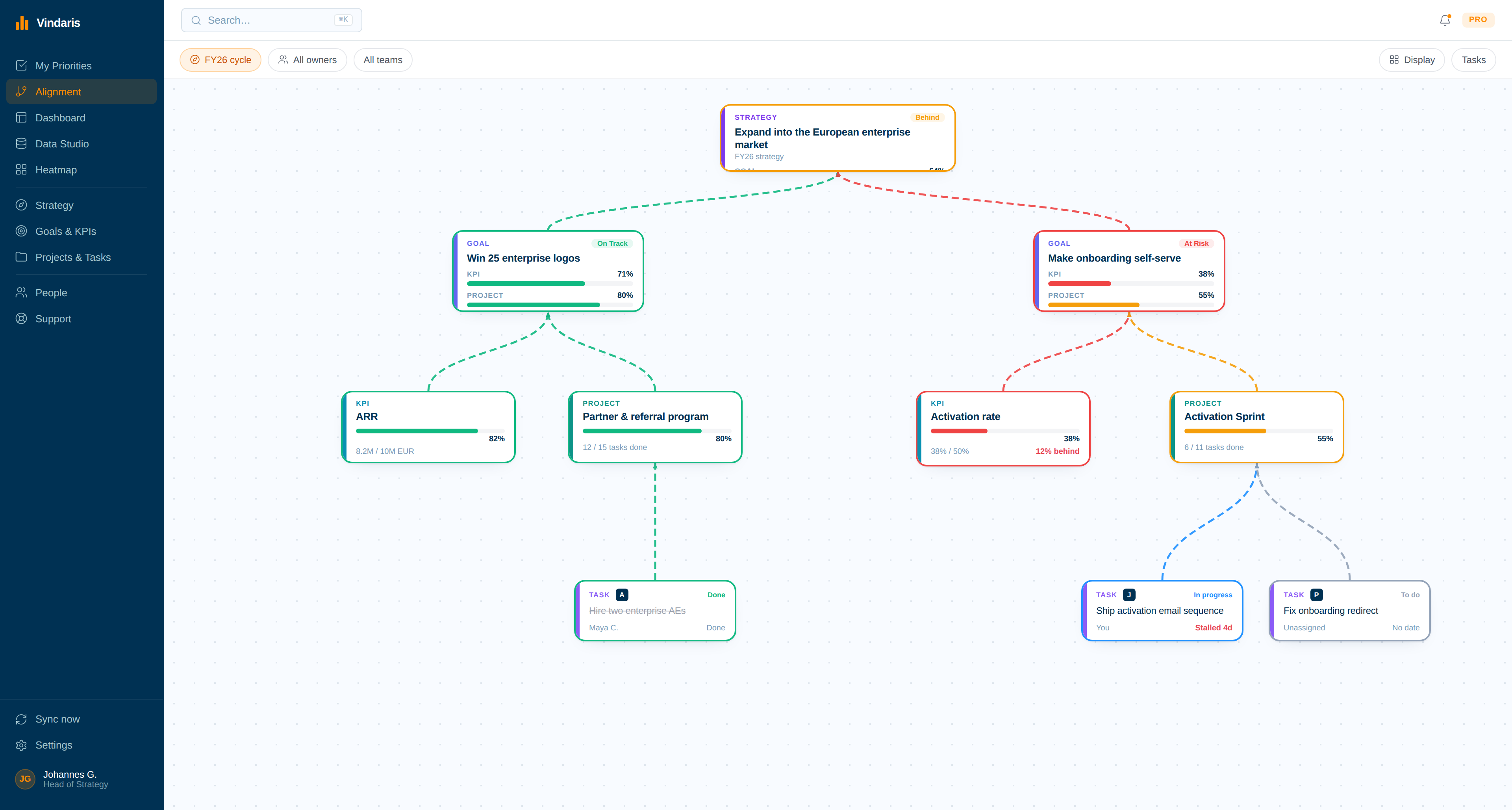
Everyone knows exactly what matters most.
A clear view of each person's goals, KPIs, projects, and tasks. Start every week focused on what's important and due.
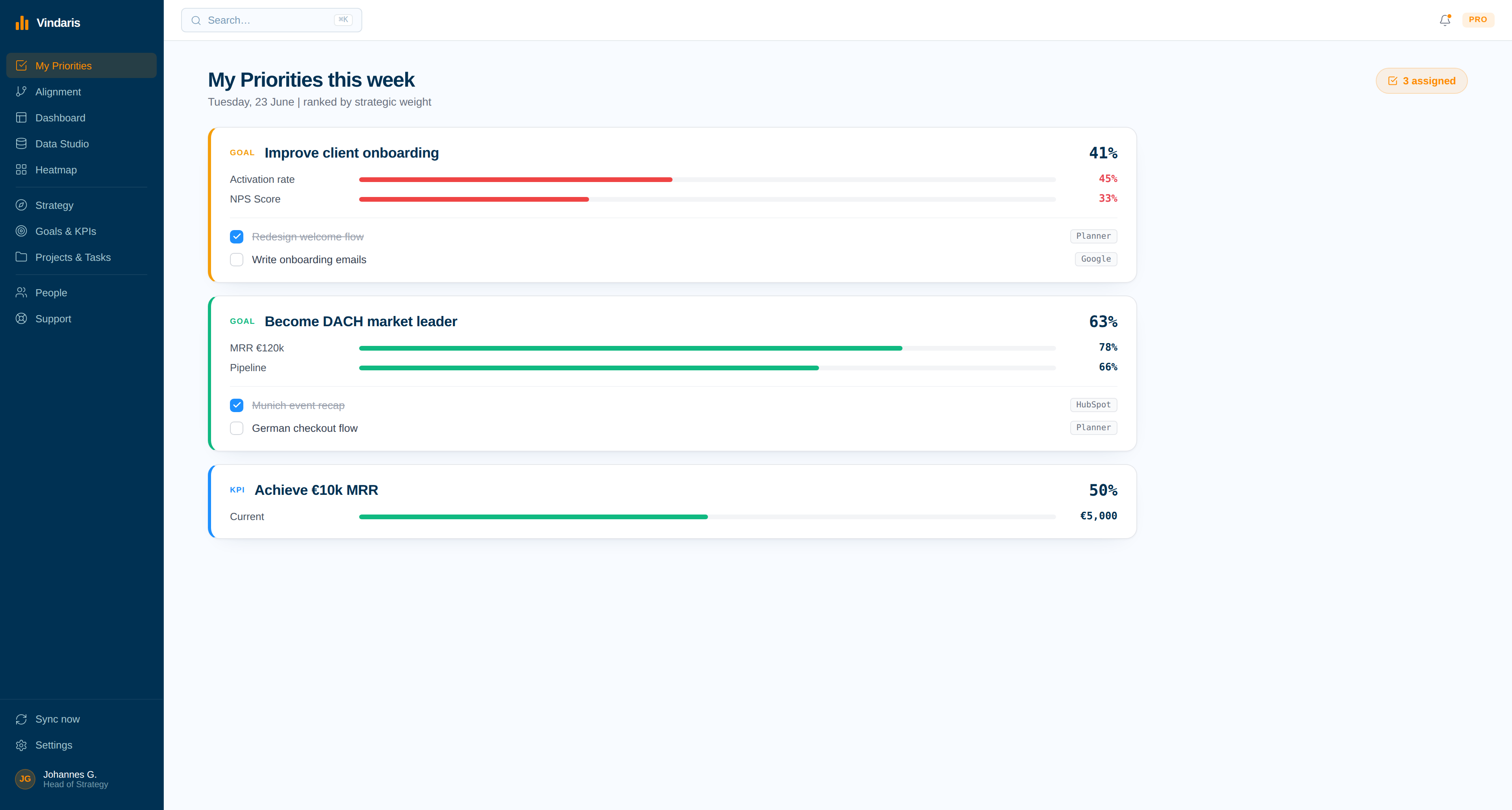
Run reports the way your management needs them.
Build custom views to rank teams, spot risks, compare KPIs to work. AI summaries push updates to Slack, Teams, and email.
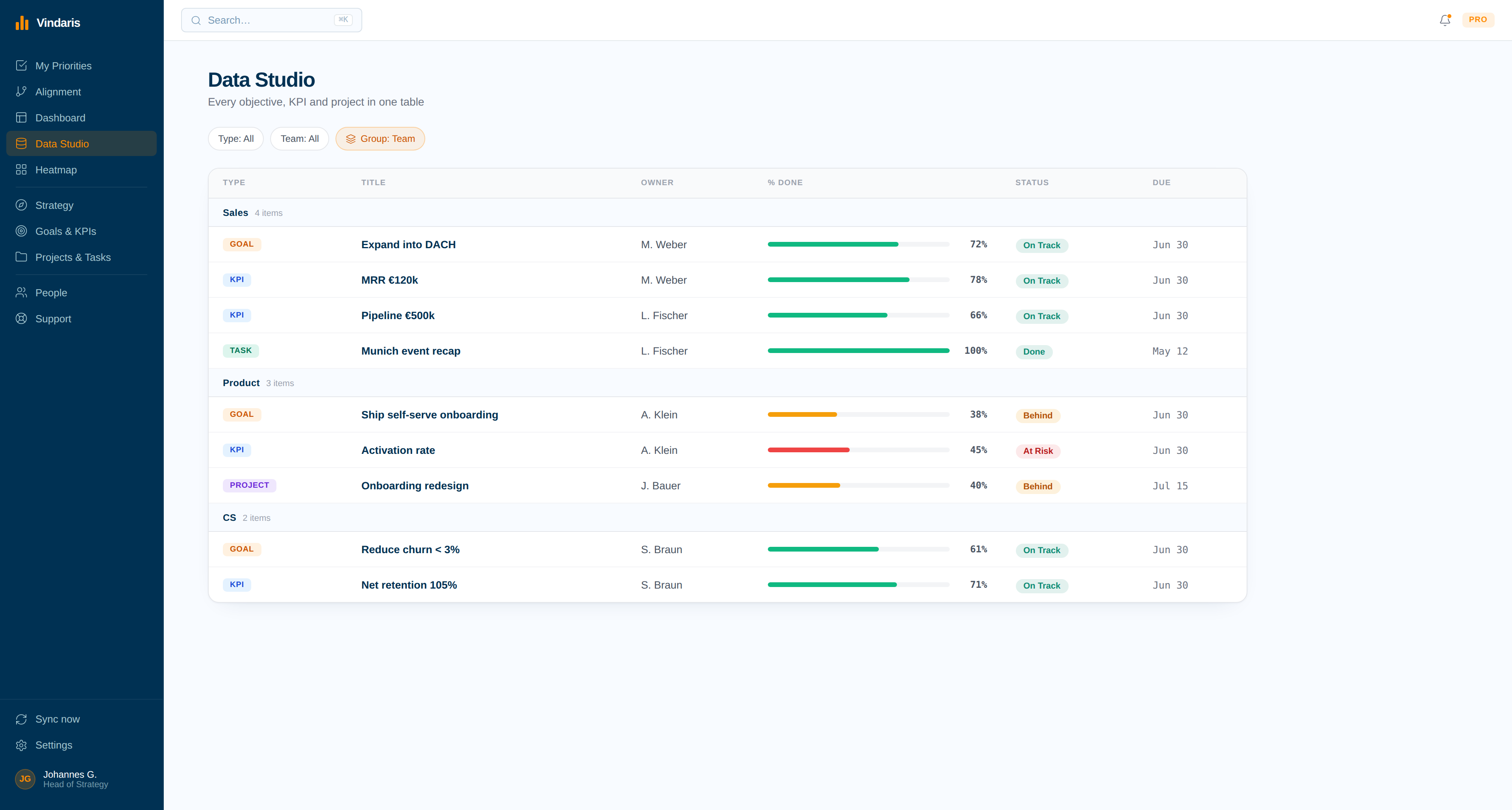
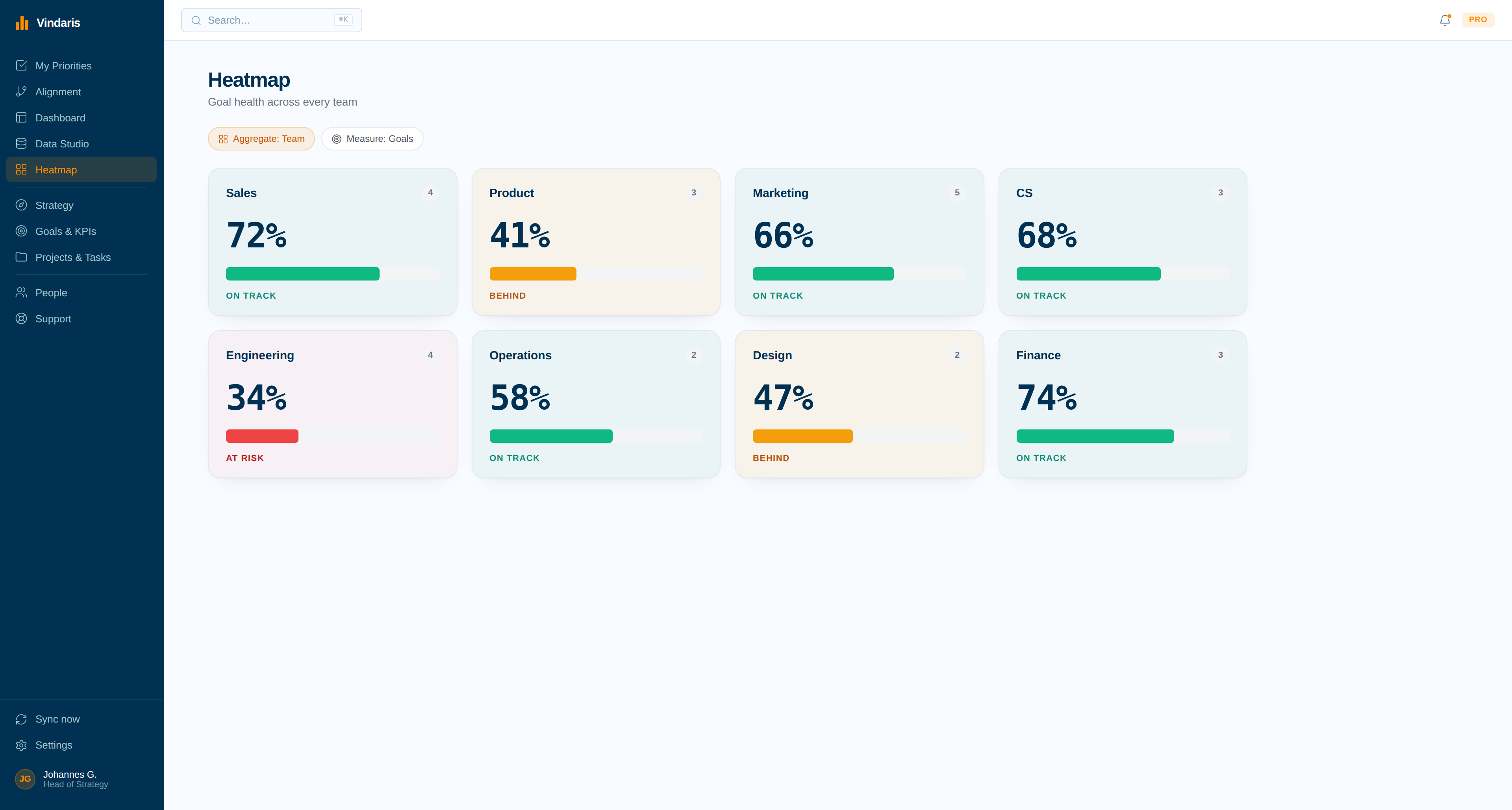
Spot risks while there's still time to fix them.
Run heatmaps across teams, goals, KPIs, and projects. Save views and get notified when risk levels change.
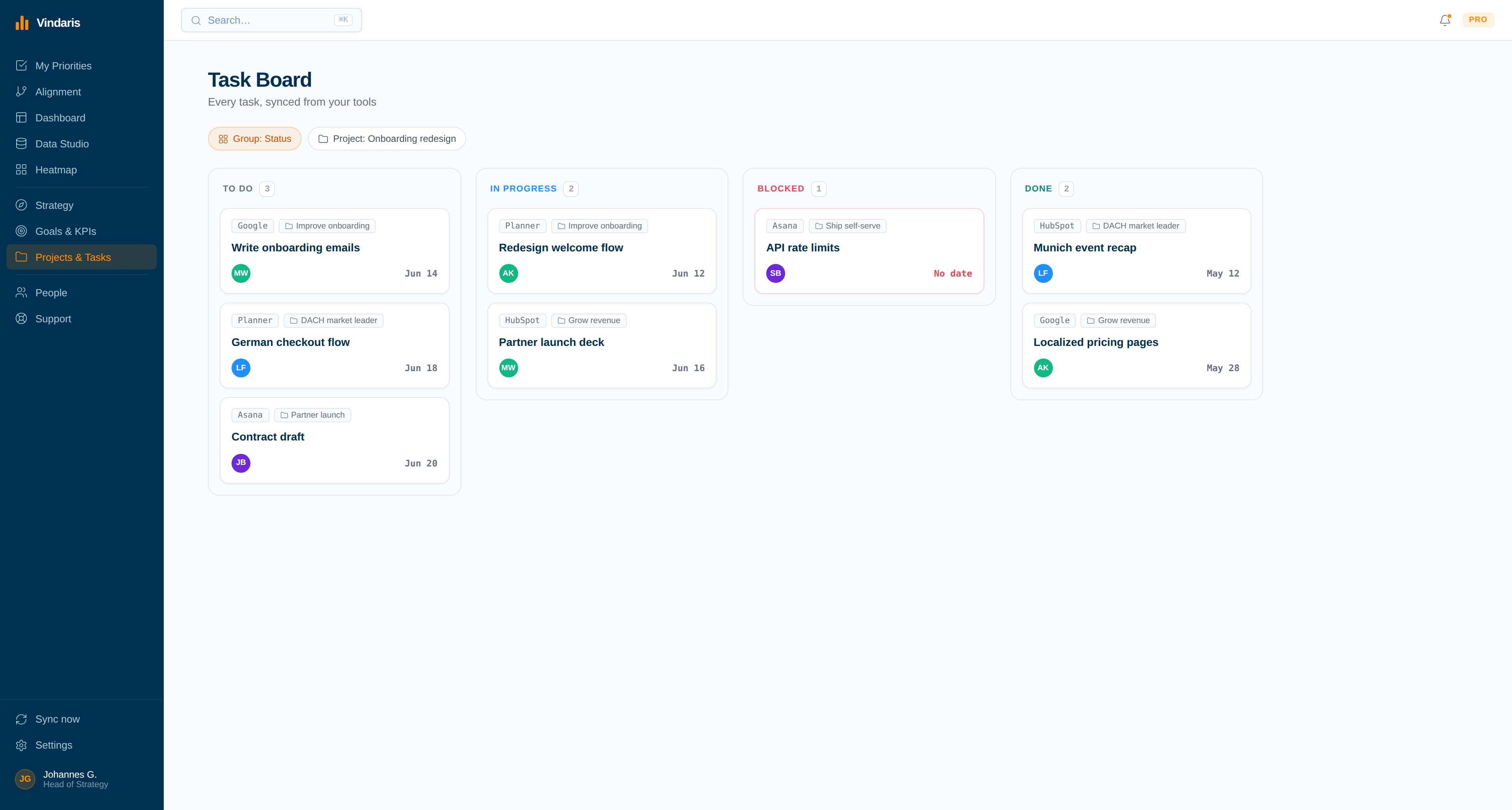
Combine tasks and projects across your systems.
Sync HubSpot, MS Planner, Google Tasks, Asana and more into one view. Bi-directional sync keeps everything current while teams stay in their own tools.
Common questions, answered
Can SMART goals and OKRs be used together?
What is the main difference between SMART goals and OKRs?
Are SMART goals better than OKRs?
Why do SMART goals and OKRs both fail in practice?
How does Vindaris handle SMART goals and OKRs?
Free forever, including two integrations
Start free with full strategy, goal, KPI, task, and project management. Pay only when you add more than 4 people, need more integrations, or more AI summaries.
Best for individual contributors, small teams or startups. No credit card required.
- All features (incl. Alignment Canvas, My Priorities, Heatmap, Data Studio & Task Board)
- Set up 2 integrations of your choice
- Invite up to 4 additional members
- 5 ad-hoc AI risk summaries per month
Best for teams, small agencies, or departmental and team management.
- All in Free
- All integrations, unlimited sync
- Unlimited AI risk summaries & alignment suggestions - ad-hoc and scheduled
- Up to 10 users within one organization
Best for multiple teams, exec teams, Chiefs of Staff, departmental leadership or full-org deployments.
- All in Connect
- Unlimited users within one organization
- Direct human support email, 24h response time
- Human-led onboarding support
Other framework comparisons
SMART goals, OKRs, or both.
Vindaris connects them to the work.
Stop debating the framework. Start connecting goals to execution.
Try Vindaris freeNo credit card | Free forever for goal management