How to Cascade Goals Across the Organization
A goal cascade is supposed to connect a person's daily work to the company's direction. Done badly it becomes a brittle tree built once at planning time and frozen, admired on a slide and ignored in practice. The difference is method. This playbook covers how to cascade by aligned linkage rather than rigid copying, and how to design the cascade so it survives the inevitable mid-quarter change of plans.
The steps
A cascade can only be as clear as its root. If the company has eight competing objectives, every team below picks a different two and alignment is an illusion. Two or three sharp company objectives give teams an unambiguous thing to support.
Do not paste the parent goal down each level. Let each team write its own goal in its own language that explicitly links to a parent. Strict copying guarantees alignment but is rigid; aligned linkage keeps each level's goals meaningful to the people who own them while preserving the trace upward.
When a team's draft goals roll up, leadership and the team negotiate: is this enough, is it realistic, what would it take. This back-and-forth, from Hoshin Kanri, is slow on purpose. The time spent agreeing is recovered many times in execution, because teams defend goals they helped shape.
Not every individual needs personal OKRs. Cascade to the level where goals still mean something and stop before it becomes box-ticking. For many companies that is team level; pushing to individual goals everywhere often produces paperwork, not alignment.
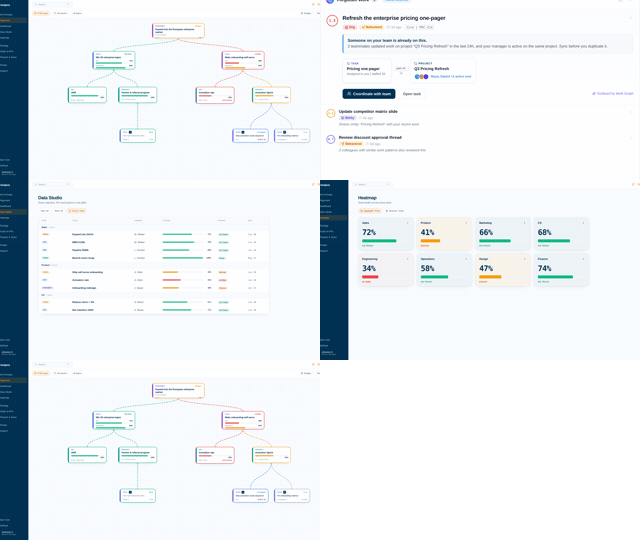
The cascade is only real if its leaves connect to the tasks and projects delivering them. A goal with nothing beneath it is the gap that matters most, and a tidy hierarchy diagram hides it well. Linking the bottom of the tree to traceable work turns the cascade from a picture into an execution system.
Plans change mid-quarter. When they do, update the links instead of leaving the tree to rot. A cascade that no longer reflects reality is worse than none, because it gives false confidence. Treat the structure as living, and review the links whenever a major priority shifts.
Frequently asked questions
What is the difference between cascading and aligning goals?
Cascading often implies copying a parent goal down level by level; aligning means each level writes its own goals that link to a parent. Alignment is more flexible and is how modern OKR practice usually works, because it keeps goals meaningful at every level.
Should every employee have their own OKRs?
Not necessarily. Cascade to the depth where goals still drive real decisions, often team level. Forcing individual OKRs everywhere tends to create paperwork rather than alignment.
Run this playbook on goals connected to real work
Vindaris connects every goal to the traceable work moving it, so the cadence in this playbook runs on real progress instead of hand-typed status. Start free, no credit card.
Sign Up for Free