Ninety runs EOS by the book. The book is typed in weekly.
The most complete home for the EOS ritual, with Scorecard numbers entered by owners. Vindaris runs Rocks and the L10 on the work itself.





Last reviewed August 2026
Ninety is software for running EOS: V/TO, Rocks, Scorecards, Issues and L10 meetings, with numbers entered by their owners each week. Vindaris runs the same EOS cadence connected to your team's real work in Jira, Asana, HubSpot or Planner, so Rock and Scorecard status is derived from tasks rather than typed in, and a slipping Rock surfaces before the meeting.
Complete for the method. Blind between the meetings.
Ninety covers EOS end to end: V/TO, Accountability Chart, Rocks, Scorecards, Issues with IDS, the Level 10 agenda, plus coaching content around the method. For a team running EOS with an implementer, the fit is close.
Ninety is purpose-built software for the Entrepreneurial Operating System, and it covers the method end to end: the V/TO, the Accountability Chart, Rocks, Scorecards, Issues with IDS, and the Level 10 meeting. Teams working with an EOS implementer adopt it quickly, and the coaching material around the product is genuinely good.
The gap opens between the meetings. Scorecard measurables are entered by their owners, usually in the hour before the L10, and a Rock's status is what its owner says in the meeting. The tasks and projects that actually deliver the Rock live in Jira, Asana, Planner or a spreadsheet, and Ninety's integrations do not reach them; its task-tool connections are listed as coming soon. So the weekly meeting is the detection mechanism. A Rock that quietly stopped moving on the Tuesday after the L10 stays on track for up to a week before anyone is asked, and for longer if the owner reports optimistically.
The Scorecard shows what owners entered, which is not the same as what happened. Ninety can hold a red number once someone types it. It cannot notice that the work behind a measurable went quiet two weeks ago, or that the Rock's owner has been pulled onto something else. The method assumes honest weekly self-reporting; the data model cannot check it.
What teams consistently praised
- Faithful, complete EOS implementation that implementers recommend.
- V/TO, Rocks, Scorecard, Issues and L10s in one system.
- Coaching content, assessments and a knowledge portal around the method.
- Free observers, so the whole company can see the plan.
Where teams hit the limit
- Scorecard numbers are typed in weekly, not derived from work.
- Rocks are items; the tasks delivering them live in other tools.
- Task-tool integrations are listed as coming soon.
- Locked to EOS, so adding OKRs means adding a product.
The ritual is complete. The data is still manual.
- Rocks live in one system. The work delivering them lives in another.
- Owners enter Scorecard numbers before each meeting.
- Integrations cover sign-on and calendars rather than the task layer.
- The Scorecard shows what owners entered, which is not what happened.
- Locked to EOS, so a framework change means a tool change.
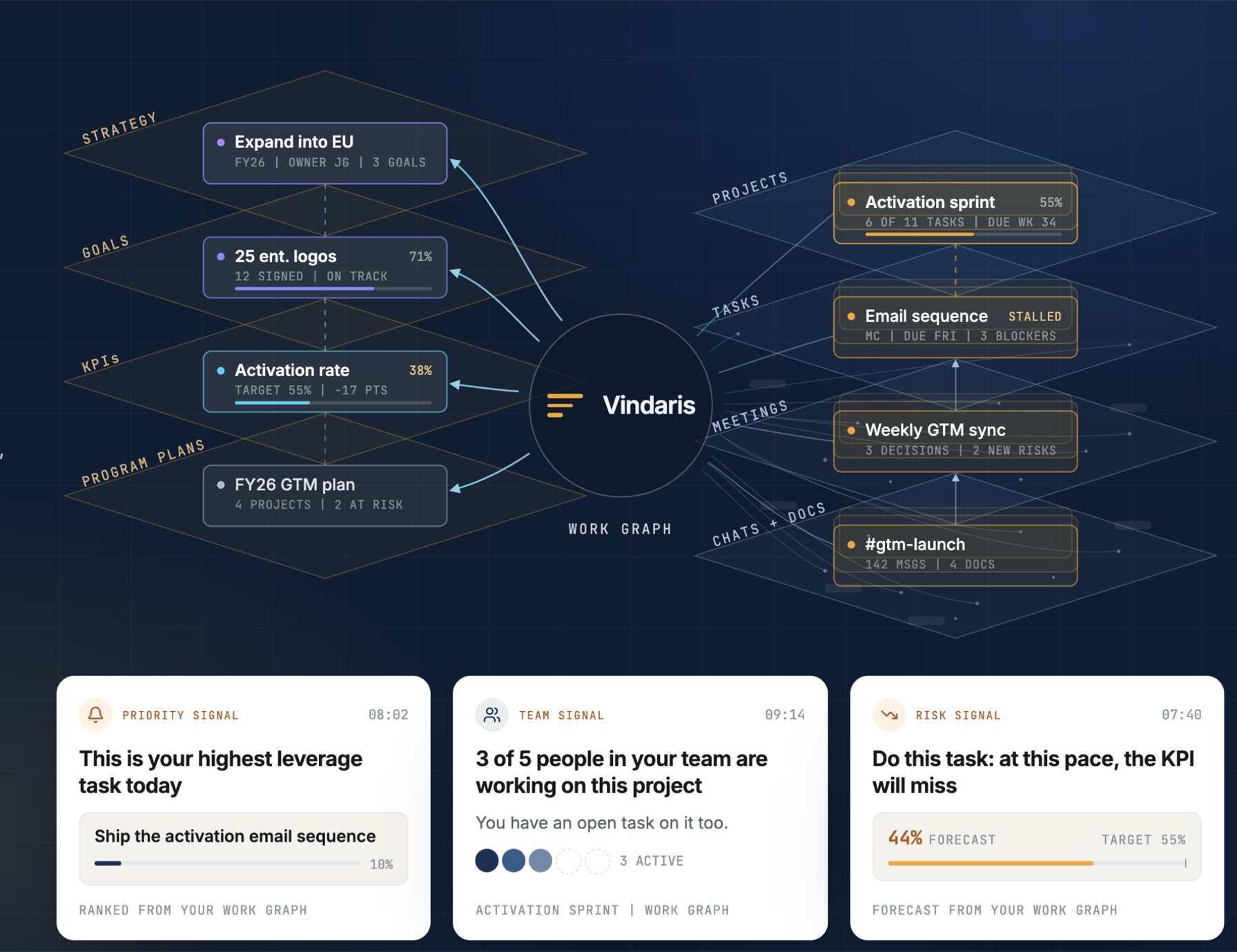
- Rocks connect to the tasks delivering them, so status is observed rather than reported.
- Scorecard measurables read from the systems the number lives in, not from a weekly entry.
- The Work Graph flags a Rock that cannot land at the current pace before the L10, not during it.
- EOS runs natively beside OKRs, KPIs and OGSM when other teams need other frameworks.
- Slack and Teams context sits next to each Rock, so the why travels with the what.
Ninety models the meeting. It does not read the work.
Ninety's central objects are the EOS artifacts themselves: the V/TO, the Rock, the measurable, the Issue, the meeting. That is exactly right for running the ritual, and it is why the product feels complete in the meeting. Outside the meeting, none of those objects is connected to the work that moves it.
| Object | Ninety | Vindaris |
|---|---|---|
| Central object | The EOS artifact: Rock, measurable, Issue, meeting | The task, and every edge running up from it to the Rock |
| Progress source | Owner enters Scorecard numbers and Rock status weekly | Derived from task state in Jira, Asana, Planner or HubSpot |
| Time resolution | One week, on the L10 rhythm | Continuous, updated as the work moves |
| Risk detection | An Issue someone raises, usually in the meeting | Flagged from pace, focus and task movement between meetings |
| What a Rock knows about | Its owner, milestones and reported status | The projects and tasks feeding it, and who is actually on them |
The practical difference is the week between L10s. A Rock whose work stalled on Tuesday is still on track in Ninety until its owner says otherwise in the next meeting. In Vindaris the Rock inherits the state of the work under it, so the stall is visible the day it happens, and the L10 spends its time deciding rather than discovering.
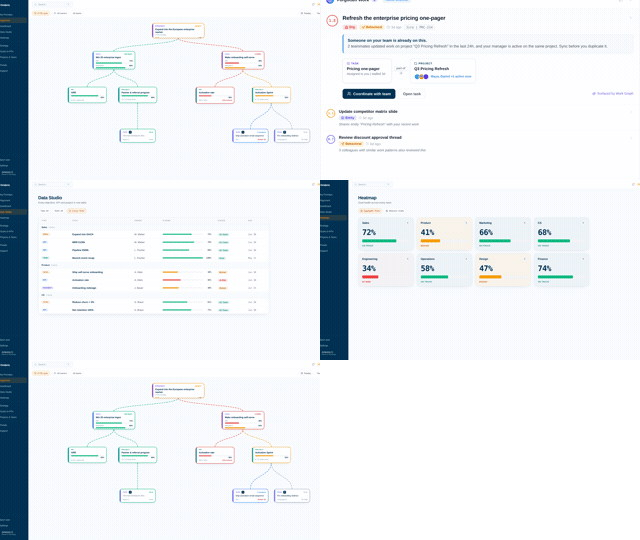
Five views that keep strategy and execution in sync.
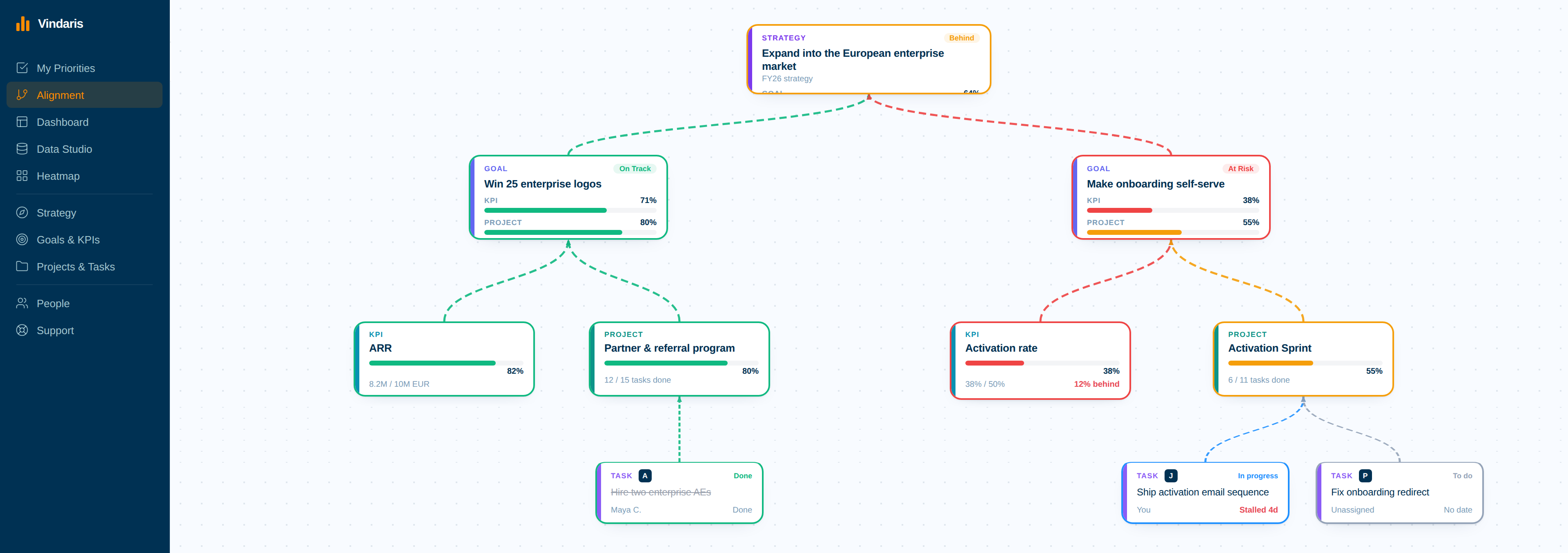
See every goal connected to the work moving it.
Drag and drop your alignment structure. Roll up work progress, KPIs and goals without enforcing any framework syntax.
Alignment Canvas →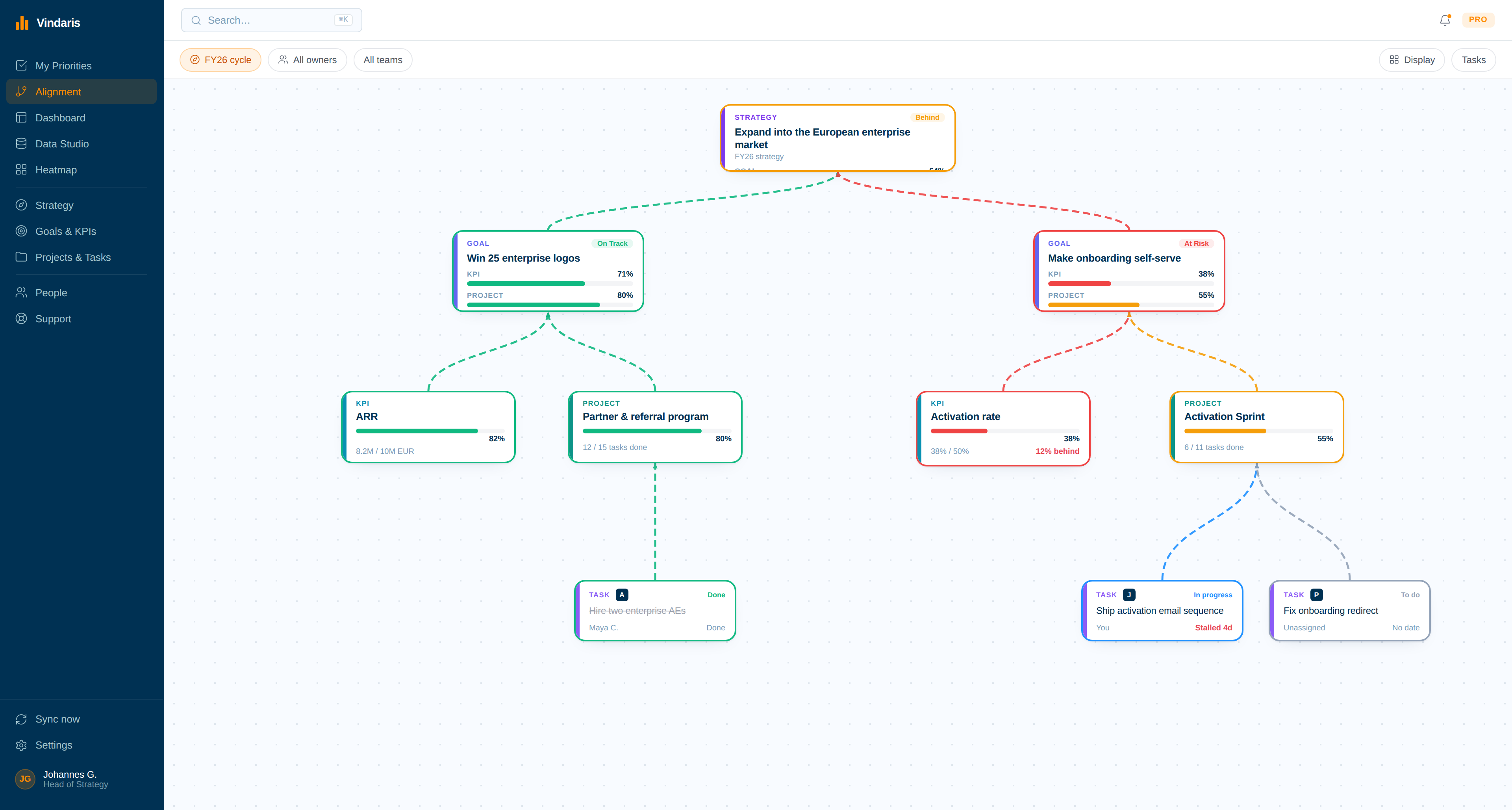
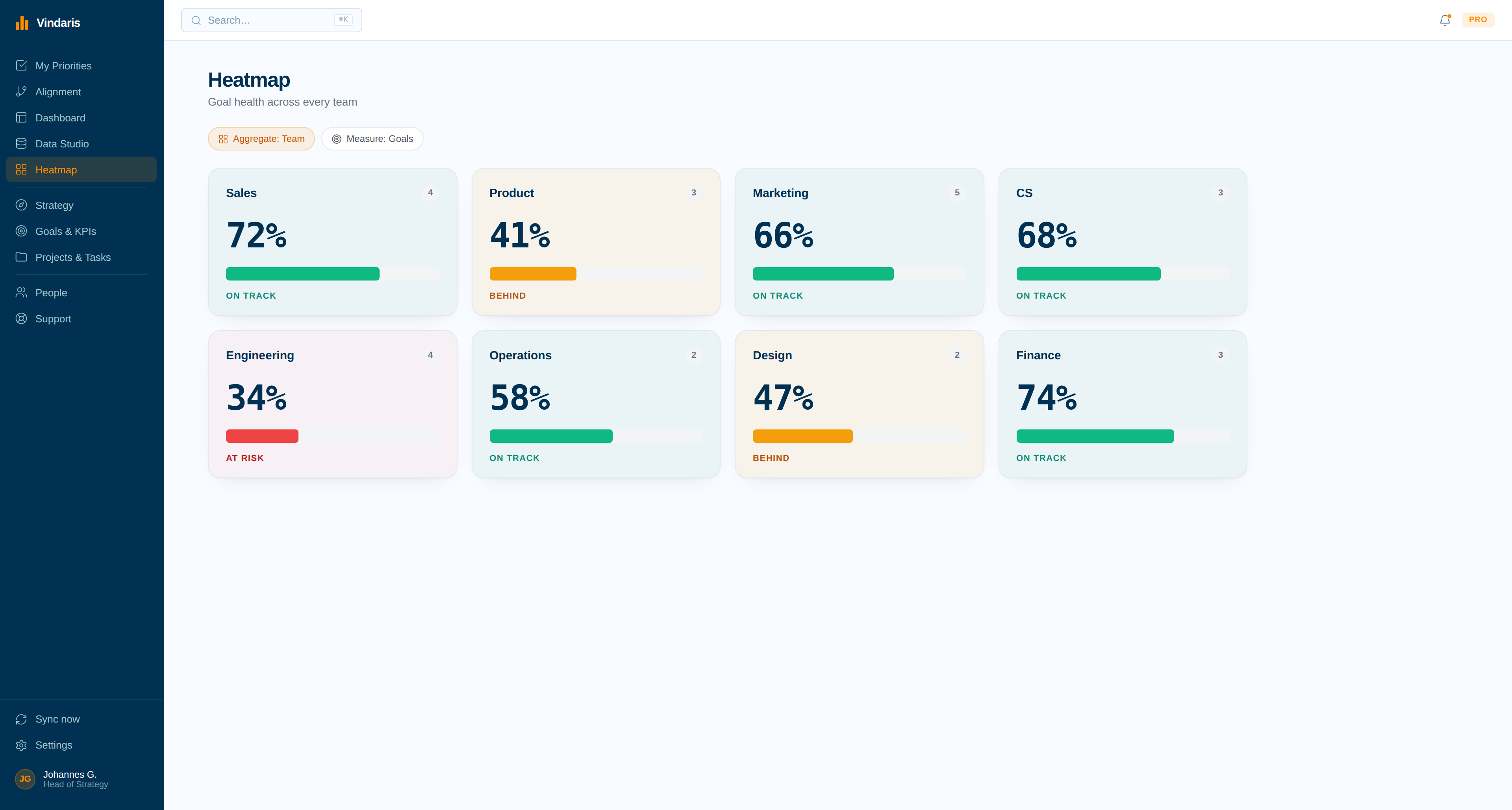
Spot risk while there is still time to fix it.
Run heatmaps across teams, goals, KPIs and projects. Save views and get notified when risk levels change, from task movement rather than a reported number.
Combine tasks and projects across your systems.
Sync HubSpot, MS Planner, Google Tasks, Asana and more into one view. Bidirectional sync keeps everything current while teams stay in their own tools.
All integrations →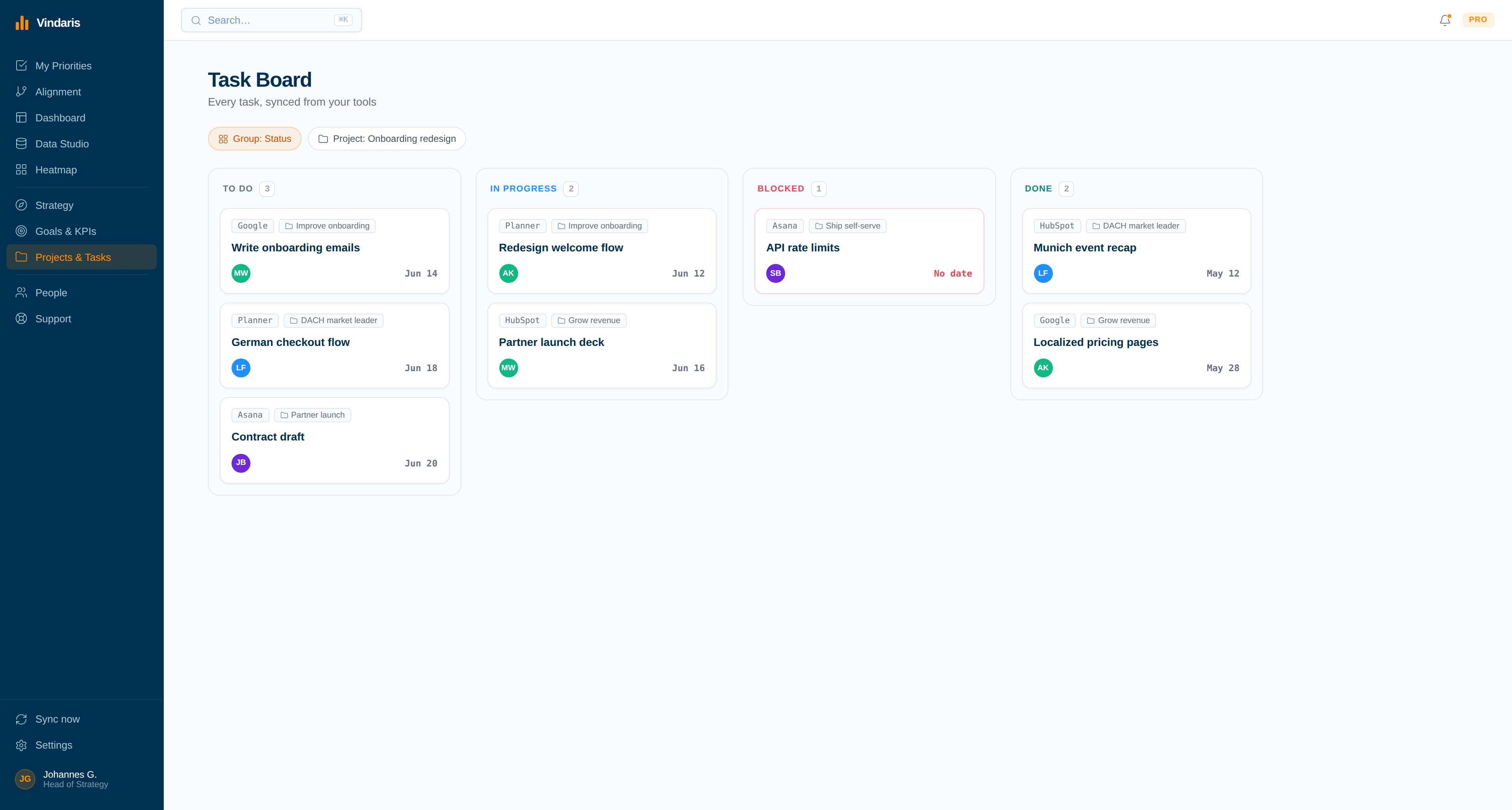
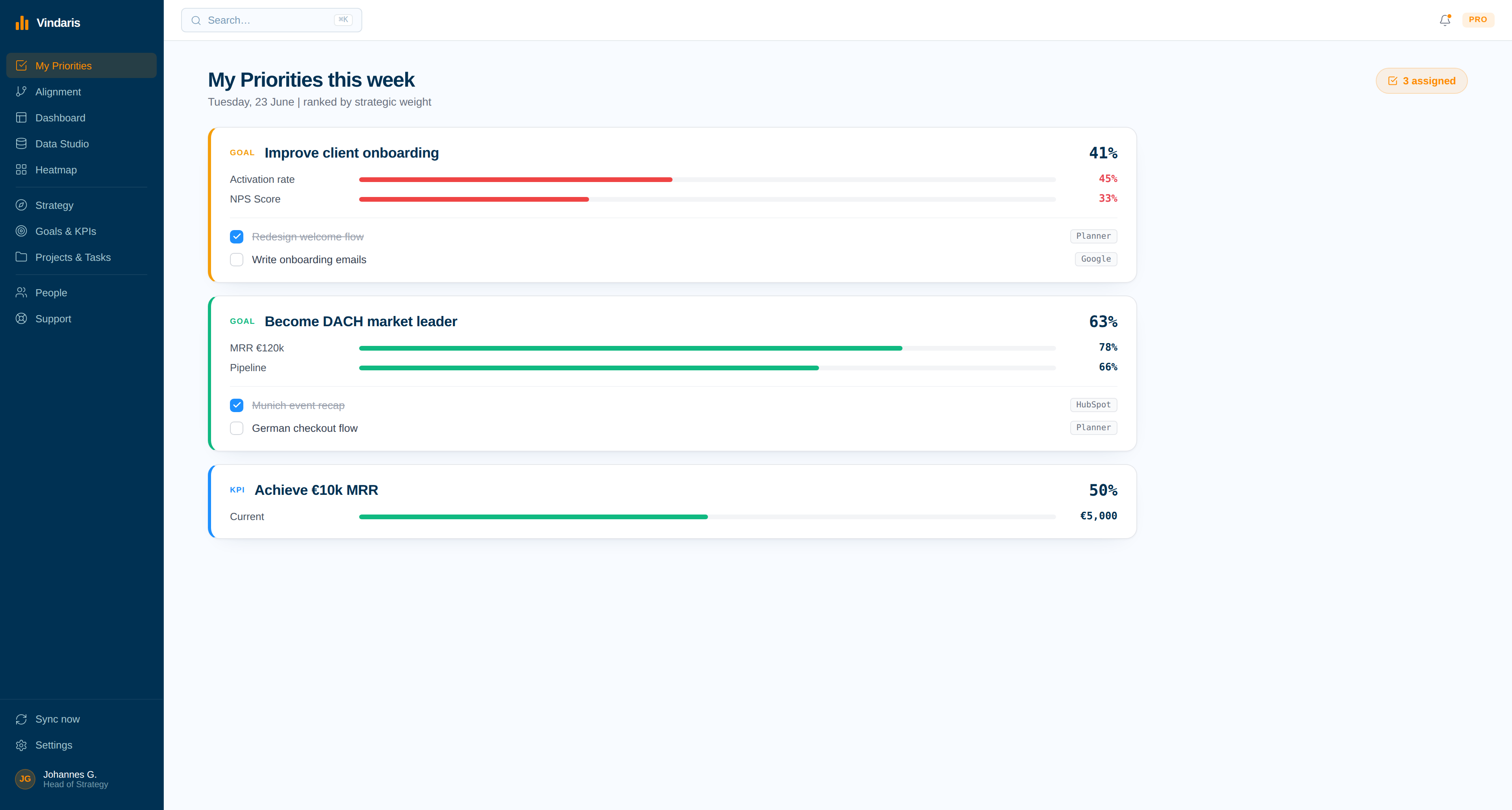
Everyone knows exactly what matters most.
A clear view of each person's goals, KPIs, projects and tasks. Start the week focused on what is due.
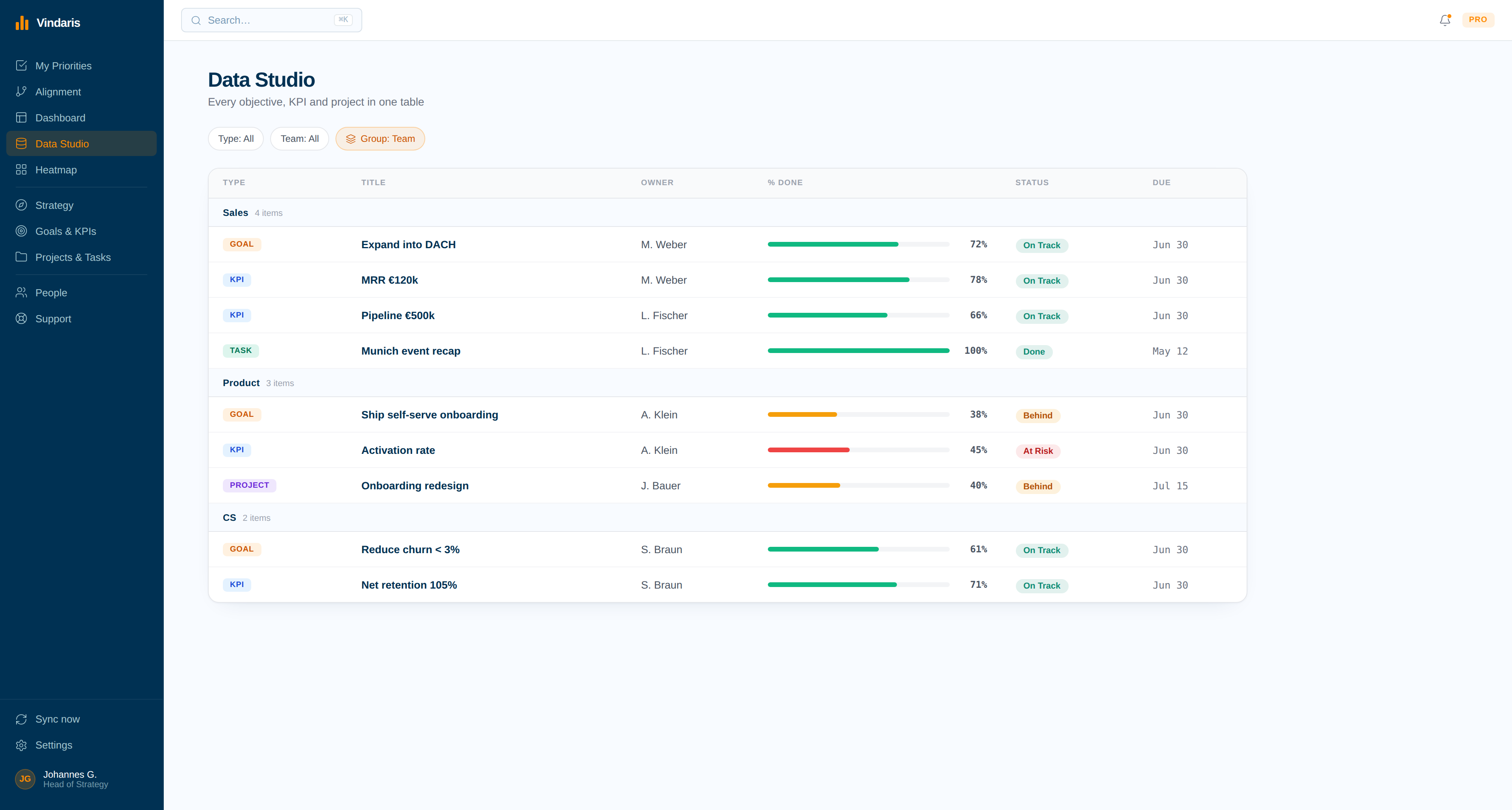
Run reports the way management needs them.
Rank teams, spot risks, compare KPIs to work. AI summaries push updates to Slack, Teams and email.
Keep the Rocks and the L10. Connect them to the work.
The EOS structure maps one to one, so the move is mostly attaching work underneath the Rocks you already run.
Recreate or import your current quarter's Rocks, measurables and Issues as they are. Every level renames to EOS language, single accountable owner included, so the structure your implementer set up carries over without translation.
Jira, Asana, HubSpot, Planner, ClickUp and Google Tasks sync bidirectionally. Teams keep working where they work today; the difference is that the Rocks can now see it.
Vindaris proposes connections from owners, labels and project structure. Confirm them once, and a closed task starts moving the Rock above it, which is what the weekly self-report was approximating.
The on-track round becomes a review of what the Work Graph already flagged during the week. Issues arrive in the meeting pre-discovered, with the stalled tasks and the Slack thread attached, and IDS spends its time on the solve.
Free forever for up to 5 people. No credit card required.
Start free Book a demo No credit card requiredVindaris vs Ninety, feature by feature.
Ninety wins on EOS fidelity. This table compares what each product knows about the work beneath the Rock.
| Feature | Vindaris | Ninety |
|---|---|---|
| How progress is measured | Read from task-level work and Slack context in the tools your team already uses. | Scorecard numbers and Rock status entered by owners, typically before the L10. |
| Goal frameworks supported | Framework-agnostic: OKR, KPI, EOS Rocks, OGSM, SMART, Balanced Scorecard, or hybrid. | EOS only, by design. No OKR, KPI-framework, OGSM or hybrid support. |
| Connection to real work | Native work layer with bidirectional sync to HubSpot, Planner, Google, Jira, Asana. | No native work layer. To-Dos live in Ninety; project work stays in external tools, with task-tool integrations listed as coming soon. |
| Risk detection | Automatic execution-risk flags from task movement, focus and pace against plan. | Raised as an Issue when a person notices it, usually in the meeting. |
| Status reporting | Live views and AI risk summaries pushed to Slack, Teams, and email. | Scorecard views, meeting agendas and analytics built around the weekly cadence. |
| Capacity and bandwidth | Built-in bandwidth and capacity planning. | Not covered. |
| Ownership model | Single-owner accountability enforced structurally. | Single accountable owner per Rock and seat, which EOS enforces well. |
| Free plan | Free forever, including 2 integrations and up to 5 people. | Free plan covers vision tools (V/TO, Accountability Chart); running the cadence needs a paid tier. |
| Best fit | EOS companies that want Rock and Scorecard status derived from the actual work, or that expect to run other frameworks beside EOS. | Teams fully committed to pure EOS with an implementer, who value the coaching content and assessments around the method. |
The category as a whole is compared in the best strategy execution software guide, and the argument underneath it is set out in the strategy execution gap whitepaper.
Per-seat EOS tooling, or a free tier that reads the work.
Ninety publishes per-user monthly pricing across tiered plans, with a free plan limited to the vision tools. The comparison that matters is what a paid seat buys: a faithful home for the ritual, or a system that also reads the work between the meetings.
| Plan | Ninety | Vindaris |
|---|---|---|
| Free tier | Free plan covers vision tools (V/TO, Accountability Chart); the working cadence sits in paid tiers. | Free forever. Up to 5 people, 2 integrations, all core features. |
| Entry paid plan | Published per-user monthly pricing, with the entry tier carrying meetings, Rocks and Scorecards. | Connect, EUR 10 per user per month. All integrations, unlimited sync. |
| Upper plan | Higher tiers add analytics, custom meetings, AI assistance and API access. | Pro, EUR 20 per user per month. Unlimited users in one organization. |
| Published pricing | Yes, published on the website, with view-only observers free. | Yes, on the website. No quote required to evaluate. |
| Minimum commitment | Monthly or annual per-seat billing; no setup fees. | None. No seat minimum, no annual term, no setup fee. |
Vindaris is free forever for up to 5 people with 2 integrations and all core features, Work Graph included, so a leadership team can run a full EOS quarter on real data before paying. Paid plans are EUR 10 and EUR 20 per user per month, published, with no minimums.
Best for individual contributors, small teams or startups. No credit card required.
- All features (incl. Alignment Canvas, My Priorities, Heatmap, Data Studio & Task Board)
- Set up 2 integrations of your choice
- Invite up to 4 additional members
- 5 ad-hoc AI risk summaries per month
Best for teams, small agencies, or departmental and team management.
- All in Free
- All integrations, unlimited sync
- Unlimited AI risk summaries & alignment suggestions - ad-hoc and scheduled
- Up to 10 users within one organization
Best for multiple teams, exec teams, Chiefs of Staff, departmental leadership or full-org deployments.
- All in Connect
- Unlimited users within one organization
- Direct human support email, 24h response time
- Human-led onboarding support
Common questions, answered
What is the difference between Ninety and Vindaris?
Does Vindaris support EOS Rocks, Scorecards and Level 10 meetings?
How do Scorecard numbers get updated in Ninety vs Vindaris?
Can I migrate from Ninety to Vindaris?
Free resources for this topic
A template you can download, a playbook to run, and the thinking behind both. No email required.
Or start with the full picture: strategy execution software that connects your plan to the work delivering it.
Keep running EOS. Run it on the work itself.
Free forever for up to 5 people. No credit card required.